Moisture In Primers? Failure to Ignite

Longer dimension to shoulder = case cant be pushed as far forward off the bolt face by the firing Pin. I think that is what you're saying? Tighter fitting case = more reliable ignition.

By size better, you mean less right? Because sizing too much is what leads to the case stretch.

Those are pretty hard measurements to get accurately just based on the radiused nature of them. If you dont have a comparator to put on the shoulder, an empty 9mm case might work to use as reference to know how much you are bumping your shoulders when sizing.


My guess, is that the aftermarket brass, sized or not, is shorter to the shoulder datum than the factory ammo. Might be compounded by low FP energy or protrusion and harder to light primers vs what is in the factory ammo but I'd bet case size is a primary cause unless you can provide measurements compared to fired that paints a different picture.

I have heard of more stories of CCI primer duds than other brands but nowhere near the prevalence you're talking. Maybe a handful out of a thousand.

Great info. I will get on top of getting some of this.
 
The .400" datum line at the very middle of the shoulder is what you are "moving" when you size the brass. All that sizing really does is re establish the correct angle and the correct distance from the base of the brass to that .400" datum line and squeeze the rest of the case back to pre fired dimensions. Going off a reamer print or case print is only going to get you the dimensions as shown. Realize that that may represent the standard, but your chamber is almost always going to be slightly different because of many factors- tool wear, how accurate the chambering machinist was, barrel material spring back etc. There is a tolerance, very small, but allowable. That's why I say size your brass so the bolt just closes on a sized case, in your chamber, not to a set number. (yet) If you look at a standard .308 chamber and a .308 Palma chamber, there is a wide range of dimensions that have been changed over the years for many different reasons, so a reamer print is only good if it was the print of the reamer used in your barrel. When you get to the point where the bolt falls closed (no firing pin spring or ejector in the bolt) that is now your baseline for that brass, in that rifle chamber. Record all the same dimensions- base to datum, overall case length, diameter at the pressure ring just above the case head, neck wall thickness.... The base to datum does not have to be exactly the same as shown in the drawing, as long as you use the same method and tools to measure every time. A 9mm case, will have roughly a .375" diameter (It needs to be round) and the point it sits on the shoulder should be close enough if you use that one 9mm case as your gauge every time and never touch it for anything else. It will show you when you shorten that base to datum measurement each time you size your brass.
 
....so I pulled the primer... and hit it with a hammer. Primer went off. If I do this again I will remember to wear ear pro....😅
or if primers fire in 2 other rifles take it that it’s likely the gun or brass as discussed? I guess now you know for certain.
 
I was at the range yesterday and happened to find a 9mm round which didn't fire. looked like the firing pin strike was really weak. Case brand was I think R-P. Don't know if it was a handload. Are all Remington primers golden in color? There were other spent cases, some of which I picked up and threw in my scrap brass barrel.
 
Longer dimension to shoulder = case cant be pushed as far forward off the bolt face by the firing Pin. I think that is what you're saying? Tighter fitting case = more reliable ignition.

By size better, you mean less right? Because sizing too much is what leads to the case stretch.

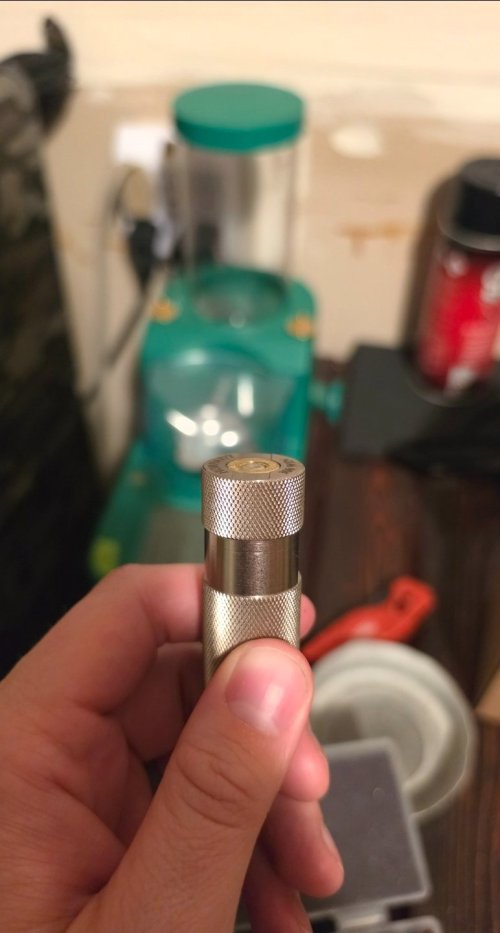
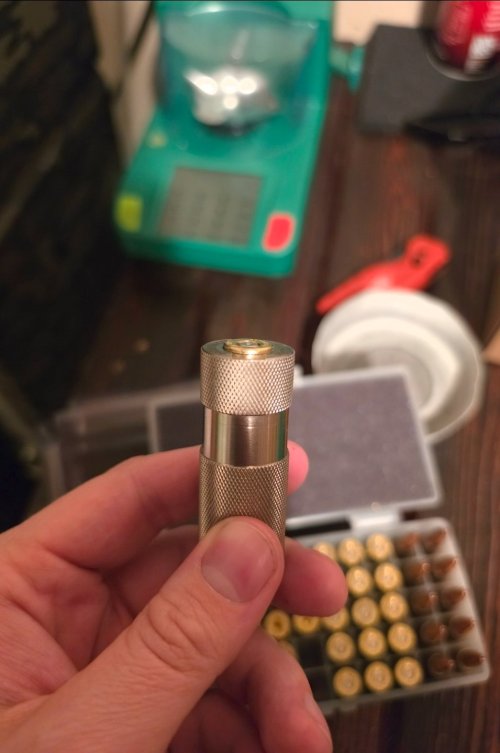
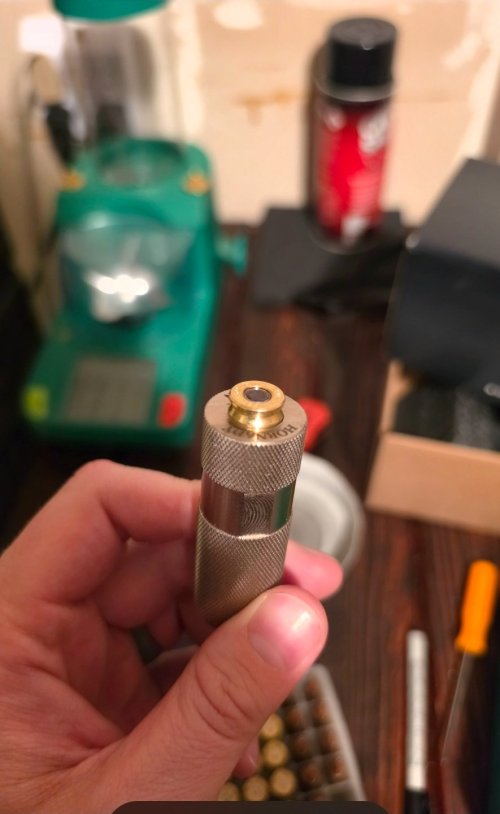
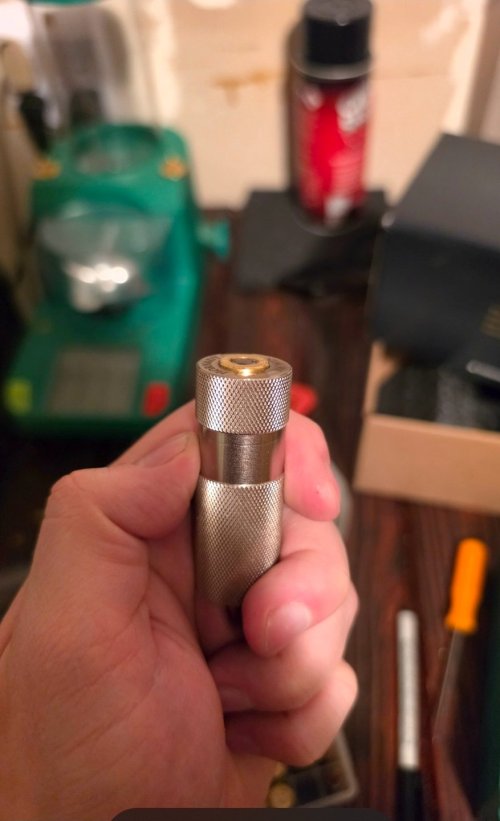
Those are pretty hard measurements to get accurately just based on the radiused nature of them. If you dont have a comparator to put on the shoulder, an empty 9mm case might work to use as reference to know how much you are bumping your shoulders when sizing. View attachment 379935


My guess, is that the aftermarket brass, sized or not, is shorter to the shoulder datum than the factory ammo. Might be compounded by low FP energy or protrusion and harder to light primers vs what is in the factory ammo but I'd bet case size is a primary cause unless you can provide measurements compared to fired that paints a different picture.

I have heard of more stories of CCI primer duds than other brands but nowhere near the prevalence you're talking. Maybe a handful out of a thousand.

So I used a 10 mm case because that should line up with the .400 line in the neck. I only had the ogive comparator tool.
Here is the findings.
Bad Primer Case 1.615"
Other Hand Loads that did fire 1)1.634" 2)1.636" 3)1.635"
Brand New Starline Brass 1)1.627" 2)1.627" 3)1.628"

So I think that this is my problem. I appreciate the tip and the advice.
 
So I used a 10 mm case because that should line up with the .400 line in the neck. I only had the ogive comparator tool.
Here is the findings.
Bad Primer Case 1.615"
Other Hand Loads that did fire 1)1.634" 2)1.636" 3)1.635"
Brand New Starline Brass 1)1.627" 2)1.627" 3)1.628"

So I think that this is my problem. I appreciate the tip and the advice.

I think that’s your gremlin, glad to hear it sounds like you’ve got it figured out.

I’d use those 40 cal casings or get dedicated comparator inserts to avoid bumping the shoulders back anymore than you need to for 100% reliable feeding and you’ll get much better brass life and less trimming too.
 
Last edited:
I know from experience oil, or too much oil really, will slow down a firing pin and cause light strikes. It seems crazy, but it does result in light strikes. Storing oiled guns muzzle up for long periods can allow the oil to seep into the firing pin hole.

I just recently started getting serious about humidity control in the gunshop. I got it to 40-45% now. Still, I put all my primers in GI ammo cans with desiccant from Amazon. It turns from orange to black when the beads are saturated.

I saw the cans that had ammo in cardboard boxes saturated the desiccant after a week of storage. Ammo stored outside carboard, the desiccant was still fairly fresh orange. The primer cardboard boxes are much thinner and I see there wasn't a saturated desiccant bag, but it does make me wonder if I should store them loose in plastic containers, like Berger plastic bullet boxes and the like.

Not that I'm worried they won't ignite, but I want them to ignite consistently for ES/SD.
 

Latest posts

Forum statistics

Threads
117,710
Messages
2,165,760
Members
38,325
Latest member
Armtdawg
Back
Top