Do not throw away "wet" primers. Dry them out. All primers are kept wet during manufacturing. The last step is drying and packaging.
Unless the water has been mixed with motor oil. Motor oil soaking is the prescribed method of killing primers before disposal. This is right in the Speer manual.
I have used primers which have been wet and then dried. I repackage them in old primer slip boxes and mark them with blue painter's tape. Each one I put in a cartridge gets a circle with a blue sharpie pen so they don't get back in my other ammo or primer stock. I will use them for workups and range fodder loads, but not "make-or-break" loads for self defense or hunting.
Every spring I find tons of .22 LR ammo at the range that has been in the snow and rain all winter. More than half of those will fire after I dry them out. I usually put a bunch of them upright in a jar lid and put them under a lamp overnight. I like them for defense pistol practice because I don't know when I will get a misfire. It gives me real time TRB (Tap,Rack,Bang) training.
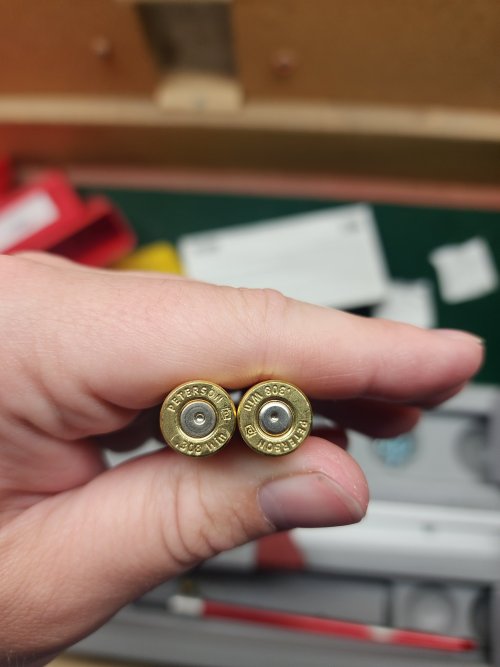
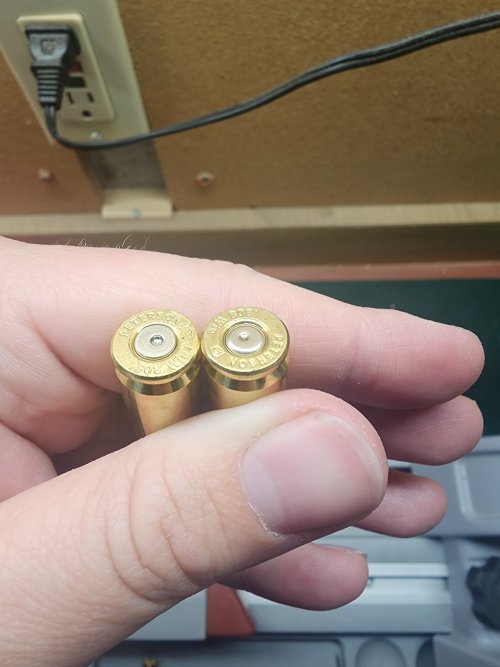
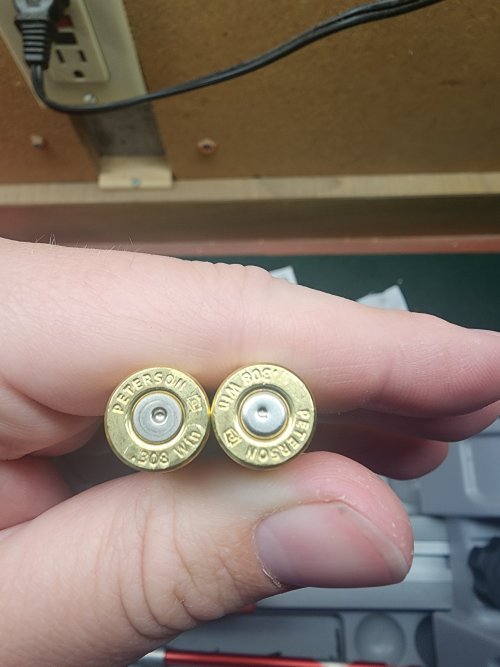
So when I originally looked at the range I thought it looked like a good strick but I just compared it to one that went off and it looks a little light. Left one went off right one didn't.
These really look like light strikes. My first guess is seating inconsistencies. I had plenty of these when I first started hand loading. Forget "precision" primer seaters. All cases can have different primer pockets. Especially if you get too aggressive cleaning primer pockets. Old carbon in a primer pocket means nothing as long as the vent hole is clear and the primer seats. We should all learn to seat primers by feel. Speer #10 says a primer should be about .006" below the base of the case. With experience you can feel when it bottoms out.
Speer #10 also describes that you can actually get light strikes from high primers also. If you look at a primer new out of the case, the anvil is not flush with the cup. We drive it flush when we seat it. If we underseat the primer, the anvil is still a little up from the rim of the cup. The first pin strike drives the primer down onto the anvil, but does not fire it. If you strike it a second time and it fires this is often the cause.
This is why I don't use case blocks when I load. I stand my cases up on my epoxied bench top. Any cases with underseated primers are immediately evident. They will tip or wobble.