Unlimited #300
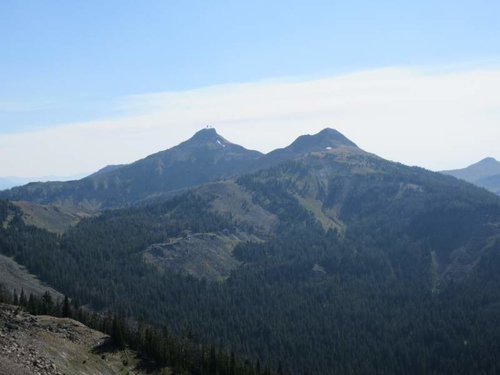
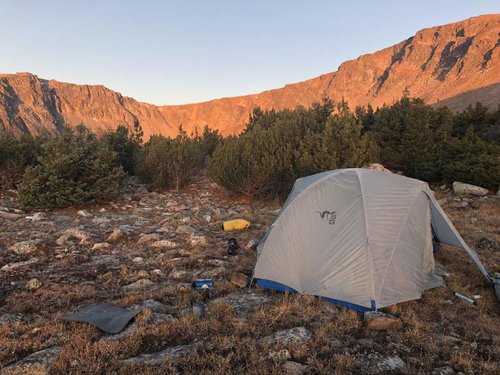
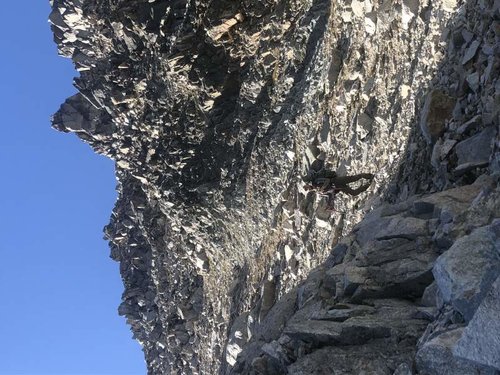
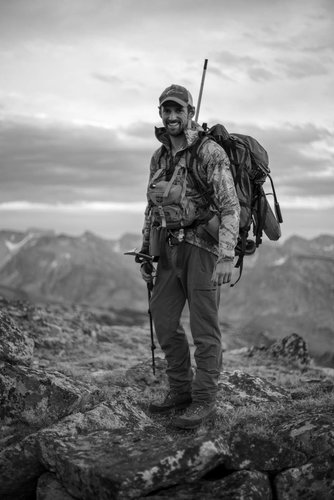
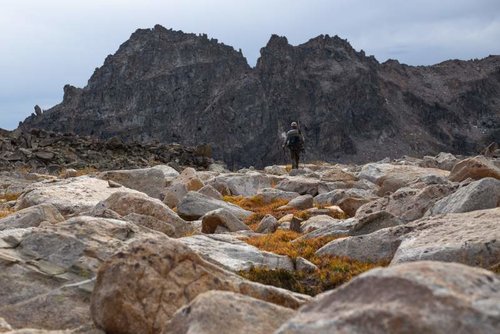
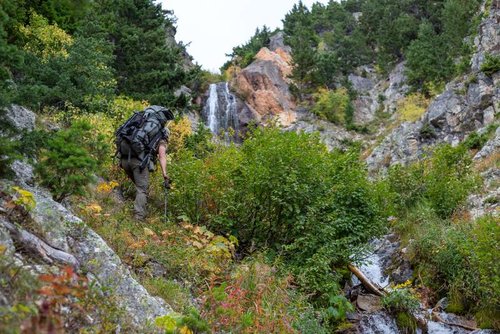
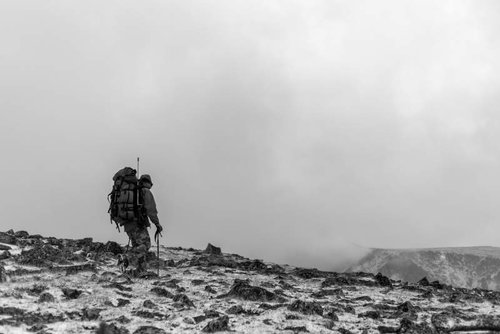
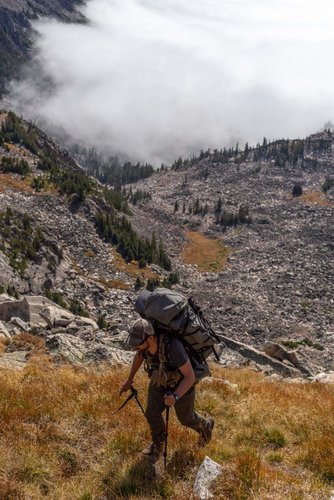
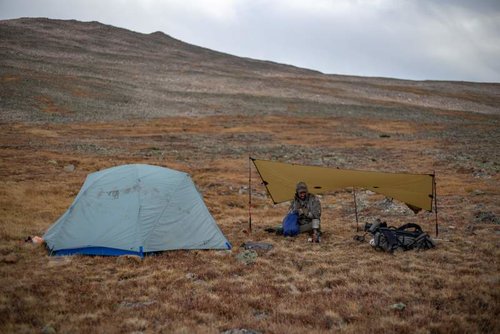
I solo scouted and hunted District #300 up Tom Miner Basin for most of the September 1-10[SUP]th[/SUP] season there, going northwest of the road rather than joining the circus along the Park boundary. I did come down out of the hills twice to take a day off, rejuvenate and eat like a starving bear. I took in a food cache on my last scouting trip and packed as light as humanly possible. It would have been too light if it had been colder but we were blessed with good weather that allowed me to just sleep out under the stars. I managed to waddle around up in the high country pretty well for a fat guy over fifty with a long list of injuries, but the furthest I went in one day was only four miles and the distance was more often only one or two. I had tried to get in condition with mountain hikes all summer but should have tried much harder. Some of the country kicked my butt physically but I still had a ball.
Quite a few years, pounds and miles have passed since I last spent much time above timberline. With the cool, clear air, high viewpoints and seemingly endless vistas it’s kind of magical up there. Even crusty old Elmer Keith felt it and waxed poetic about the high country.
“Have you ever seen a mature bighorn ram silhouetted on the sky line of his rugged domain? If so, then you know that no word picture can ever quite do him justice. Ranging at or above timberline, no other animal so typifies, or is so symbolic of, the rugged grandeur of the lofty snow-covered peaks, beautiful glacier-fed lakes and alpine meadows of the Rocky Mountain chain. Some of the wildest, roughest and most beautiful country that God ever made.”
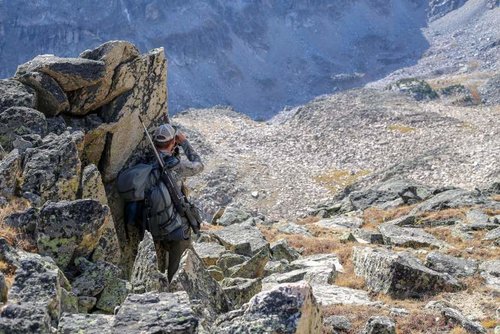
I put in many hours of glassing with Swarovski binos and spotting scope but still only saw four other hunters off in the distance the entire trip. Good optics including a spotter are essential. I actually glassed sheep virtually every morning and/or evening, finding them anywhere from the timber way down below the cliffs to the very tops of the peaks and ridges. Of course, every last one of them was a ewe, lamb or juvenile; I never did see a mature ram the whole time. So now I know where not to go. Didn't get any good pics of game since I couldn't use my digital camera in conjunction with the optics. Otherwise it only has 6x actual magnification...everything above that (up to 48x) it just plays with the pixels.
Mostly below me there were tons of wapiti full in the rut everywhere I went, including a 5-point and his harem way the hell up on South Twin Peak just below the communication site at about 10,000 feet one morning. One night with a good moon I slept atop a knife ridge and had bulls bugling away on either side of me most of the night. I saw some mountain goats most days as well, from loners up to one bunch of nine, but I only saw one or two stray mulies per day up that high. The only grizzly I saw was better than two miles away and at least 2,000 feet below me on Rock Creek. I never even saw any fresh grizzly sign up high; they all seemed to be down low in the main creek bottoms going after the berries and chokecherries. I still stuck with all the Bear Aware practices to avoid meeting one. Other than learning the country much better and finding out where the rams were not, I did recall some old and/or re-learn a few new mountain hunting lessons.
- A Forest Service road listed as a “Dirt Road Suitable For Passenger Cars” actually requires a high-clearance, armored and fully-tracked “passenger car” along the lines of an M113 Armored Personnel Carrier. I bottomed out my F-150’s work duty suspension and hit the frame on more than one occasion and I’m pretty sure I was throwing up a good bow wave with my bumper in one particular mudhole. I used the granny low side of the transmission both up and downhill just to keep my pace down to a slow enough crawl that I didn’t rattle the fillings out of my teeth bouncing over the rocks and ruts. A saw and a tow chain came in handy on a couple of particularly big blow-downs blocking the road after a strong thunderstorm went through the area just prior to season.
- Good boots are priceless: They were rather heavy, since they say one pound on the foot equals four pounds in the pack, but I did good with some seemingly indestructible all-leather Austrian Army surplus mountain troop (Gebirgsjaeger) boots.
- Slow and Steady. I learned a long time ago to sidehill back and forth up steep slopes and to proceed slowly and with short steps, just so long as you keep on putting one foot in front of the other. And it’s often better to take the long way around the head of a drainage following the contour lines than lose and regain all that altitude dropping down to cross it. Once you gain the top of a ridge stay with it as long as you can.
- Walking stick(s)/Trekking Pole(s): I don’t know how I managed to ever get along without these for the first forty years. I think they reduce fatigue a great deal simply by helping you keep your balance. And my wife used hers as a dandy bipod when she filled her ewe tag over by Anaconda about ten years back.
- Never miss a chance to fill your water bottles whenever you come across any water source. They are few and far between up high and it kind of sucks if you have to drop down and give up more than a thousand feet of elevation just to get water. It can be a real balancing act when it comes to carrying enough water without adding too much weight. I wound up lugging a gallon in three containers…that’s 8 pounds worth of H2O in case you were wondering. I carry an old folding handle USGI canteen cup, too; it comes in handy for dipping out of tiny rivulets too small to submerge a water bottle in. I brought powdered Gatorade mix and drank one quart of that for every two quarts of water. On one scouting trip I got water from a big snowbank tucked into a hollow high on a north-facing slope…ten days later while I was hunting it was all gone. On another scout I filled water bottles directly from a beautiful tiny spring in a small meadow at the edge of the whitebark pines; a week later, it was one big muddy reeking elk wallow that plugged my filter.
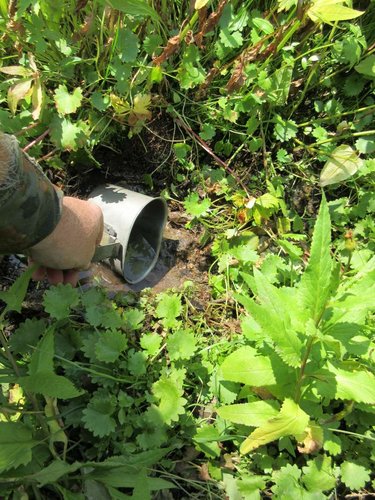 Never miss a chance to get water.
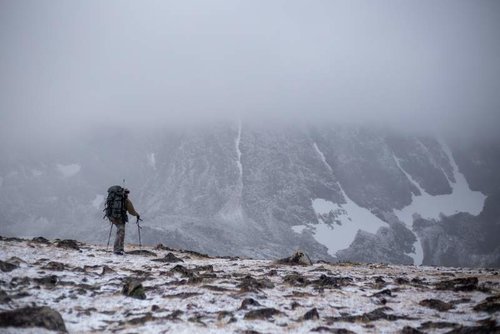
It’s colder than you think. On average, you lose 3-5 degrees of air temperature for every thousand feet in elevation gain. In very dry air, and we often have extremely low humidity in August and September, the temperature can drop as much as one degree for every 150 feet of elevation gain. When you get up to elevations approaching 10,000 feet, on a bright, sunny day the air temperature in the sun versus the air temperature in the shade can vary by as much as forty degrees. The clear air up high undergoes both rapid heating and cooling; as soon as the sun dips down behind a peak to the west, one immediately feels the heat loss. Winds are common in the mountains as well, adding the effect of wind chill. I always carry a Gore-Tex jacket in my fanny pack. When you stop hiking and start glassing on some high point, the wind may get to you quickly. In such cases I don the Gore-Tex mainly as a windproof layer as well as a shell to hold in body heat. In some cases, if it’s warm and you’ve worked up a good sweat hiking in, it’s worth the effort to strip down and change into a fresh, dry base layer. I usually use Under Armor as a base layer. Despite the very good weather, on some exposed points in the evenings I had to add a vest, stocking cap and wool gloves.
Sunscreen and chapstick are two other good items to have, and maybe a hat with a broad brim. I live at 5,500 feet and am out in the sun all summer and I still got some sunburn on my face and arms.
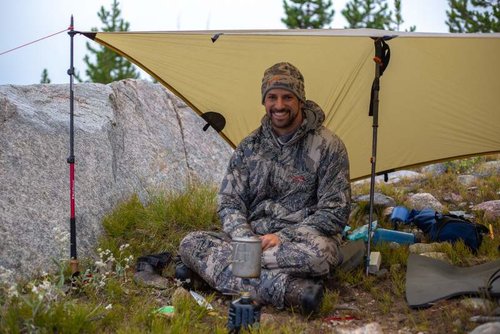
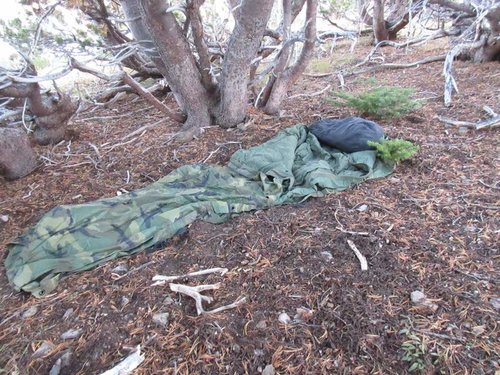 Pack light; freeze at night.
I have to put back in a drawing for a limited bighorn district next year or lose all those valuable bonus points which have yet to do me any good but I plan on doing the #300 unlimited again in 2020, the Good Lord willing and the creek don’t rise. I will, however, be doing many,
many more pre-season conditioning hikes prior to the next go-round. The better shape you’re in, the more you’ll enjoy it.