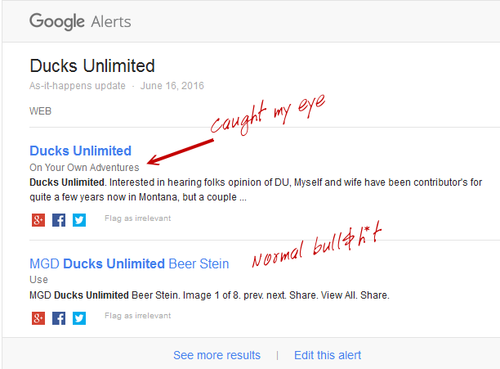
Interesting discussion to follow. As one who co-chaired a very successful DU committee for many years, I have given DU a lot of my time and money.
In my podcast and on this forum, I have given my input as to what a stupid decision it was to let Don Thomas go. Even worse was the manner in which it was explained/defended at DU. No response would have probably been a better response than what was provided.
The entire Kennedy/Schwaab, et al stream access lawsuits are a huge problem. Until those go away, DU will have an uphill public image battle in Montana. Just no way around that.
For me, the unfortunate part is to see so many great volunteers get caught up in something they really had no part of. The DU volunteers just want more wetlands protected and more ducks/geese in the air. They want to work hard and do what they think is best for conservation and the future of hunting. It's really that focused for them.
I do not see any other group able to do the wetland conservation work that DU has done in my lifetime. I don't see any group able to influence ag and grassland policy on behalf of conservation, to the degree that DU is able to.
Where does one go from here? I don't have that answer. I do know that as a waterfowl hunter, I am far better off because of the work and presence of Ducks Unlimited since their inception in 1937.
As for some of the comments about conservation easements, tax credits, and LLCs, a few tax explanations might be helpful.
A qualified conservation easement is defined by the Internal Revenue Code. Who qualifies, what property rights must be relinquished, and how the valuations are to be computed to arrive at the donation, are all explained in great detail in the tax code and associated regulations. Here is some summary:
To qualify, the property upon which the easement is placed must qualify for long-term capital gain treatment, if were sold at the date of the easement. Under current law, it must be held for at least one year.
To qualify, the property rights related to surface mining and a few other extraction activities must be relinquished for perpetuity.
The organization to which the property rights conveyed by the conservation easement must be an organization qualified under 501(c)(3), the Internal Revenue Code section governing non-profit groups. There are long lists of regulations about deductibility of easements made to related parties. You can still make a donation of the property rights covered by the conservation easement, it just may not be deductible if you do not meet the related party rule.
The manner in which the charitable donation is arrived at is explained in great detail. Summarily, you take the value of the property without any missing property rights and subtract the value of the property that is now absent the property rights conveyed under the conservation easement. The difference shows how much the property was devalued by donating some of the property rights. All of these values must be provided by Certified Appraisers and copies of all appraisals must be attached to the tax return claiming the charitable deduction for the conservation easement.
The charitable deduction is then allowed on the individual tax return of the person who owned the property, or the LLC Member/S-Corporation shareholder of the business entity owning the property on which the easement (deed restriction) was placed. If we are equal partners in an LLC, the LLC allocates half of the charitable donation deduction to each of us. We then claim that deduction on our individual return to lower our taxable income. There are restrictions at the individual level as to how much of that charitable donation deduction can be used to reduce your taxable income each year and rules as to how far forward you can carry any unused portion to offset taxable income in future years.
Most often, conservation easements are donated. If they are sold/purchased, then it is treated as a taxable sale, the same as if you sold the entire property, rather than selling just one of the bundle of property rights represented by your ownership in said property.
Most often, conservation easements only give up development rights, plus those other rights required by the Internal Revenue Code to qualify for the charitable donation deduction. Very seldom do donated easements give up the right to control access to the property. Often, purchased easements do come with access rights. Just depends what the donor/seller is willing to give up and what the recipient/buyer expects to received.
The non-profit organization is required to hold the donated property right in perpetuity. The organization must inspect the property every years to insure compliance with the terms of the easement. If a violation is found, the organization is required to take corrective action against the property owner who has retained the underlying land.
Conservation easements are a very valuable tool in conservation valuable habitat on private lands. They are highly scrutinized by the IRS. Most all of my CPA clients with net income over $5 million get audited every couple years. Toss in a large conservation easement deduction on their tax return and you are almost guaranteed an audit for that year. If not a full audit, at least an audit of the charitable deduction claimed for the conservation easement.
The biggest complaint I hear about conservation easements is that they do not necessarily convey the access rights. That is understandable, as the landowner usually wants to protect the land from development and is thus willing to donate the development rights. The development rights are usually very valuable, so they do realize significant tax savings for donated those development rights, while retaining the right to control who accesses the property.
I wish I had an easy answer for the DU situation. The easy answer to us out in the hinterlands would be that DU gain a better understanding of the importance of public access to the future of hunting and fishing and make assertive statements about such, plus place their advocacy and political force behind those access efforts. I suspect to those running the organization, both senior staff and Board, it is not as easy as I paint it to be. Regardless, my heart is with the volunteers and the mission they work hard to fulfill on behalf of wetlands and waterfowl.
If anyone is interested, some really good volunteers are holding an event in Bozeman on August 25th(?).