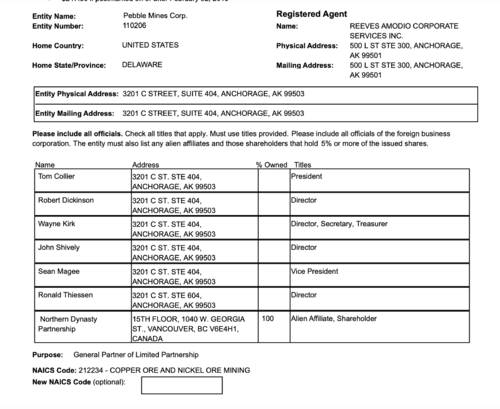
@Bigfin Lots of questions on the business side that I don't really track as far as liability is concerned. The bond for the mine doesn’t care who owns the property, the state would be the beneficiary.
This may be difficult to read, my brain is fried, too much report writing recently.
To answer the question on bonding. In Alaska, all mines are required to have a bond to cover all reclamation activity costs up to the largest liability/disturbance they will incur within the next 5 year mining period. Taxpayers have zero responsibility, or that is the goal of the State. Mines are not required to bond for a bull buildout until they get to that point. As the mine grows, so does the bond. There are instances where the full buildout may not be the largest liability. For example at the end of mine a pit may be backfilled, thus reducing acid mine drainage generation and thus long term water treatment costs. There are 100 other reasons why it could be more or less at some point in the mine life and the bond will reflect that. Water treatment costs and those associated with managing water can be large long-term and operational cost, however a good mine plan can reduce those liabilities and reduce long term costs at actual closure vs closing the mine mid-life. Good planning will limit the exposure throughout the life of the mine, but in some instances its not possible, hence the reason a mid-term mine plan could be the highest liability. There are many, many things to consider.
The bond covers all physical reclamation and long-term costs which would occur should the mine close within the permit cycle (which is 5-7 years). Bonds are calculated assuming a third-party contractor comes in with rental equipment and pays Davis/Bacon wages. These rates are far higher than an actual contractor would pay because they own their equipment (which they can operate at about 70%), and they wouldn't pay DB wages and benefits. So right out of the gate we are 30%+ over actual costs for equipment and labor. We look at the mine plan and determine what is the likely highest cost/disturbance/water treatment liability in the next 5 years, and then develop a concept reclamation and closure plan around that, then cost it all out. It takes about a year to pull it all together, and another 3-6 months to get it approved. There are numerous engineering studies that must be completed to feed information into the plan and estimate. Water balances, pit water management plans, acid-based loading analysis, growth media balances, waste rock and tailings cover designs, etc. I worked on industrial civil engineering projects in my past life, and a mine reclamation plan is 100 more complicated than any civil project, fact. Things aren't just dreamed up as they go, the amount of planning and engineering is unfathomable to most people.
Generally costs are broken into 3 phases. The first phase (temporary closure) is immediately after default when the State takes ownership and receives the bond. There are costs associated with holding the property and maintaining the environmental integrity property and permit compliance. It also includes development of final reclamation plans, procurement, etc. These costs can be in the $2-20 million range per year. This is generally calculated as a 2 year period, but can be longer. The reality is, there would be substantial planning already done, and moving into the physical reclamation period (phase 2) should be fairly straightforward because its planned out already. The second phase includes all the remediation and reclamation activities. This is usually a 2-3 year event, and includes all costs required to stabilize the site forever, generally with the lowest long term risk and liability/cost. The third phase covers all costs associated with long term management and maintenance. We calculate costs for in perpetuity water treatment, and any other holding and maintenance costs (dam maintenance, cover and vegetation, channel armoring replacement, etc) environmental studies, capital replacement and construction, etc. The phase 3 costs are discounted, generally. In AK the discount rate is based on the performance of the Alaska Permanent fund performance and inflation. The reason why discounting is allowed is because in terms of a default, the state would receive the entire bond, and would park it somewhere that would make money. If they for instance received a $500 million dollar bond, and the first 2 phases of the project were only $100M, that money is going to grow and start growing immediately upon receipt, 5 years of growth on $400M is a heck of a lot of money. That money also grows faster than inflation.
The actual cost of the bond the mine has to put up is dependent upon the size of the company and their assets requesting the bond. They are generally put up by large banks, or insurance companies. There is a risk, but as you can see by the % the risk is apparently low. Some of the large companies can pick up a bond for about 1.5-2% of the total reclamation estimate, while others are in the 3-5+% range. Bonds can have any time frame, but most are year to year, and are adjusted annually. The total reclamation estimate amount is also increased annualy based on inflation (Anchorage CPI). The bond can be reduced if the operator performs reclamation and reduces their liability.
AK also has the option to set up a trust fund for reclamation that would mature at the end of the mine life. The fund would be used for reclamation and closure. This is in addition to the bond they are required to provide, however they can lower their liability (bond amount) by the amount in the trust fund as they add money to it. Some of the larger, long-term operations have considered doing this, and to be honest I wish it was required vs the bonding. It requires more capital upfront, but reduces it long term. It further reduces risk, but it doesn’t mesh well with the bean counters. The issue is that capital up front, makes projects less attractive in terms of ROR, especially when you can discount the reclamation costs at the end of the mine life. $500M discounted 20 years reduces that capital a considerable amount. (I think the answer to your second question).
During the feasibility stage of a project, reclamation activities must be taken into account with all capital costs associated with development, operation and closure of a project. The reclamation costs are usually calculated as being done by the mine, with their equipment and people. (Huge trucks haul rock way cheaper than rental trucks.) To add another level to this, the estimates associated with capitalizing a project (though shareholders), are beholden to federal investment regulations, which changed recently...
There is a lot to explain, but like most mining related items, people are stuck in the past and have no idea what is actually required for permitting a mine. Once someones mind is made up you can’t change it. As you probably recall a few years ago Trump “abolished” mine reclamation requirements. This was 100% false, but made good headlines, and those that wanted to believe it lapped it up. What he did was toss out the new regulations that the Obama administration enacted on the way out the door. Those regulations were redundant to state requirements for reclamation, they were essentially federal requirements that mandated the exact same thing as the state. The reason it was killed, was because the people that put the regulations together were third graders, with zero mining experience. It was laughable the way they implemented their cost estimates. It was based on average costs on a per acre basis of reclamation estimates. Every mine has different requirements. Using their methods, some mines would have been over bonded by 2-3x while others with HUGE liabilities were underfunded 3-5x. Then there was the issue of jurisdiction. Environmental groups lost their minds over the regulations being rescinded, mostly because they were clueless as to how inadequate the changes where. Mining companies were vilified, but where right.
It takes roughly 100 permits to start a mine, along with millions of dollars in environmental and engineer studies. It literally takes decades to go from discovery to production. The rhetoric that the mine was "fast tracked" is laughable. The EIS permitting phase shouldn't take more than 2-3 years once all the studies are done. They have been doing studies in support of the EIS for decades, and the mine has been in the spotlight for just as long. Should we move the goal posts out and make it longer for everything, or just Pebble because we don’t like it?
If you have an hour or three, read a few sections of the EIS, mainly the fishery section, and dam construction failure scenarios/results. They are fairly easy to read and understand. As I mentioned before 99.99% of people don’t know anything about dam construction. They only understand that dams fail and believe that everything related to mining is “toxic.” The tailings will basically be benign as they intend to remove all sulfides from them, and deposit them in the pit under water at closure. In water they cannot go acid. A pit full of water does not create acid, air is what makes acid. The tailings facility will have very little water, and the tailings will be well drained. They can’t flow far without water, and if they did… they are fairly benign, not some all ocean killing toxic waste. This EIS is probably one of the largest ever written/studied … if you ask NGO’s it’s not good enough and was fast tracked. Easy to say when it’s not your money but is your gravy train. The end game is to require studying it to death or until you get the answer they want.
https://pebbleprojecteis.com/documents/finaleis








 ) and have made up their mind based on doomsday information that was spoon fed to them by anti-mining and development groups. On top of that there are very few people that understand anything remotely related to engineering or environmental controls related to modern day mining, or what will be employed at the project. Everyone is an expert on tailings dams, and jump in citing recent failures, yet don't have a clue on how they were constructed or failure reasons, let alone could make any sort of argument in a comparison between Pebble and the failed dam. They just jump to the conclusion that all dams will fail.