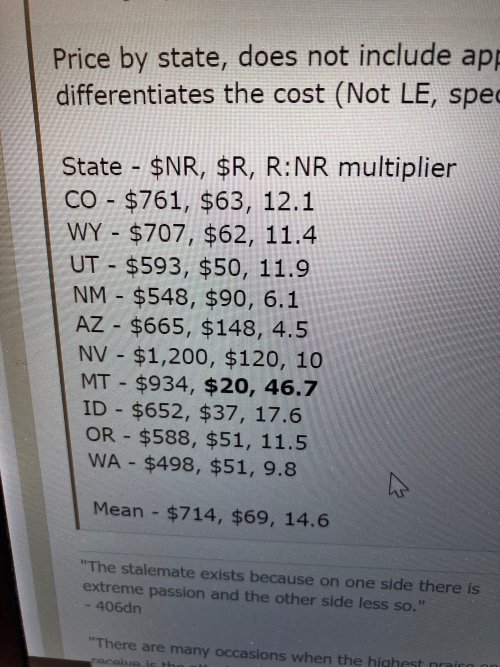
Therein lies the rub. We've tethered all of this to money, and you are actually making my point for me. My argument is the same argument Nick Gevock made when MSA was testifying in support of 525. If we only think about the money generated by sportsmen's dollars, then we have to maintain an unsustainable model of throwing more hunters on the landscape to keep up. It's clever and ties our hands.
Respectfully, I don't think it makes the point you or Nick think it does. It's essentially playing into the hands of Rosendale (PR/DJ funding elimination) and Lee (LWCF opposition) as those individuals continu to make the case that all conservation spending should be allocated on a yearly basis and not contain clauses that allow for statutory appropriations. Stable, reliable funding sources do more to enact long-term conservation plans that the herky-jerky back and forth of the biennial season setting process. by eliminating the funding sources for conservation, you simply give the legislature far more authority over wildlife management than if you left the funding mechanisms alone and focused on other issues within the same sphere.
When the B10 & B11 were brought into existence in the 80's or 90's, the compromise that conservationists were able to establish is that the NR licenses that get sold the most should fund programs that benefit resident hunters, landowners and wildlife. Because Montana's wildlife funding has to go through a budgeting process, unlike Wyoming, the ability of legislators to mess with FWP funding has been severely limited in terms of raising funding to pay for other things. It's also helped create a much stronger advocacy for conservation funding because there's a stable, secure source of money to help ensure we have more WMA's, Conservation Easements & almost 7 million acres of public access to private land through Block Management.
There are ways to cut NR licenses that don't get into the mix of conservation and access funding. 525 was not one of those ways. That bill would have eliminated the funding for the migratory bird conservation fund (wetlands restoration that helps wildlife, including native fisheries and species in need of conservation like sage grouse) and it would have cut the Upland Game Bird Habitat Enhancement Fund to almost nil as well. That helps ensure that we have grouse and private lands access. That's why the 13 national groups lobbied against 525 and the Molnar bills which would have totally eliminated Habitat MT funding out of the license dollars (while Molnar was trying to kill 442, which if he was successful, would have totally gutted Habitat MT and gutted funding for the access enhancement account (Block Mgt)
The reason sportsmen dollars are the primary driver of FWP budgeting is precisely the reason why we've had to defend the recreational mj tax funding going to Habitat MT, non-game, trails and parks. It has come under attack both sessions, and we're going to see more attacks on this funding in the next session, and probably for a few after that.
Like it or not - the budget is what drives 99% of all policy decisions. For wildlife, if we start cutting willy-nilly, we end up shortchanging not only the general license account, but the actual conservation of all wildlife. As I mentioned to several folks who were working on 525, crunch the numbers and know what you're cutting and who's ox is going to get gored.
Meanwhile, FWP funding is pretty stable and if you look at the budget picture encased in the pdf I linked too earlier, there are going to be years where the Ending Fund Balance is out of alignment with the cost/revenue estimates. There are ways to cut licenses without impacting the bottom line outside of the GLA hit, which can be made up through targeted license increases.
if the desire of the legislature and the people is to bust up the B10's & B11's, then we need to understand the total impact of those decisions before sending a bill to the Governor's desk. If we're going to try and cut NR waterfowl hunters or upland hunters, then there should be a replacement funding source identified before hand - unfortunately, the USFWS has indicated that any more grandfathering of dedicated funding sources using license dollars is likely a loss of control issue for PR/DJ and as such the agency isn't willing toi lose the PR/DJ funding to try and alter those programs too far outside of the boundaries that the Service laid out.
Conservation shouldn't suffer because of an attempt to course correct on resident versus non-resident, I don't think that's really a radical position.