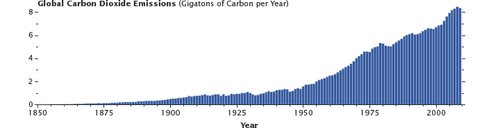
Humans are not to blame for climate change. Don't fall for that lie. So called "climate change" is just a natural occurrence that happens and will continue to happen regardless of what the human influence is.
Absolutely correct. Climate change
is a natural occurrence that has happened in Earth's history.
As the Earth moved out of ice ages over the past million years, the global temperature rose a total of 4 to 7 degrees Celsius over about 5,000 years. In the past century alone, the temperature has climbed 0.7 degrees Celsius, roughly ten times faster than the average rate of ice-age-recovery warming.
However, 1) no one has asserted that humans are
solely responsible for climate change. The important issue is a matter of magnitude and rate of change. Engines run fine at a range of RPMs, but push it too hard and they tend to break.
CO2 concentrations are increasing at a
much much greater rate than recent history (last 400,000 years) with no proportionately increasing source other than fossil fuel combustion and global temperature is changing more rapidly than ever. Climate change has
mountains of evidence (theoretical, physical, chemical, and mathematical) that corroborate the central hypothesis. Skeptics have a bunch of unrelated arguments that outright contradict each other or otherwise fail to meet basic physical laws and measurements.
Climate is what you expect, weather is what you get. Weather isn't homogeneous, but the global energy system can be modeled as such and inputs/outputs can be measured. However, increased variation in weather can be the result of a rapidly changing system. Adding more energy to a system can lead to greater fluctuations. Pull a rubber band tight and let it go, it will oscillate up and down a certain degree. Pull it much tighter (increase potential energy in the system) and let it go and it will oscillate in magnitude and rate. Add energy to earth weather systems and patterns can oscillate to a greater extent. The jetstream dips down a bit further for a bit longer, drawing cold polar air to areas that don't typically see that type of weather.
Pulling this back to moose, which are at the edges of their southern limit in the lower-48 and as a result they are much more susceptible to climate shifts away from their preferred climate than animals already within their preferred range. I don't think there's one reason (loss of habitat, warming temperatures/shorter winters leading to parasites, whitetail deer population explosion, increased predation, etc.) why moose populations in the L48 are struggling and generally declining, but there isn't anything happening that works in their favor at the moment. Woofs (I'm using Ben's term) and other predators (including parasites) disproportionately prey on the old, young, and the weak. Predation is going to look outsized if there are fewer calves as a result of poor feed and habitat and more weak animals as a result of parasites and disease. If woofs were solely to blame, then decreasing populations in ME, NH, and VT wouldn't be occurring.
One population that is increasing or generally steady, as best as current studies can tell, is the small population (500 to 1000+ animals) in the Adirondacks of NY. However, there are three (four, including no woofs but there are bears and bigger coyotes than the west has) things working in the moose's favor there: Low densities of whitetail deer (less than 6 per square mile); colder regional winters as a result of prevailing wind patterns, elevation, and lake effect snow; and plenty of preferred habitat/browse with few roads. How long that area remains friendly to moose remains to be seen with rapid changes in climate.





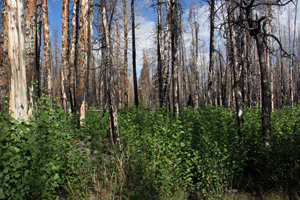


 Dude, people don't like facts. Those deniers have their horse blinders on. Humming Ted Nugent thinking "screw future generations"