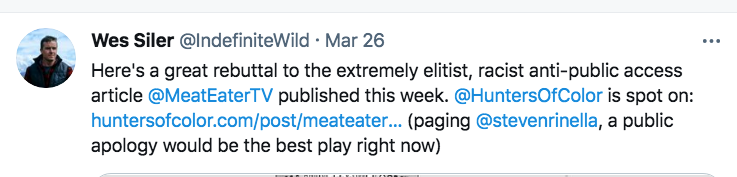
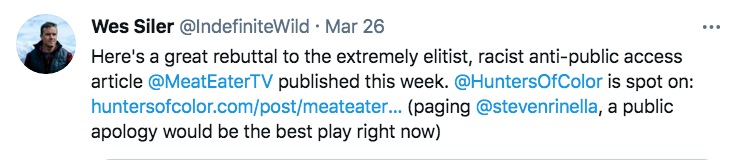
I was on the road when this article came out. It has populated my emails since then.
I think it is good that Meateater let Matt give this perspective. As I read it, I was waiting for the end conclusion that would emphasize the importance of improving access and finding new places to get hunters in the field, keeping hunter density to levels where guys like Matt wouldn't feel like they do.
We built these platforms on public land advocacy, mostly focused on access to public lands. We've advocated for LWCF, opposed state transfer, worked on tons of land exchanges, and many things related to public lands. Yet, access can also be to private lands. It can be easements. It can be state access programs like WIHA, BMA, HMA, Access Yes, etc. It can be opening access to inaccessible public lands.
The hunting experience depends on two basic foundations - Access to a place to hunt (land) and access to the opportunity to hunt (tags/licenses). One without the other is neither.
I think some were left with the premise that Matt sees this as too many hunters. Whether that is what he meant, or just what some perceive from his article, "too many hunters" comes down to hunter densities - the number of hunters using the same land at the same times.
We can improve and protect access, though it is much harder and way more expensive. Access is something far harder than increasing interest in the outdoors. A once-in-a-century pandemic got more people outside than all the R3 or "Take a Kid Fishing" effort the agencies have done in my lifetime.
Yet, the pandemic did nothing to increase or protect access. Every year we lose private acres to development, new ownership that doesn't allow hunting, bad hunter behavior that causes lands to be closed, financial incentives that landowners find more appealing, and a host of other reasons.
Every time we lose access, it displaces hunters to other areas. It increases hunter densities on the existing accessible lands. The hunter densities are what I read as Matt's frustration. I wish he had expanded on how to create more access, as that is another way to address hunter densities.
I agree with what many have said on this thread. Hunting has its swings in popularity. The fair weather newbs come and go, continuing the peak/valley curve of hunter numbers and license sales (two different metrics). Some of them will stick with it and be long-term hunters. They will carry the torch of advocacy and be the future conservation leaders. I want those people to be part of the hunting community. Even the newbs who drift off to the next fad are of ancillary benefit if they get exposed to hunting, fishing, shooting, and gain understanding of the reality of those activities.
R3, or whatever one wants to call it, is the easy work relative to access. Protecting and increasing access is the hard work. It requires a lot of effort, a lot of money, persistence, and relationships. The cause of access isn't helped by legislatures who want to defund access programs or eliminate the use of easements. The cause of access is inherently at risk in a society of property rights where owners of much of the access (and not just east of the Rockies) are looking to maximize the financial returns of those property rights.
I was in Portland all last week. I did four Q&A sessions. In every session the topic of access came up. The OR and WA folks all cautioned me about how crowded their public lands got five years ago when the timber companies started leasing to private parties or charging more than many were willing to pay for a seasonal pass. The adjacent public lands saw huge jumps in hunters, hikers, campers, bikers, and other public land use. Densities are now far higher than they were prior to that.
As one person said, "We didn't know how good we had it when that private land access was free. Now we know. Had we known then, we hopefully would have done something to keep it that way."
Not much he/they can do now. But it is another lesson for those of use facing some of the same issues, whether private timber lands, private ranches, etc. I think of the public lands of NW Montana adjacent to previously accessible lands formerly owned by Plumb Creek. I think about every big ranch that might allow access of be enrolled in Block Management-type programs, which when sold will likely congregate more hunters on public lands.
Even within states, we have places where the hunting gets depleted and folks go to other parts of the state and crowd those public lands. I think
@Randy Hodges opined that the best thing to reduced public land deer hunting pressure in Regions 6 and 7 of Montana would be to improve the deer hunting in Regions 1, 2, 3, 4, and 5. The same idea to reduce public land elk hunting pressure in Regions 3 and 4 would be to improve elk hunting in Regions 1, 2, 5, 6, and 7. That is where access equates to hunter density and is heavily impacted by wildlife management policies.
When I talk to Midwest hunters, it is almost as if they have given up on access. Leasing of prime lands and development are gobbling up ground with dollars they can't compete with, so they either quit or they just hunt out west. I understand why they do it, but it would be nice if they and their states could find ways to combat that lost access.
I had hoped Matt would connect more of the dots showing his frustration with hunter densities is multi-faceted. We are losing access, so to maintain hunter density on the fewer accessible acres, it would require fewer hunters. I would prefer that we keep hunter numbers robust and work on improving public hunting access, thus keeping hunter densities similar.
The NSSF studies continually show that the most common reason hunters quit, why they don't hunt as much as they previously did, or why a person from a hunting family doesn't get into hunting, are all related to access problems. For any of us frustrated with hunter densities, we can all help toward improving that by increasing accessible lands on which to hunt. Access is a hard problem to solve, but if we don't solve it, the recruitment, retention, and reactivation will have provided no benefit to the long-term future of hunting.