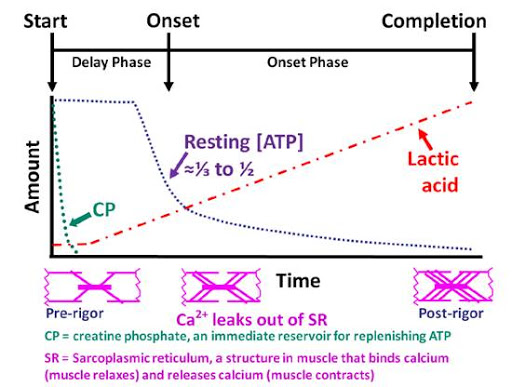
At the bottom of Fig. II-6 is three sarcomeres representing the contractile states of the muscle at the beginning, onset, and completion of rigor. The left, prerigor sarcomere can still contract and relax, has a limited number of cross bridges, and is very sensitive to some meat processing conditions. The center sarcomere is shorter indicating that the muscle is shortening just as far as the skeletal restraint will allow. Calcium is leaking out of the SR (the sarcoplasmic reticulum) and stimulates muscle contraction and formation of cross bridges between muscle filaments. The sarcomere on the right represents the final contractile state of post-rigor muscle where the number of cross bridges between the filaments is greatest, the distance between muscle protein filaments if the lowest, and the meat is the least tender. Rigor, therefore, decreases WHC because of less total open space for entrapment and holding of water.
The time muscle remains in the sensitive delay phase of rigor depends upon the chill room conditions (temperature, air movement, carcass spacing, etc), the fatness and total mass of the carcasses, muscle location within a carcass, and the type of muscle cells (fibers) within a muscle. In addition, the state of the animal before death has major impacts on meat quality. Exhausted or highly excited animals go into rigor faster than rested animals because their total energy supply (creatine phosphate and glycogen) is less and the critical level of ATP needed to delay rigor is soon reached. Meat from excited animals at slaughter is very likely to exhibit some degree of PSE, less WHC, and may have greater spoilage potential (due to its wet surfaces) than normal pH meat. Meat from exhausted animals at slaughter will have a higher pH and WHC[ Water Holding Capacity ] than normal but often has some undesirable quality characteristics (e.g., its darker color and greater susceptibility to microbial spoilage (due to the higher pH) even though it is just as wholesome and nutritious compared with meat with a normal rigor mortis pattern. These undesirable muscle properties result from the interaction between timing of the events, muscle pH, and carcass temperature; all three of which ultimately affect WHC.