Believe me or not but I’ve tried several times to search HT knowing that it’s had to have been discussed previously. I get this message that says Oops! we ran into some problems. A server error occurred, try again later. Like I mentioned, I too have been doing research on it.
I’m intrigued by what I’ve learned so far and as most research does, it’s produced additional questions along with the information learned. It’s interesting how different states have chosen to deal with this so far.
Some states like Illinois have upped harvest in an attempt to “flatten the curve” and others have just monitored the situation and are conducting tests.
Norway chose to eliminate entire localized populations. Not saying one is better than the other. The science hasn’t shown a preferred method yet.
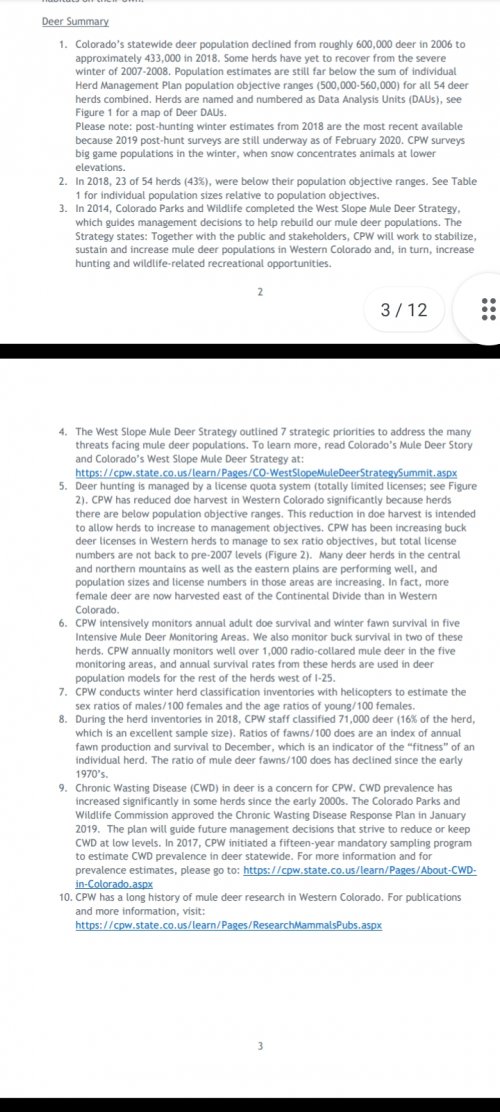
I do wonder about different management scenarios. Like letting it run it’s course for example. It seems that Colorado has just been observing it and still been able to manage deer and elk numbers successfully. Could this indicate that it’ll self regulate????
Perhaps herd reductions are necessary and will prove to be helpful. I can’t help but wonder about unintended consequences that could happen if this was the adopted method. Not being suspicious of intentions or a hoax here, just thinking of scenarios.
What happens if we let it play out? Massive die off? Not much change? No change? If we reduce numbers preemptively? No slow down in spread? Effective reduction in cases?
One thing that I find interesting is in the cases where entire deer farms have been tested and shown to be free of CWD and were strictly monitored. Somehow it still was able to become present.
There’s a lot of concentrated effort on this right now and I’m hopeful it turns out data we can use to curb this.
Wisconsin has said that the biggest risk of spread comes from younger age class bucks and is encouraging harvest of them. Looks like Montana is ahead of the game by whackin all those young muleys. Proactive! LOL
Well shit.
Frustrating. I’ve spent hours and hours and hours of work looking up and posting links to research and breaking it down here so folks would have access to it. That really sucks.
If you are satisfied with a Clif’s notes version…
Look up Wind Cave elk. They’ve been monitoring that population because it is semi-captive in the National Park and this does not get hunted (though some individuals that leave the park do get harvested). The prevalence in this herd is much higher than we’ve seen so far in free-ranging elk, and models suggest if things continue, this population will not persist. Why? Range restriction? A game-farm type scenario? We don’t know. What does that mean for other places we artificially concentrate elk, like feedgrounds? I’m guessing we’ll get a chance to find out in the next couple decades.
Look at some of the recent Wyoming mule deer studies. Significant population level declines in some herds. Why some herds and not others? We don’t know. I believe Saskatchewan is also seeing some significant mule deer declines now as well, based on notes I’ve seen from meetings between SK and ND and MT wildlife managers.
Same can be found published from a couple upper Midwest states and whitetails, though which two states had published data on this escapes me at the moment. (The Upper Midwest runs together for me. I apologize to all you MichSconsiWegians out there).
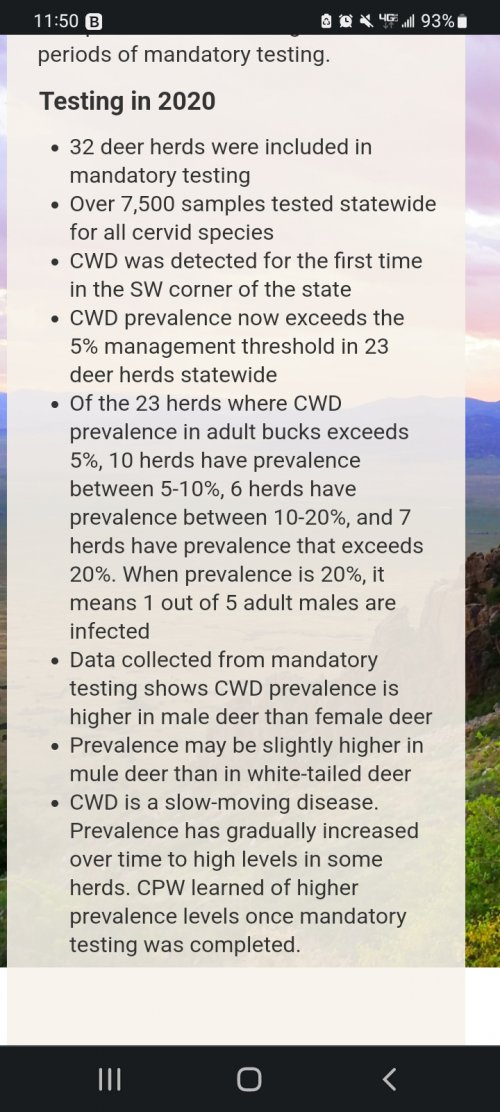
The reason there have been so many different strategies by wildlife agencies is because of public sentiment. The only state to go all in on local depopulation swiftly and hard after their first detection was New York. I haven’t checked back in a year or two now, but last I checked they were at 10 years (at least, but maybe more) post-management and had not detected a single additional case. That is impressive. They are the only ones to actually implement that strategy. Otherwise, every state has adopted a test and monitor or a scaled-back herd reduction strategy, and has watched the disease spread geographically and prevalences spike, some into that 40-60% rate. It’s when prevalences start getting into those 30+% that population level effects were being seen, IIRC. That was some of the newer research I read; trying to identify where this threshold is that population declines begin to become observable. Still in the works I think.
Other good research…CWD contributes to higher mortality rates from other causes. So CWD deer are more likely to die due to cars, predators, accidents, etc than non-infected deer. Which people always try to pull a “gotcha!!! They’re not dying from CWD. It’s not 100% fatal!!”. Well, it is. We know this from game farm and research facilities where we protect them until the inevitable end stage. But populations don’t live in captivity. Infected individuals still must be able to survive all the other causes of mortality that face wild cervids. And once they get CWD, they suck at it. If it impairs their motor and sensory function to the point they can’t avoid being killed by things a healthy deer might escape, they are still dead, and more of them are dying from these other causes, faster, than we would expect in a healthy population. And as prevalences get high, you have a higher and higher percentage of your population that is no longer able to survive the various dangers of being a wild cervid. So populations look like they will eventually decline under that scenario. Decline how far? Who can say.
I have never quite believed that CWD alone will kill populations to extinction. But I do believe that it will significantly impact population’s ability to recover from other stochastic events or other sources of population decline. Particularly in mule deer, which are already not doing well across large portions of their range. My gut tells me that CWD is going to severely hamper a population’s ability to bounce back after droughts, or hard winters, or EHD outbreaks, or just the general pressures that are causing declines already. I have no data to support this idea. I just have a feeling.
If anyone really is unhappy with the state of CWD knowledge and wants the states to do better, I encourage you to go look at TRCP’s website. They have been very staunch advocates for CWD funding. Congress cut funding for CWD back in 2012. Almost no progress has been made since. We need to change that.