Lots of different opinions on the man, I'm sure.
PHILANTHROPIST, ENVIRONMENTALIST AND CABLE PIONEER TED TURNER PASSES AT 87
PHILANTHROPIST, ENVIRONMENTALIST AND CABLE PIONEER TED TURNER PASSES AT 87



Follow along with the video below to see how to install our site as a web app on your home screen.
Note: This feature may not be available in some browsers.



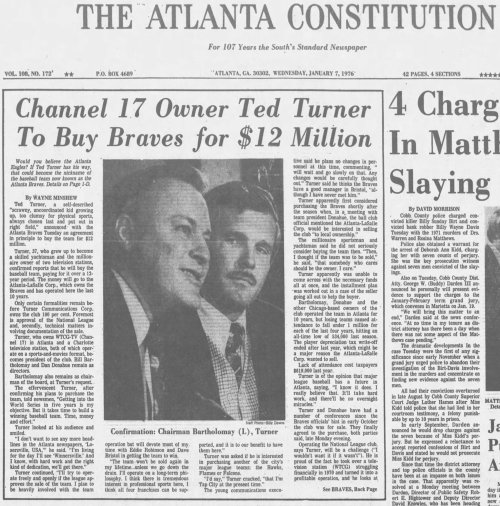
The Braves were a key asset and I had to go for it. Major League Baseball was high-quality programming for Channel 17 and by owning the team I would control its long-term TV rights. Plus, buying this franchise would really put our company on the map. There was just this one little problem—I couldn’t afford it. Our other businesses were performing pretty well but we still had a lot of debt and even if I could scrape together $10 million it would be hard to justify paying that for a business that was losing a million a year.
I might have had room to negotiate on price, but I decided to focus on terms. I told Dan [Donahue], “Look, I’ll buy the team, but I can’t afford to pay cash. How about I give you a million dollars down and you give me nine years to pay the rest, with interest?” He said he’d need to talk to his partners and would get back to me. I knew that since I’d been given the first look I needed to put in a strong bid. My offer was unconventional, but it would allow them to tell the world that they got their $10 million asking price. Dan got back to me quickly and told me my offer had been approved. I was elated, but we were only halfway home.
The next hurdle was approval from the Major League Baseball owners. In addition to my not fitting their mold, I think I was the first person to try to buy a team with less than 100 percent cash. Some were also concerned about my ultimate intentions on the TV side of things. I would be just the second owner who controlled both a team and its broadcast station, and I had made a few comments about distributing WTCG on cable outside Atlanta. Some owners worried about what this might mean in terms of TV competition in their home markets. But the Braves were a bad team in a relatively small southern city and I don’t think many of them saw me as a threat.
Still, I couldn’t take any chances so I went into full sales mode and did everything I could to get into baseball’s good graces. In a lucky break, the guy running national sales for Channel 17 just happened to be Stan Musial’s son-in-law, and when it came time for me to meet with commissioner Bowie Kuhn and the rest of the owners, none other than “Stan the Man” provided my flattering introduction. I was also careful to make sure that Bill Bartholomay agreed to stay on as Braves chairman after our deal closed. Through our previous rights negotiations I learned that he was a man of integrity and I knew that the other owners liked and respected him. Major League Baseball was a new world to me and Bill’s presence would be very helpful.
We successfully resolved our financing and league approval issues through the fall of ‘75, and in January ‘76 Turner Communications Group took over as owner of the Atlanta Braves. It was a thrill for all of us at the company. The team might have been losers, but they were in the big leagues, and now so were we.
—Ted Turner


I was wondering the same thingI wonder what happens to those ranches. He bought some attractive pieces of dirt.
I have no idea, but I'd assume that Ted had succession plans for his properties. I imagine a guy that cared enough about conservation and preservation to spend as much money as he did would want the land to continue to be preserved.I wonder what happens to those ranches. He bought some attractive pieces of dirt.
 www.tedturner.com

Yes. I read an article that his kids/family are going to continue with the plans they've always had for the properties. Everything is in CE's.I wouldn't presume to know but I know he has a number of kids. Wonder if he left the land in their care. Was sharp enough to avoid trouble in doing that I think assuming he wanted management there to continue as it has been.
Yeah, that is what i have heard regarding CE, and his kids.Yes. I read an article that his kids/family are going to continue with the plans they've always had for the properties. Everything is in CE's.
I worked for Ted for 2 years managing riparian/wetlands on 2 of his Montana properties in 1999, 2000. Met with him several times. IMO, he managed his properties very well balancing use and put a priority on wildlife and land health.
He also did a fair bit of hunting and lots of fishing. He bought at least 2 moose governors tags in Montana. There were 2 good bulls on the ranch I spent the most time on and Ted really wanted the bigger of the 2. I saw those bulls all summer, but they couldn't find them the first couple days of the season. Ted scrambled over to the D and killed a good one over there. He came back over to fish the Snowcrest and that bigger bull was walking up the road when he was going to his house! Should have been more patient, but from what I saw with Ted, patience wasn't his strong suit.
Anyway, sorry to read about his death, but he lived a pretty good and long life. Nobody is getting off this SOB alive.


Same!I wonder what happens to those ranches. He bought some attractive pieces of dirt.