



2rocky
Well-known member
This Elk Season I do not have a tag. In fact I have not had an elk tag since my Utah 2022 hunt. But I've been on eight elk hunts since then. And next week will be 2 more.
In 2023 one of my ranching clients approached me to come assist with their Tule Elk hunts. They coordinate with a neighbor to sell all-inclusive hunts for four Private Land Management Tule elk tags. Past clients include a number of names folks would recognize from hunting media and record books. They have two hunters in camp each week for two weeks in September. Usually when the rut is going strong. Hunts are based out of a ranch house with 3 meals a day, and conducted by driving jeep or side x side on ranch roads to access where the elk herds roam over about 5000 acres between the two ranches. Both ranches are active cattle operations so it is not unusual to see cattle and elk feeding adjacent to each other. While the elk are not as spooky as hard hunted public land elk in the Western Rocky Mountain states, they will not tolerate catching human scent the wind or seeing a human form or vehicle for very long.
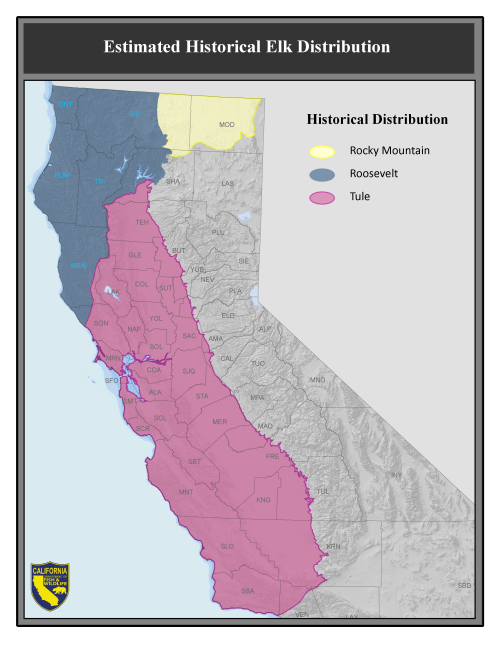
Tule elk, for folks unfamiliar, is a subspecies of elk native to the California Central Coast and San Joaquin Valley. In the late 1800's they were reduced to a small remnant population in Kern County where cattle baron Henry Miller created a sanctuary and helped the herd grow. Eventually, they grew to the point they could be transplanted to other areas in the state. During the period from 1914 to 1934, the California Acadamy of Sciences relocated 235 tule elk to 22 different locations, including Cache Creek and the Owens Valley with mostly poor results. in 1978, ten head were introduced to the Point Reyes Penninsula in Marin County at Point Reyes National Seashore as well as 65 head released in the Diablo Range. Since then Tule elk have expanded to 22 distinct herds and are estimated by California Fish and Wildlife to have a population of around 5700 head in 2020.
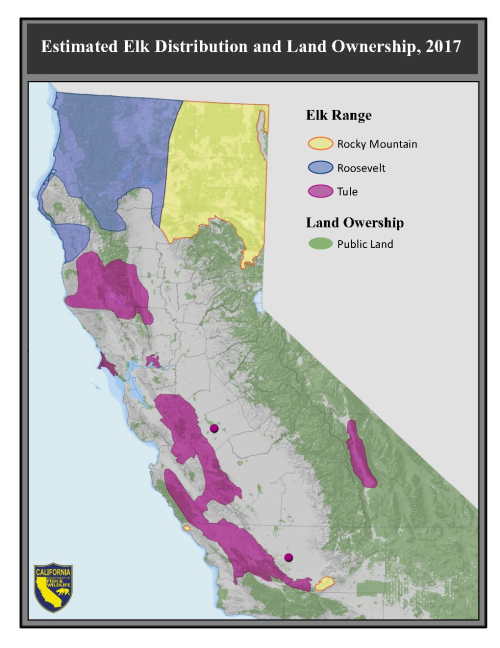
In terms of Public hunting opportunities there are between 240-260 Draw tags that hunters can apply for in the annual draw in June. In addition, 165 SHARE tags where CDFW partners with private landowners for a separate draw opportunity outside the preference point system in both Roosevelt and Tule elk areas. Usually these are population management hunts on smaller acreage that may not support a Private Lands Management allocation. About 36 of these are bull tags. The Private Land Management tags are for landowners who do habitat management projects on parcels of land large enough to support an elk population for the majority of the year. Tag allocations are managed through aerial population surveys and completion of habitat work. The private landowners can then sell or distribute those vouchers. These tags are specific to the landowner's population and not statewide.
Tule elk are smaller than Rocky Mountain Elk. Bulls weigh 450 to 700 pounds while cows weigh 375 to 500 pounds on average. Their antler structure is similar to a Roosevelt Elk with crown points and webbing occurring in many mature bulls. They are scored for P&Y and B&C with the same score sheet as a Roosevelt Elk and all antler points above the 4th point score without deductions for symmetry
Elk Subspecies Record Book Minimums
Pope and Young interactive score sheet
Boone and Crockett Score Sheet
Is there any interest in seeing or hearing more?
In 2023 one of my ranching clients approached me to come assist with their Tule Elk hunts. They coordinate with a neighbor to sell all-inclusive hunts for four Private Land Management Tule elk tags. Past clients include a number of names folks would recognize from hunting media and record books. They have two hunters in camp each week for two weeks in September. Usually when the rut is going strong. Hunts are based out of a ranch house with 3 meals a day, and conducted by driving jeep or side x side on ranch roads to access where the elk herds roam over about 5000 acres between the two ranches. Both ranches are active cattle operations so it is not unusual to see cattle and elk feeding adjacent to each other. While the elk are not as spooky as hard hunted public land elk in the Western Rocky Mountain states, they will not tolerate catching human scent the wind or seeing a human form or vehicle for very long.
Tule elk, for folks unfamiliar, is a subspecies of elk native to the California Central Coast and San Joaquin Valley. In the late 1800's they were reduced to a small remnant population in Kern County where cattle baron Henry Miller created a sanctuary and helped the herd grow. Eventually, they grew to the point they could be transplanted to other areas in the state. During the period from 1914 to 1934, the California Acadamy of Sciences relocated 235 tule elk to 22 different locations, including Cache Creek and the Owens Valley with mostly poor results. in 1978, ten head were introduced to the Point Reyes Penninsula in Marin County at Point Reyes National Seashore as well as 65 head released in the Diablo Range. Since then Tule elk have expanded to 22 distinct herds and are estimated by California Fish and Wildlife to have a population of around 5700 head in 2020.
In terms of Public hunting opportunities there are between 240-260 Draw tags that hunters can apply for in the annual draw in June. In addition, 165 SHARE tags where CDFW partners with private landowners for a separate draw opportunity outside the preference point system in both Roosevelt and Tule elk areas. Usually these are population management hunts on smaller acreage that may not support a Private Lands Management allocation. About 36 of these are bull tags. The Private Land Management tags are for landowners who do habitat management projects on parcels of land large enough to support an elk population for the majority of the year. Tag allocations are managed through aerial population surveys and completion of habitat work. The private landowners can then sell or distribute those vouchers. These tags are specific to the landowner's population and not statewide.
Tule elk are smaller than Rocky Mountain Elk. Bulls weigh 450 to 700 pounds while cows weigh 375 to 500 pounds on average. Their antler structure is similar to a Roosevelt Elk with crown points and webbing occurring in many mature bulls. They are scored for P&Y and B&C with the same score sheet as a Roosevelt Elk and all antler points above the 4th point score without deductions for symmetry
Elk Subspecies Record Book Minimums
| Elk Subspecies | P&Y Typical (Archery) | P&Y Non-Typical (Archery) | B&C Awards (Short-Term) | B&C All-Time (Permanent) |
|---|---|---|---|---|
| Rocky Mountain (American) | 260" | 300" (Min. 20" abnormal) | 360" | 375" |
| Roosevelt | 225" | 255" (Min. 15" abnormal) | 275" | 290" |
| Tule | 225" | 245" (Min. 10" abnormal) | 270" | 285" |
Pope and Young interactive score sheet
Boone and Crockett Score Sheet
Is there any interest in seeing or hearing more?