Just trying to understand what point you were trying to make. It was the example you used after saying that "sometimes individual rights go too far" and bringing up no-fault divorce.
I'm with
@wllm1313, it seems like a normal contract that neither party wants to enforce or see to its conclusion (death of one party). If one party feels aggrieved by the other non-performing party, they can hire a lawyer. I'm sure any district court telling two people they can't get divorced or have to find a basis for divorce would end up on SCTOUS plate pretty quickly because you are taking away the freedom of two parties to mutually agree to break a contract. But I could be wrong.

No worries. Just a confusion about what the example was intended for (individual rights) and the state of current US family law.
To add some perspective, no-fault divorce was first adopted in California in 1968, and then, with some variations, over the next 20 years it became the law in every state. No-fault significantly changed the way people thought about marriage. Under the old divorce laws, married people couldn’t just choose to end their marriage; rather, they had to prove spousal misconduct—like adultery or mental cruelty. In those days people perceived the state as a party to the marriage. Therefore, only a judge representing society’s interests could determine when a divorce was justified.
As originally conceived, no-fault divorce had worthy goals. It added irretrievable marriage breakdown, regardless of personal fault, as an additional basis for divorce, which simplified divorce actions and reduced messy personal litigation. No-fault also improved how the law saw the economic interests of women. And in theory, only a judge, who represented society’s interests, could decide whether a marriage was indeed beyond repair. But in practice, family court judges began to defer to the personal preference of a couple, and eventually they deferred to whichever partner wanted to end the marriage.
So, as one legal scholar put it, no-fault divorce no longer “looked at marriage . . . as a [social] institution.” Rather, no-fault saw marriage as “an essentially private relationship between adults terminable at the will of either” without regard to the consequences for children, let alone the effect of divorce on society. Before long, judges’ doubts about society’s right to enforce wedding vows gave married couples the false impression that their personal promises held no great social or moral value, whatever justifications we may come up with.
As these new legal assumptions have blended with larger cultural swings, most Americans no longer see marriage as a relatively permanent social institution; rather, they see it as a temporary, private source of personal fulfillment. That has been proved over and over again with various social studies. So when marriage commitments intrude on personal preferences, people are more likely to walk away.
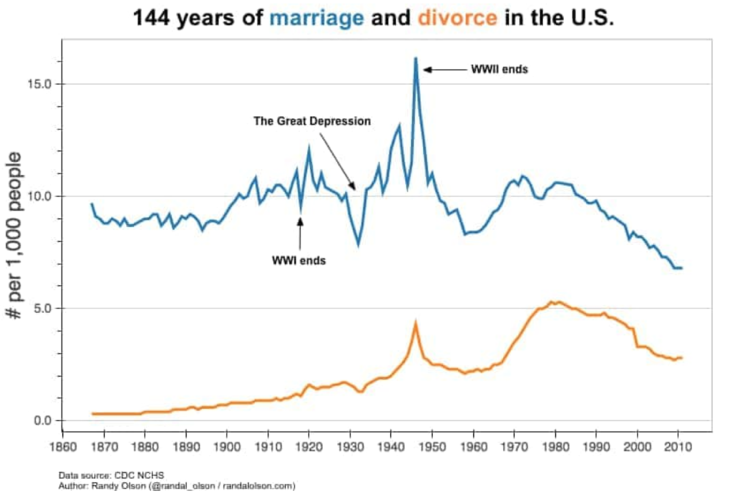
If we look at the stats, the divorce rate has doubled in the past 70 years. The US is the most divorce prone country in the world, with about half of all marriages ending in divorce. The percentage of children born into a single-parent home has gone from 9% to 26%. In a recent Times article, they showed that children in single-parent homes have less upward economic mobility than those in two-parent homes, and that children of unwed or divorced parents have three times as many serious behavioral, emotional, and developmental problems as children in two-parent families. Is it any wonder that dysfunction eventually leads to our society?
Listen, I'm not saying that there are not benefits to individual rights, and there are many nuances to the world of family law. But as Scalia said, like most rights they cannot be unlimited and they must be balanced with society's interests. If some of you disagree with me, that is great and I welcome the discourse in a PM where we won't distract from the OP's thread.