Curious,
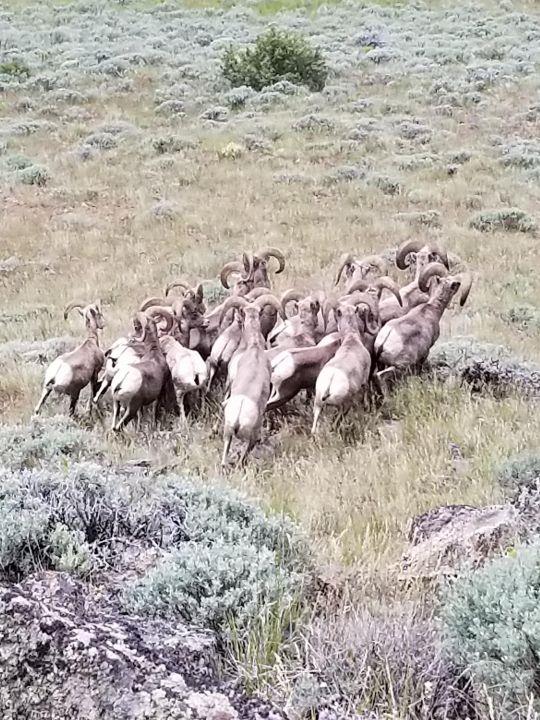
The portion I placed in bold, wouldn't this be a great study group? I don't know near enough though my edumacation reading the above leads me to believe something within these bighorn has prevented the bacteria from taking them down. I didn't take the article to note the "Adult bighorns" as the chronic spreaders...
Wouldn't this be great news that these adults are not getting pneumonia? Learn the difference within this immune group and compare with other adult bighorns elsewhere who are dieing from pneumonia- not accounting for the fire, of course.
There are likely hundreds of strains of
Mycoplasma ovipneumoniae circulating within domestic sheep herds throughout the west. In a flock of 1,000 sheep, you might find 60 or more strains. Strains have different levels of virulence to bighorn sheep when herds are exposed to them, and outcomes can vary greatly. Exposure to a low-virulence strain might result in nothing more than runny noses in the herd for a year or two, while highly virulent strains may cause all-age mortality of 60-90% of individuals. It's important to understand that MOVI infection is not what kills bighorns. MOVI is a setup agent that allows other bacteria such as
Mannheimia haemolytica,
Bibersteinia trehalosi, and
Pasteurella multocida to enter the the lungs. It does this by binding to and paralyzing the cilia in the respiratory epithelium that are the normal defense against infection.
It's also important to understand that serology tests of bighorn sheep survivors of an MOVI spillover event from domestic sheep to bighorns will show that they have been exposed to MOVI, as mentioned in the article. Numerous herds throughout the west have been exposed. The long-term outcome for herds can vary from
seemingly complete recovery in a couple of years to chronically reduced annual lamb recruitment that results in a stagnant to declining herd. This reduced lamb recruitment is caused by what is called "summer pneumonia" in lay terms. It's attributed to one or more adult "chronic shedders" of MOVI in the herd. Over the long term it can lead to a "hollowing out" of the population as adult mortality is not replaced by new recruitment. How doe this happen....
Over time, infected herds can build MOVI
strain-specific immunity. But in lambs, maternal/passive antibody doesn't meaningfully delay or prevent infection or disease progression. So every new cohort of lambs is essentially a fresh, fully susceptible population being exposed to a pathogen the herd has already "solved" immunologically. The chronic shedder ewes are the exposure source, infection can happen within days of birth, and because lambs have no strain-specific immune memory, the full polymicrobial disease process (MOVI impairing clearance → Pasteurellaceae proliferation → fatal bronchopneumonia) can play out essentially every year, in most or all of that year's lamb crop.
So this is why "test and cull" strategies for adult ewes are so promising for recovery of herds. If you can remove the chronic shedder(s) that are leading to infection of lambs each year, you can restore recruitment. However, it's important to keep in mind that herd immunity is strain-specific, and a spillover event involving a different strain of MOVI can still have a catastrophic outcome for the herd.





 bakercityherald.com