No King's Deer

respectfully, this is a bad take.
Which part? The part that Montanans do understand and appreciate what we have, or the part that we don't owe our wildlife to people merely because they exist and are more privileged than the rest of us? There's nothing "bad" about acknowledging a fundamental flaw in that way of thinking. It is deeply infused, and I understand how Gerald and you would balk at it. The narrative has always been "thank the generous stewards of the land, they are more connected and love it more than you could ever know, etc." It's a belief held with an almost religious fervor in some circles. I felt the same as a commercial fisherman, I loved the ocean, the people, and the place and felt a deep connection to those public resources too. But I didn't make the leap to saying I therefore deserved gratitude in the form of taking from the public, when ultimately my role as a fisherman was work.

You're not reading between the lines of what I wrote earlier too, which is that I don't have an issue with a fair exchange:
But they all ask me this question, "why should I let everyone else hunt my place if I can't."
If someone is letting someone hunt their place, then they should get to hunt their place too. That is fair, and no disagreement there. Because that equalizes the opportunity.

Giving someone a license without any concession to the public, however, is a different thing.

As a grad of the Master Hunter program, I'm far from tonedeaf to the plight of the landowner. I am, however, asking people to challenge their thinking that ownership alone entitles someone to a bigger slice of the pie. And framing it as I have, under the banner of No King's Deer, is rhetorical and helps with understanding. There's nothing wrong with pushing the envelope to get people thinking.
 
Jake,

respectfully, this is a bad take.

Landowner preference licensing has been a standard in western states since at least the early 1970's. Montana and Wyoming are the two Rocky Mtn states that don't have some kind of transferable license program (aside from all those lotto and auction tags everyone lobbies for) and their is no credible chance of getting those through either legislature, IMO. Montana - as a state that elected their leaders, legislators and executives, made the conscious decision to reward good stewardship of wildlife through Landowner Preference if you go to a draw (which is really when you only need LOP since a general license is guaranteed for every resident landowner). That is the democratic allocation of wildlife, even if you dislike the outcome.
I would like to have your conference in the prospects of transferable landowner tags in the legislature. In my opinion, if MT were to go to a total LE system like many other western states, It would be difficult to keep the transferable landowner tags camel out of the tent. I just made @Treeshark a prepont of limited entry.
 
Jake,

respectfully, this is a bad take.

Landowner preference licensing has been a standard in western states since at least the early 1970's. Montana and Wyoming are the two Rocky Mtn states that don't have some kind of transferable license program (aside from all those lotto and auction tags everyone lobbies for) and their is no credible chance of getting those through either legislature, IMO. Montana - as a state that elected their leaders, legislators and executives, made the conscious decision to reward good stewardship of wildlife through Landowner Preference if you go to a draw (which is really when you only need LOP since a general license is guaranteed for every resident landowner). That is the democratic allocation of wildlife, even if you dislike the outcome.

If it weren't for landowners, introductions of elk in the Bitterroots, Breaks, Elkhorns, etc wouldn't have happened regardless of the clubs who ponied up the funds. It is landowners who help conserve those habitats by not subdividing them. It is private landowners who provide refuge for animals when the pressure gets to be too much. It was a private landowner in R2 that agreed to be the release site for the first sharp-tail reintroduction west of the divide in an effort to restore those historic populations. If it wasn't for landowners, R6 & R7 would likely still be over-issuing licenses for mule deer. If it wasn't for private landowners in Montana, you'd have 7 million fewer acres to recreate on. I think that kind of investment into the public trust is worthy of a license, personally on top of a payment for impacts from hunters. It's a small recognition of their stewardship, public engagement and community development. Equating LOP to "the kings deer" does both issues a grave disservice.

And because of all of that, it's private landowners who's bottom lines are negatively impacted by an abundant public trust resource. Landowner preference as MT does it is a very small token of appreciation for their outsized impact on wildlife abundance. Claiming that they seek a "kingly entitlement" is pretty tone deaf. Can it be better, absolutely. Is it an a sign of lordly entitlement? Hardly.

I have met no landowner, rich or poor, resident or non, who wants the "kings deer." To a person, they all have said that the egalitarian model is necessary and the best way to keep what we have today. But they all ask me this question, "why should I let everyone else hunt my place if I can't." I think that's a valid question. Especially when you look at the economic impacts that ranches play in rural communities (both resident and NR landowners). It may not be perfect and I think there's an unintentional downside to consolidation of ranchland in the form of raising barriers of entry for new farmers and ranchers, etc. That's all far larger than a licensing bitch, and I think that if we're honest with ourselves we'd recognize that range wars have been rolling in some form or fashion since El Chivato saddled up for Tunstall and went against Dolan in the Lincoln County wars or Tom Horn got framed for Willy Nickel.

Maybe we'd all be well served to re-read Back from the Brink as well as Roosevelt's Hunting Trips of a Ranchman and Wilderness Hunter. Our history shows that wildlife wins when we find ways to work together, not tear each other down. It's easy to fall into combat mode. There's a ton of comfort in it, and it treats us like a nice 0 degree bag on a cold night but it's a false comfort. Combat is addictive. The adrenaline rush is real but so are the lows when it wears off. But then you're always left chasing the next thing to elevate your blood and keep you fired up. I hope you get as exhausted of constant conflict as I did but I hope it doesn't take you 20 years to get there. It's counter-productive to achieving lasting results that benefit all, in my experience.

applause.gif

Pshhh, they are all just selfishly motivated byproducts of their ag business or billionaire playground desires though so we shouldn't recognize em. /sarcasm
 
Which part? The part that Montanans do understand and appreciate what we have, or the part that we don't owe our wildlife to people merely because they exist and are more privileged than the rest of us? There's nothing "bad" about acknowledging a fundamental flaw in that way of thinking. It is deeply infused, and I understand how Gerald and you would balk at it. The narrative has always been "thank the generous stewards of the land, they are more connected and love it more than you could ever know, etc." It's a belief held with an almost religious fervor in some circles. I felt the same as a commercial fisherman, I loved the ocean, the people, and the place and felt a deep connection to those public resources too. But I didn't make the leap to saying I therefore deserved gratitude in the form of taking from the public, when ultimately my role as a fisherman was work.

You ignore their outsized input into the management of those animals when they are often a net reduction in revenue (unless monetized). As a commercial fiusherman, you were heavily regulated on take for your harvest. You were taking from the public resource to sell as a commerical product. Where does your economic vulnerability lie there? How is being an industrial remover of wildlife compare to being the person who grows the grass the critters eat? I don't think it's a decent comparison. I'll leave subtle digs at my and Gerald's intentions alone.


You're not reading between the lines of what I wrote earlier too, which is that I don't have an issue with a fair exchange:
If someone is letting someone hunt their place, then they should get to hunt their place too. That is fair, and no disagreement there. Because that equalizes the opportunity.

Good., We're getting somewhere. MTBHA has been supporting the EHA's lately. Is 3 to 1 a fair exchange? What about someone who already allows 50 people to hunt their place, both antlered and antlerless, but it's not an FWP program? There's a rigid inflexibility in the common refrain of your first statement here, and it comes across to the landowner community of "let me on first, then we'll think about you." What I've seen in practice is that if you find a way to put a tag in someone's hand, they'll star to get addicted to sharing their place. I know of a few properties that have been asking about how to responsibly scale up their access programs outside of the FWP ones so they maintain control and have the hunting happen how the landowner/manager decides. Would they be worthy of a general license?

Giving someone a license without any concession to the public, however, is a different thing.

So it's the entire landowner preference system you wish to eliminate?

As a grad of the Master Hunter program, I'm far from tonedeaf to the plight of the landowner. I am, however, asking people to challenge their thinking that ownership alone entitles someone to a bigger slice of the pie. And framing it as I have, under the banner of No King's Deer, is rhetorical and helps with understanding. There's nothing wrong with pushing the envelope to get people thinking.


Jake, you've spent the last 24 hours encouraging people to sue landowners over corner-crossing and now you're saying that they shouldn't get LOP. I can't imagine you to be so self-unaware that you don't understand how this comes across as anti-landowner.
 
Any landowner permit program should begin with the premise - is this good for the trust, the associated resource, and the public for which the trust is held?

If it isn't - the trustees (legislators + commission) have failed at upholding their basic fiduciary responsibility.

Looking at recent LO preference programs, and recent pushes for more of them - at least here in montana - they fall majorly short. Any benefit paid out by the trust, i.e. a permit, should have strings attached to show that the benefits to the trust exceed whats been paid out.
 
I would like to have your conference in the prospects of transferable landowner tags in the legislature. In my opinion, if MT were to go to a total LE system like many other western states, It would be difficult to keep the transferable landowner tags camel out of the tent. I just made @Treeshark a prepont of limited entry.

I'd say it likely wouldn't get out of the first committee. I can't think of 51 legislators in the House or 26 in the Senate that would vote for it. I can think of about 5,000 pissed off Montanans hitting the capital to oppose.
 
What I've seen in practice is that if you find a way to put a tag in someone's hand, they'll star to get addicted to sharing their place.
Interesting - has that worked out for the wilkes ranch and access? Or anywhere else?

As a trustee - if you were to "invest" in something to "hope" for a return - how is that doing a good job?
 
Any landowner permit program should begin with the premise - is this good for the trust, the associated resource, and the public for which the trust is held?

Yes, this. Keep in mind though, roughly 80% of the public for which the trust is held does not hunt themselves.

As far as having strings attached to “compensate” the public, I think that’s right: with a transferable LO program, those strings should include access and financial upside (tax). I don’t think handing LO more tags and expecting them to have an epiphany is going to lead to the promised land.
 
Interesting - has that worked out for the wilkes ranch and access? Or anywhere else?

Well the Wilkes have gone from almost no access allowed to allowing a pile of it, primarily for cow hunters, but some bulls as well. I think they're a pretty good example of how you can increase access by not being a gaping asshole. They've allowed overland travel to the Durfee's for folks who help at the outfit (fencing, etc), they've steadily increased the number of people they run through the ranch each year to about 350-400 last year as I understand it. They bring on all kinds of people who might not have a chance at a large, mature animal due to exigent circumstances and their reputation around Lewistown is changing significantly. I know that they've been asked to quantify their access program in numbers and I think it's important that those properties do so to show the increase in access allowed, and especially when there's a roughly 90% success rate on harvest.

As a trustee - if you were to "invest" in something to "hope" for a return - how is that doing a good job?

Do you invest in the stock market, real estate? Every investment is carried on gossamer wings of a hope of a healthy return. I manage a couple of trusts, you? You can make informed decisions and still lose. You can make gut calls and reap a windfall, but the steady application of knowledge in a field of investment can usually help ensure that your gut is right, and your informed decisions are rooted in real world impacts rather than based on the arguments of internet denizens.
 
Interesting - has that worked out for the wilkes ranch and access? Or anywhere else?

As a trustee - if you were to "invest" in something to "hope" for a return - how is that doing a good job?
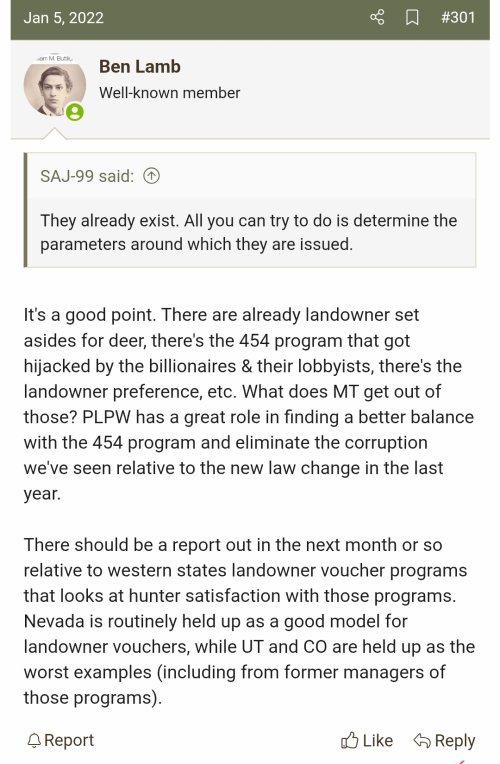
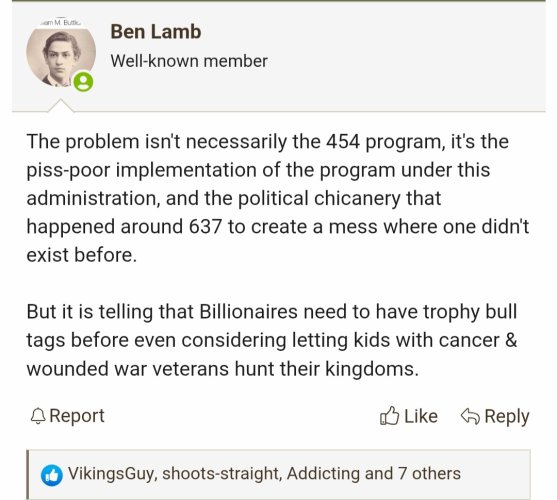
Screenshot_20251021_144836_Chrome.jpg
Thinking like this - validating and understanding the return - is good.

Handing something out and hoping for a return isnt useful.
 
Do you invest in the stock market, real estate? Every investment is carried on gossamer wings of a hope of a healthy return.
Theres a difference in hopeful penny stocks and responsible investments. Id hope if you manage a trust - you arent investing in risky propositions that have only a chance at a reward. While no investments certain - everyone can see the difference between buying the sp500 and investing in a shady startup.

Theres a great movie about someone ripping the public off with penny stock sales. Its a good one. Not too far from the story here in terms of ethics.
 
Theres a difference in hopeful penny stocks and responsible investments. Id hope if you manage a trust - you arent investing in risky propositions that have only a chance at a reward. While no investments certain - everyone can see the difference between buying the sp500 and investing in a shady startup.

The key is understanding what's shady startup and what's a venture worth losing your investment over. In the terms of LOP, it's a low investment for a very solid return.
 
The key is understanding what's shady startup and what's a venture worth losing your investment over. In the terms of LOP, it's a low investment for a very solid return.
Ive only heard about healthy returns. No such receipts.
They've allowed overland travel to the Durfee's for folks who help at the outfit (fencing, etc), they've steadily increased the number of people they run through the ranch each year to about 350-400 last year as I understand it. They bring on all kinds of people who might not have a chance at a large, mature animal due to exigent circumstances and their reputation around Lewistown is changing significantly.
I guess i just have to agree with your earlier perspective. It is telling.
 
Not to stray too far from the OP, but I like this thinking of things in terms of investment when it comes to access. In the name of talk about a great return on investment from a public/private partnership, I will as always bring up Block Management. For a bit over 30 million dollars a year, Montanans have access to nearly 7 million acres of hunting providing roughly from what I can recall, 600,000 hunter-days annually. That's about $50 a day per hunter - a hell of an exchange relative to what a day of hunting goes for on the private market. Of course it's not apples to apples in terms of quality relative to a hunting lease, but I am telling the truth when I say that right now from my home desk out the window I can see mule deer and about 15 elk grazing on one of my county's largest BM areas. The existence of which is also improving the hunting on public where those days aren't occurring, and is additionally giving access to significant acres of public otherwise inaccessible. A further aspect of this great exchange, is its funding. Nonresidents pay large amounts, to hunt here, and everyone regardless of residency benefits. It's an investment built upon an investment. All that to say it is complicated - the pieces are intertwined.

No, it doesn't work for all landowners, but it is the foundational cornerstone of public access to private lands in Montana, and we should continue to invest in it - more and better - and should take into consideration how other access programs/ideas might affect it.
 
we should continue to invest in it - more and better

I don’t think this would be all that difficult.

Montana sells out of NR big game tags with thousands of additional people in line on the alternate list for deer, elk and combo tags.

Why they don’t increase NR tag fees up to near the point at which they no longer sell out is beyond me. A fair bit of that increased money raised would go a long way towards increasing/improving the BMA program.
 
I'll leave subtle digs at my and Gerald's intentions alone.
That wasn't a subtle dig at your intentions, and if it was seen as such I sincerely apologize. I truly understand how deeply rooted the notion of us owing our gratitude to "the good stewards" is. I just don't feel the same, because at the end of the day they are just doing their jobs, or happen to be lucky/rich enough to afford land. I save my gratitude for our veterans.
So it's the entire landowner preference system you wish to eliminate?
If I had my druthers and to be ideologically consistent, yes. But the time to take a stand against it would have been long before me, so I have to concede that it has already existed, at least for residents, for a long time. And my own stance comes with the caveat that it does make sense if there is something being exchanged with the public that preserves the public's right to the wildlife. Mere ownership alone will never justify LP. I have said before that resident LP makes a little more sense though because these are people that do pay state taxes and are active participants in their communities. But if the deal was for a certain number of damage hunts, block mgmt, etc., I'd feel far better about the whole system. (all great questions you raised in the middle of this too, and worth thinking about hard)
Jake, you've spent the last 24 hours encouraging people to sue landowners over corner-crossing and now you're saying that they shouldn't get LOP. I can't imagine you to be so self-unaware that you don't understand how this comes across as anti-landowner.
If a landowner is illegally blocking public access to public land, they should absolutely be sued. If they aren't, then they shouldn't. It's not anti-landowner to say someone doing something that is illegal should face consequences. Being an advocate for the public and the public's rights does not inherently mean anti-landowner. If someone can't see the difference, that's on them, not me.

I'm just anti- further privileging people simply for already being privileged.
 
Ive only heard about healthy returns. No such receipts.


I guess i just have to agree with your earlier perspective. It is telling.
Well, maybe one day you will have enough wisdom and experience to understand the paths that some things take.

Like, you do understand there has been legislation to fix the 454 issue in '23 that all groups supported? That includes the large landowners, etc?

Ralph Waldo Emerson once said that a foolish consistency is the hobgoblin of a small mind.

Since that post, over 4 years ago, there's been a lot of learning. That post is exactly what I mean about being tired of the conflict. I've been where you are. It doesn't lead to much success. Since adopting different approach, I think there's been a pile of great work done in MT for wildlife. We saw that bear fruit when Wylie Galt carried the MTBHA bill in the Senate, when 932 passed, the elk package, 4 block mgt bills with zero opposition, 454 reforms, etc.

It's been an awesome 4 years.
 
I don’t think this would be all that difficult.

Montana sells out of NR big game tags with thousands of additional people in line on the alternate list for deer, elk and combo tags.

Why they don’t increase NR tag fees up to near the point at which they no longer sell out is beyond me. A fair bit of that increased money raised would go a long way towards increasing/improving the BMA program.

I've thought about this. Essentially, NR big game tags have not reached market equilibrium where cost aligns with demand. I think a few reasons would be:

1. Finding out if you've gotten to that point, or exceeded it, might mean missing out on money.
2. If I recall they recently raised fees on NRs, and whether they sell out or not might still be contingent on the national economy as a whole. I don't know if that is true anymore.
3. This one matters to me. I don't think we should be trying to max out how much we can skin from nonresidents. They already pay a ton more than we do, which is appropriate, but the cost of their tags has increased at a higher rate than resident ones over the last 40 years. Though I know it is expensive, I personally like the idea of some normal dude from Wisconsin who budgeted for the experience, being able to come out here with this family and hunt.

I’d like to think it’s a balance of things and not just pure economics. Ultimately, I think we would benefit fromMontana residents having a bit more financial skin in the game.
 

Latest posts

Forum statistics

Threads
117,761
Messages
2,167,662
Members
38,341
Latest member
SouthernGirl
Back
Top