I do enjoy the comment where they suggest with the amount of tags maybe avoid opening weekend. Solid advice might save a life.Yep I believe they only use 10 years as the long term average. The antelope one is wild to me. They aren’t in the areas I’ve been to this year that’s for sure



Navigation
Install the app
How to install the app on iOS
Follow along with the video below to see how to install our site as a web app on your home screen.
Note: This feature may not be available in some browsers.
More options

You are using an out of date browser. It may not display this or other websites correctly.
You should upgrade or use an alternative browser.
You should upgrade or use an alternative browser.
Montana Mule Deer Mismanagement
- Thread starter rogerthat
- Start date

antlerradar
Well-known member
I can agree with most of this. I think the buck I shot in 97 is a good example.This is why I don’t think cutting out rut hunting, now, by itself, is going to solve everything, because the ‘race to get him before someone else does’ (aided by technology and information sharing) is more prevalent today. This point also contradicts the idea of rut hunting allowing for so much selectivity. I thought the argument yesterday was that pre-rut hunting is by default, more random, and rut hunting is why there are fewer nice bucks than there should be.
Both things could happen to a varying degree, enough to make everything very nuanced and complex to solve, but neither is the direct cause of everything wrong with mule deer. Perhaps some of this was truer back then as opposed to today, and it’s collectively difficult to adapt to how fast things are changing, now, too.
First found this buck in the fall of 95. He was a sold 170 buck with kickers. At the time he was living on some difficult terrain for Eastern Mt public land that overlooked some hay meadow. He was following standard practice for an older eastern Montana buck in early October. Spend nearly all of the daylight hours in a nasty hole and travel down to the meadows after dark. Of course when the rut started he was down on the meadows well after daylight, but luck was on his side as the ranch then was in between outfitters and didn't receive much hunting pressure that fall. I found him again five miles back into public that winter, so I knew he made the season. The next year I only saw him one time. It was just before dark and he was starting down out of the hills for the meadows. He was a dandy, solid 180 with large hooking kickers and some small inlines. I figured the new outfitter would have him for sure, but again luck was on his side, or I should say mother nature was. That was the winter of 96/97. We got 15 inches of snow opening day and for the most part it stuck around. By the November arrived most of the does had pulled off the meadow back up into the public winter range. The snow also made accessing that public difficult at best and most of the people that would have been hunting there simply could not get there. In 97 I decided to go after him and started scouting him in July. I found him fairly quickly. He was miles back on the public with three, sometimes four other nice 150 to 160 class bucks. He wasn't as big, as old man winter had taken its toll, but he was still a fine example of a mule deer. I saw him 10 to 15 times that summer and by the end of September I had him fairly well figured out. Sometimes he would head to the meadow as dark approached and sometimes I think he just stayed in the hills. Could be he only went down when he was in need of water as water of the public was in short supply. As hunting season approach, he parted ways with the other bucks and got real hard to find, but even so I was feeling fairly confident on opening day. I was over optimist on my chances. I hunting him every chance I could. Think I spent five days in the first two weeks of the season. Not sure I saw a dozen deer during those five days on the public. There was at least two days were I saw zero deer. If I looked down on the private, I could see dozens, maybe even hundreds of does and small bucks, but I knew he was not down there. On the Saturday of the second week I was once again making the hour and a half walk into look for the buck. It was just getting light and I spotted one of the other nice bucks down just on the edge of the public checking out a couple of the does By mid day those were the only deer I had seen I decided to start sill hunting. I was working my way along a bench when he stood up 200 yards below me. It was all over but the pack out.
I have often told people that the key to killing a big buck is scout hard and hunt him hard the first part of the season. If you do this you can be selective, but there is a catch. You need to spend countless hours of scouting time, It is best if you know the place you are hunting better than the back of your hand and even with all that advanced preparation you had better be prepared for a lot of slow days in the field. Most of the orange army simply does not have the time or discipline to be selective during Oct. The rut is the great equalizer. During the rut when bucks are with the does and much easier to find, even the most ill prepared in the orange army can afford to be selective with out much fear of eating their tag.
This hunt also illustrates the access reason we need to change the season. By the end of Nov the outfitter that leased the near by hay meadows had taken all of the other nice bucks down on the private. When those bucks were back on the public during Oct, the outfitter had zero shot at them. For starters, most of his clients were not physically capable of effectively hunting on the public. Second, it is likely that even the clients that could physically hunt the public, did not have the mental toughness to go for days with out seeing more than a handful of deer. Last but not least, the outfitter did not have the hunting lease on that public. Even if he did see a buck on the public he could not hunt him. (wouldn't have stopped that outfitter). By holding the season during Nov, we as the public transferred thousands of dollars in value from the public to the outfitter and landowner. We are not using economics to our advantage.
Last edited:
Eric Albus
Well-known member
- Joined
- May 24, 2012
- Messages
- 1,871
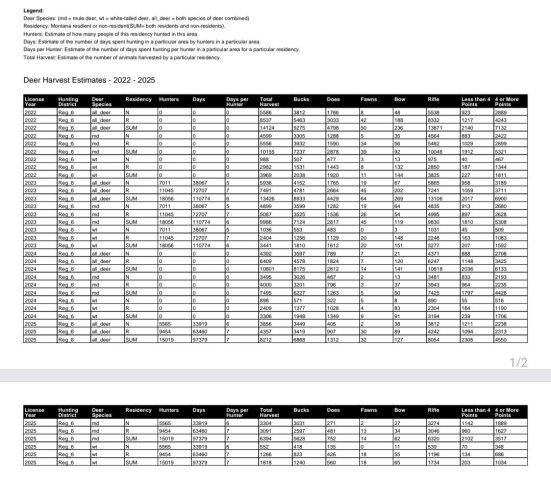
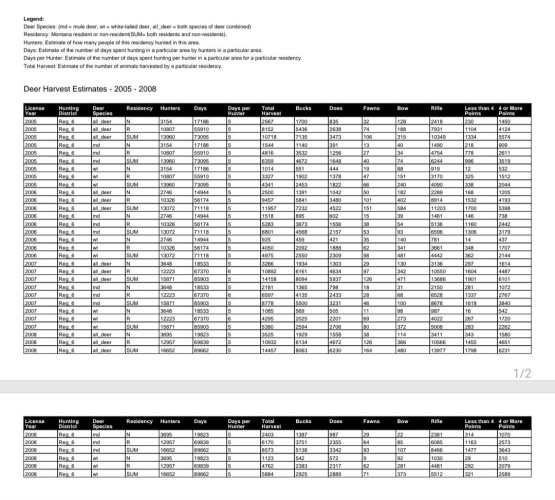
I’d like to see mandatory harvest report, so we know who’s killing what and where. Not some phone survey 80% of those surveyed don’t answer honestly.NR harvest 3.4 x as many bucks in r6 in 2025 compared to 2006.
Season structure wont address that.
Would have to be tag qtys limited.

I’m all for mandatory harvest reporting. Been saying it is the only way to get appropriate data for a while. I’m just unfamiliar with how best to enact that change.
Ballot initiative? Wildlife commission? Send a bottle of wine and a card to GG?
Ballot initiative? Wildlife commission? Send a bottle of wine and a card to GG?

Forkyfinder
Well-known member
- Joined
- Dec 13, 2023
- Messages
- 6,123
Resident buck harvest used to run ~3x non-resident harvest (2005–08), but by 2022–25 it's nearly 1:1, nr harvest exceeding r in 2025. Non-resident buck harvest roughly tripled over the ~17-year gap while resident harvest stayed flat. NR Hunter days in the region have doubled across the data set, which i understood to be a key metric in the new proposals.I’d like to see mandatory harvest report, so we know who’s killing what and where. Not some phone survey 80% of those surveyed don’t answer honestly.
I can agree that the phone surveys probably dont have the precision that a mandatory harvest report would. I dont agree that these trends can be simply discredited, especially over comparing two 4 year periods, because we dont like that its a phone survey.
It sure demonstrates a lack of proper prioritization of R, a lack of action by the commission, and complete disregard from the legislature who seem to invent more NR tags every session.
Edit: to be clear, im talking about mule deer buck harvest which is what the thread is seemingly about. Using "totals" that include wt is a strange, misleading, way of concealing the truth that NR are putting more and more outsized pressure on mule deer.
corndog1
Well-known member
No judgement here but I see pick ups full of fork horn mule deer out east while I'm waterfowl hunting. I very rarely see anything bigger. Im guessing there isn't much else to "select" after decades of over harvest.
Forkyfinder
Well-known member
- Joined
- Dec 13, 2023
- Messages
- 6,123
You might get a hold of the crew that fixed state land swaps in a dark backroom over liquor.Send a bottle of wine and a card to GG?
Seems like a lot can be accomplished that way.

It sure demonstrates a lack of proper prioritization of R
I would challenge that a bit. Due to the huge $ the state is charging NRs, and the money they bring to the state via hospitality spending on their trips, more NRs are economically better for residents as a whole.
Yes, I’m being a bet pedantic- however, it’s important to remember that only a small minority of Montana residents actually hunt.
Wildlife is held in trust for all residents of the state, not just a small minority who hunt.
Forkyfinder
Well-known member
- Joined
- Dec 13, 2023
- Messages
- 6,123
This is a popular myth passed around here and elsewhere. Especially by moga - who uses inflated numbers that include NR guided fishing. Do you have any numbers to support that? Or just economic myths paraded around by those who benefit.I would challenge that a bit. Due to the huge $ the state is charging NRs, and the money they bring to the state via hospitality spending on their trips, more NRs are economically better for residents as a whole
It doesnt really stack up to the reality though. Most of the NR head to costco, or other big box store in bigger place, stock up and move.
Their spending at such places isnt noticed. Theres a lot of reasons to vacation here. A very small sect of that spending represents hunting. An even smaller represents NR hunting.
SAJ-99
Well-known member
I have my credit card statements. Does that count?Do you have any numbers to support that?
An even smaller represents NR hunting.
How much smaller? What kind of numbers are you seeing? My data is from 2016, I would be interested to see some more recent figures.
Forkyfinder
Well-known member
- Joined
- Dec 13, 2023
- Messages
- 6,123
What kind of figures do you have?How much smaller? What kind of numbers are you seeing? My data is from 2016, I would be interested to see some more recent figures.
The ones moga polished up to sell to the clownshow in helena? Or?
About $170M in 2016, roughly equates to $240M in 2026 just based on inflation adjustment and nothing else changing (which is flawed for obvious reasons).
What does your data show @Forkyfinder?
What does your data show @Forkyfinder?
Last edited:
Forkyfinder
Well-known member
- Joined
- Dec 13, 2023
- Messages
- 6,123
De have my credit card statements. Does that count?
You to suppose the businesses are reeling in WY over losing 10k NR? Or is it business as usual? Or did they likely not notice a miniscule amount contributed thats grossly overstated?About $170M in 2016, roughly equates to $240M in 2026 just based on inflation adjustment and nothing else changing (which is flawed for obvious reasons).
If all of that line of shit was true youd see real business owners lobbying for more NR hunters. Never heard of it.
Let’s stay here for just a bit @Forkyfinder - do you have any data that shows different figures than what I posted a bit earlier?
If that data is in the ballpark, it’s fairly clear that hunters bring hundreds of millions of dollars of outside money into Montana.
Pillar 1 recognizes that this financial impact strongly supports growing Montana businesses and jobs, while the substantially higher license fees paid by nonresidents help fund wildlife management, enforcement, habitat and public hunting access that Montana residents also use.
If the data is way off, I would certainly appreciate the opportunity to learn more.
If that data is in the ballpark, it’s fairly clear that hunters bring hundreds of millions of dollars of outside money into Montana.
Pillar 1 recognizes that this financial impact strongly supports growing Montana businesses and jobs, while the substantially higher license fees paid by nonresidents help fund wildlife management, enforcement, habitat and public hunting access that Montana residents also use.
If the data is way off, I would certainly appreciate the opportunity to learn more.
Last edited:

Gerald Martin
Well-known member
- Joined
- Jul 3, 2009
- Messages
- 9,686
I would challenge that a bit. Due to the huge $ the state is charging NRs, and the money they bring to the state via hospitality spending on their trips, more NRs are economically better for residents as a whole.
Yes, I’m being a bet pedantic- however, it’s important to remember that only a small minority of Montana residents actually hunt.
Wildlife is held in trust for all residents of the state, not just a small minority who hunt.
Which is why putting an outsize dependence on NR to fund a majority of FWP’s budget is a flawed funding model. I think that all residents should have stake in paying for the management of their wildlife resources is the logical solution. Whether a resident hunts or not, his wildlife resources are a valuable asset to being a MT resident.
Whether a resident hunts or not, his wildlife resources are a valuable asset to being a MT resident.
True, but that asset yields far better returns when exploited by nonresidents vs when exploited by residents.
For the vast majority of Montana residents who do not hunt, that is a better scenario.
Whether Montana’s current funding model is flawed or not is almost entirely based upon perspective.
Similar threads


- Replies
- 12
- Views
- 809

- Replies
- 602
- Views
- 40K