This, and most all of our policy decisions that revolve around how we maintain/increase our standards of living via human comforts provided at the lowest price possible, was long ago summarized by Aldo Leopold. I think of his below line every time I see these debates about providing resources needed for the immense quality of life Americans enjoy.
“We face the question whether a still higher 'standard of living' is worth its cost in things natural, wild, and free." - A Sand County Almanac
We decide collectively what we are willing to do when it comes to paying for the resources that provide this high standard of living; do we 1) pay in the form of slightly higher financial costs from our own pocketbooks or 2) pay by having significantly lower wildlife/habitat.
There never is a "no cost" alternative. Somebody or some wild thing(s) pay. We can choose to pay more to provide this extremely high standard of living through higher costs needed to accommodate wild things and places. The marginal costs, relative to the value of the output provided, are relatively low to do it in a way that accommodates wild things/places, often adding jobs rather than costing jobs. But, will we do that?
The debates should be about how much are we willing to pay from our own pockets to do it in ways that make accommodation for wildlife. We need energy from all sources. I have no problem with coal, oil, gas, hydro, solar, wind, nuclear, or any of them. I need energy and they all have a place in that energy equation. They can all be done in ways that accommodate wildlife at pretty low marginal costs.
Yet, we let the debate be driven by the far fringes who promote a hypocritic fantasy of no energy development and those who want to pay all costs with the currency of wildlife and wild places. It doesn't have to be that way. Unless, we let it be that way.
Leopold's essays are still relevant after 80 years, for a reason. He was pragmatic, he understood our economic system and its many upsides doesn't give much voice to wildlife and habitat, and he understood our history of being willing to liquidate wild resources for the benefit of higher revenue/lower costs.
When it comes to any of these decisions, I view it as a decisions as to what are we willing to pay in the form of very small increases in the price of energy, food, housing, etc. Or to avoid those costs coming from our own pocketbook, what are we willing to pay with the currency of wildlife and habitat?
And when it comes down to this solar/wind v. fossil fuels, both sides are willing to pay the true costs of energy with the currency of our wildlife. The current administration and its willingness to pay for solar and wind with the wildlife and its habitat isn't any different than prior administrations that were willing to pay for fossil fuel energy with lower standards for wildlife. Both sides have planted their partisan flags in one camp or the other. And both sides are unwilling to have the true costs of energy paid by the users of that energy, us, rather letting it be paid with our wildlife/habitat; a decision that deprives future generations of Americans who will never see that habitat or wildlife we are willing to convert to industrial energy zones.
Paying with the currency of wildlife and habitat is generational selfishness and generational subsidy. I say selfish, as this form of wildlife currency allows our current generation to spend our children's wildlife inheritance to avoid paying the true costs for the services we demand today, a subsidy to all of us.




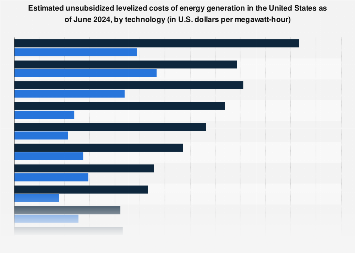
 www.statista.com