


Machinist help!

Addicting

Well-known member
Joined
Jan 19, 2017
Messages
9,250
Location
SW Michigan
I’m restoring a Remington model 24. It was my Grandfather’s and has been passed down generation to generation.

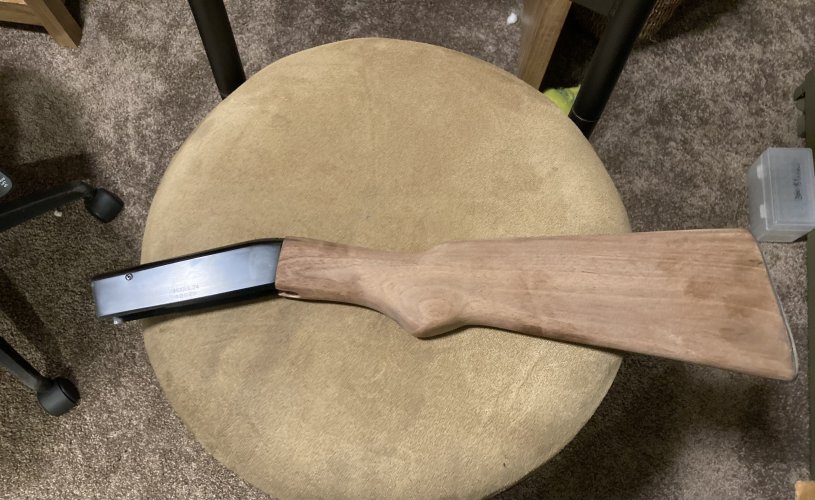
It needed a new stock and tlc after close to 100 years of use. I’m fitting the new walnut to the action and need to dry fit everything. I had to order a new magazine tube which is identical to the old one. The original was worn out and broke upon removal.

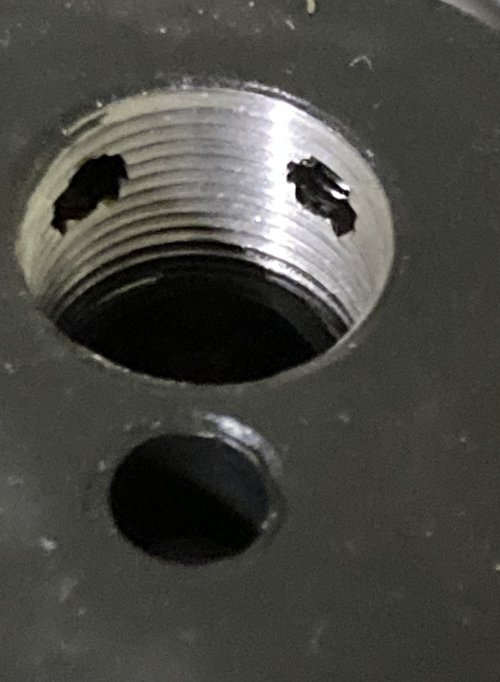
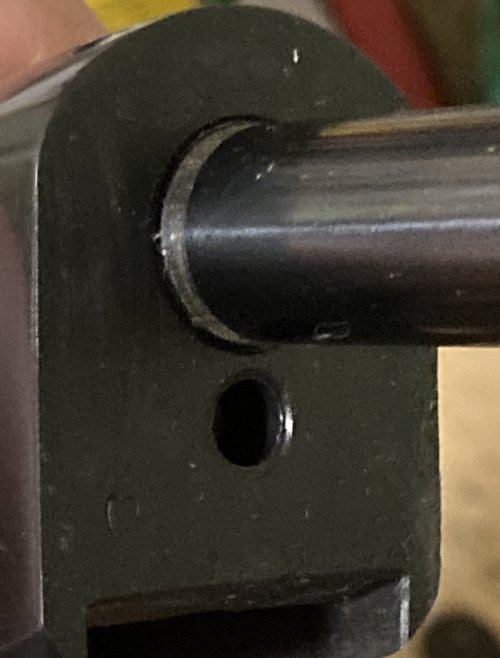
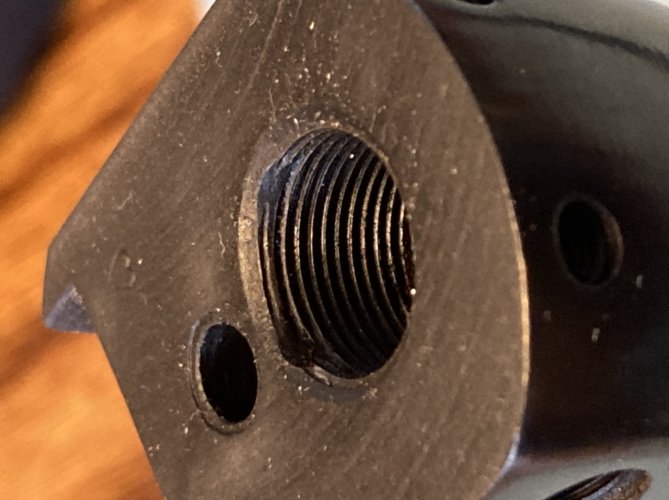
The receiver threads need to be chased as they have two bad spots in the threads. It just wants to cross thread.

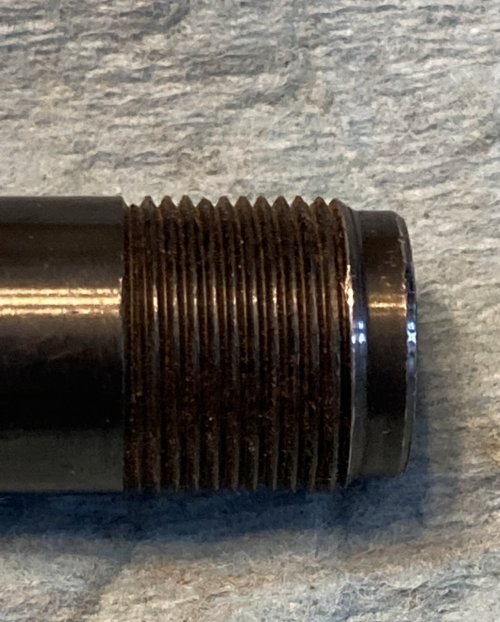
The OD of the mag tube thread is .490 and it is 32 threads per inch. I cannot find anything that matches. There is a 1/2 32 available. What do I do? @p_ham
 

Attachments
  • DE74B416-691D-4651-975F-88C331428435.jpeg
    DE74B416-691D-4651-975F-88C331428435.jpeg
    270.7 KB · Views: 18
  • AFF360DE-9EF8-41E0-B696-1B9314157985.jpeg
    AFF360DE-9EF8-41E0-B696-1B9314157985.jpeg
    329.7 KB · Views: 18
Last edited:
If the minor diameter on the internal is .45-.46 it's 1/2-32 and there are taps available.
Get either a taper or plug style, bottoming will be too hard to start. The damage on the mag tube threads can be fixed with a triangle file.
 
Last edited:
Very cool project. Should be no problem to chase those threads.
I’m 70% there. It got completely disassembled and went out to precision bluing. Came back looking like new. I have the stock mostly sanded to shape. I had to order a 80% blank. So there was considerable sanding. It’s definitely been a labor of love.

The old stock got cut up and turned into a walnut pen set. At the pace I’m working on it I should be done in 5-10 years. Lol.
 
Another way to skin that cat would be to remove the damaged threads altogether. Mag tube should be easy to clean up with some patience, but internal threads are tough to repair without the right chaser or tap.
 
I would take an end mill and remove the damaged part of the threads. Chasing threads could go badly and make things much much worse.
 
I would take an end mill and remove the damaged part of the threads. Chasing threads could go badly and make things much much worse.
Don’t have that available. I would need to send it off to have it done.
Chamfer the first thread out of the action and run a 1/2-32 thru it.
You'll also need the right tap, don't just buy one off the rack at Ace, check the pitch dia.
That I may be able to do. Here is the tap I ordered.

 
That's a +.001 pitch. Might be a tad loose when you screw it all together but will probably work. The btm tap is only gonna give you 1-1/2 thread lead, be careful when you start it.
 
Chamfer the first thread out of the action and run a 1/2-32 thru it.
You'll also need the right tap, don't just buy one off the rack at Ace, check the pitch dia. Your tenon is undersize at .490.

Looking at the thread crests, they're pretty flat, which was pretty common for mass produced threads. The pitch diameter could be spot on but unless measuring across wires then who knows.

I do agree that's not the best tap for the job though.
Look for a taper or plug tap that's 1/2-32H1.
 
To be honest I am struggling to understand all this talk about pitch. To me a tap is a tap, I ordered that one as it is a bottom out and this hole the threads go all the way to the bottom.
 
To be honest I am struggling to understand all this talk about pitch. To me a tap is a tap, I ordered that one as it is a bottom out and this hole the threads go all the way to the bottom.
A bottom tap is meant to thread up against the bottom of a hole. It only has 1-2 tapered threads to help with starting.
Taper taps have a long leade for easier starting and less cutting pressure.
Plug taps are between the two.
Pitch diameter is the diameter at halfway up the thread flanks. It's what controls the fit of the threads. Don't worry about it too much in this application, just don't go any larger than H3 on the tap size.
 
A bottom tap is meant to thread up against the bottom of a hole. It only has 1-2 tapered threads to help with starting.
Taper taps have a long leade for easier starting and less cutting pressure.
Plug taps are between the two.
Pitch diameter is the diameter at halfway up the thread flanks. It's what controls the fit of the threads. Don't worry about it too much in this application, just don't go any larger than H3 on the tap size.
I found a plug one and ordered it. It doesn’t have any details on H1 or H anything. Since they both are Amazon I can just return the one I don’t use. Thanks
 

Latest posts

Forum statistics

Threads
117,832
Messages
2,170,745
Members
38,365
Latest member
byoungs
Back
Top