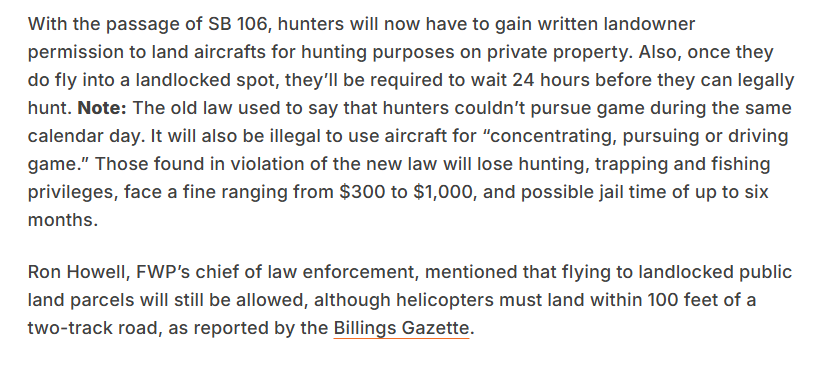
Yes, you can still fly in to public land to hunt so long as you follow the BLM laws for landing, and the law for spotting/hunting game ahead 24 hours before you hunt. The USFS isn't as open with landings for a variety of reasons, and they prefer the backcountry airstrip approach. It means you'll have a day to set up camp and get situated before you can release an arrow or pull a trigger.
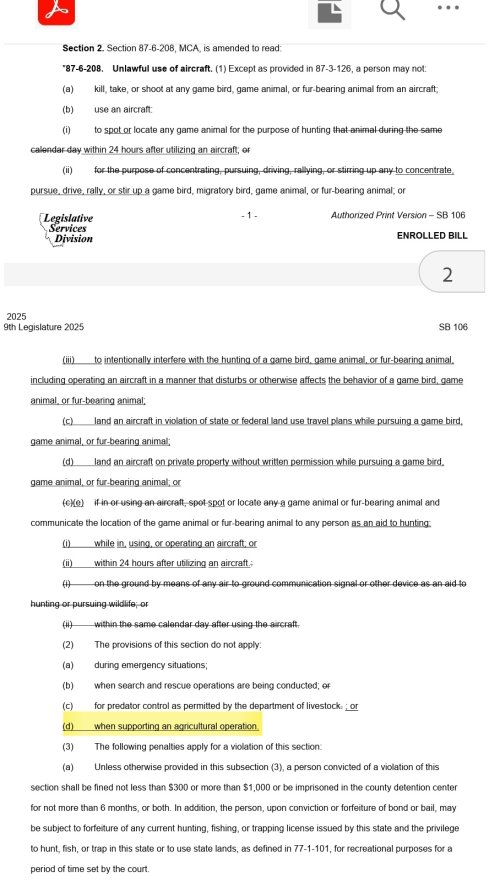
Here is the language of 106 as it was signed by the Governor:
https://bills.legmt.gov/#/laws/bill/2/LC0309?open_tab=bill
A couple of key things from my reading (Didn't work the bill, just followed along):
The bill broadens the definitions of aircraft to include all manned and unmanned (drones). I think this is a reasonable accommodation based on advancements in drone technology and how ranches are using them today (all use has to be permitted with the understanding that no permit shall be issued for the timeframe of the general or regular hunting seasons). I think that also helps when you get to section 2 of the bill and see that now spotting of game is illegal from aircraft, which drones are now defined as.
Section 2, sub 2 redefines a lot of things, but it adds a lot as well to deal with the issues of "aiding hunters" (drones & helos circling, etc), and it gets to the heart of what
@sclancy27 was talking about
Senate Bill 106 was brought at the request of the
Devil's Kitchen Working Group.
HB 202 was brought at the request of the MT Wild Sheep Foundation. Both were good faith efforts to get something fixed that was causing significant problems. HB 202 sailed through the House but ran in to a lot of resistance in the senate from pilots, hunters and ranchers who were concerned about the language and how it results in them potentially being illegal because they were working cows, and calling locations to the ground for folks to round them up. One of the folks that was deeply involved in drafting amendments is a former deputy chief game warden, and one of the finest conservationists the state has seen (He helped create the Block Management and Habitat MT, as well as many, many other things).
The groups got together and worked out their issues and part of that included some issues that ranchers had brought. It was enough of an issue that the wildlife groups worked on the amendments with the folks opposed. Ultimately, both bills passed and 202 was vetoed. The override failed. Overall, it's not a bad bill and was certainly a step in the right direction relative to dealing with the growth of use of drones and flying overall.






 . You might call the county prosecutor, or sheriff, and ask to get a feel for the risk youre taking.
 hmmm
hmmm
 If you find said transporter p!ease document that insertion by video. It would most definitely begin a new trend with the YT crowd.


 Mysteriously their ranch hands on horseback and in vehicles seem to spend a LARGE amount of time on the perimeter of the ranches that border public, especially once the elk have gotten onto the ranch.