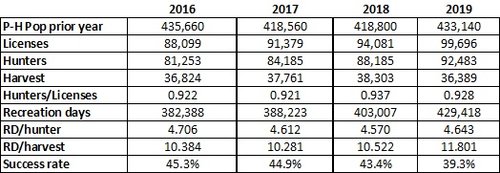
Less opportunity.... what exactly does that mean? Does that mean you have less opportunity to go on a hunt, or less opportunity to kill a buck? Those two will always have an inverse relationship.
Will Colorado have to sell less tags... kinda seems to me that CPW has proven that a viable way to lower success rates is to throw a pile of hunters in the field at once. They will step on each others toes and allow all the animals to escape. Joking... or am I

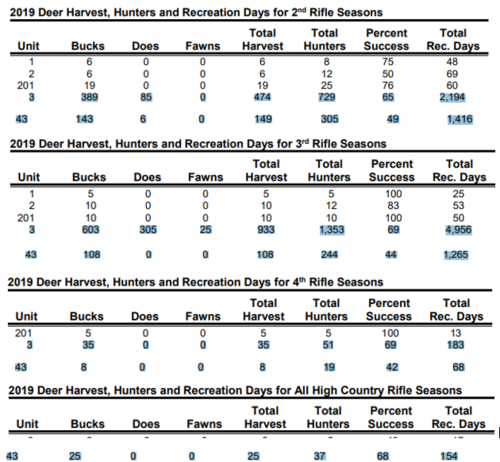
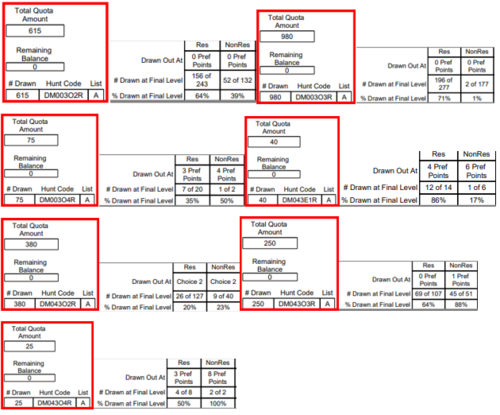
Here are the stats for 2 different units in CO 3 and 43. 3 is up by Craig and mostly sagebrush, 43 is near Aspen- High Alpine-Timber- Sage Flats.
Note 43 has a early season hunt.
Typical thinking is that deer start the season up high in August- Sept, they are visible in the high alpine therefore big bucks are vulnerable to hunters. During 2nd season the deer move into the timber and are hard to find and kill, during 3rd season they start to emerge onto the flats and stage for the rut, and by 4th season the rut is starting and big bucks are again vulnerable. This thinking matches up with 43 draw points almost exactly.
Now we don't have mandatory harvest reporting with size reporting so it's impossible to know if these are "meat bucks" or "trophy bucks", but I find it interesting that managers in 3 give out 30% more tags in 3rd season than in second season. I also find it interesting that in 43 more hunters have a higher success rate in 2nd season than they do in 3rd season or 4th season.
My point is there is conventional wisdom, then there is the data we have available. I'm not sure the data supports conventional wisdom. I'm not saying it doesn't, and it's definitely incomplete.... but I don't feel like I have enough information to draw the conclusion that moving the seasons back a week will mean less deer tags (in aggregate) are issued. These season dates get compared to MT a lot, but there are a ton of other differences between CO and MT seasons besides the dates and I don't think it's a fair to say CO will become Mt.
View attachment 134063
View attachment 134069