Artificial Intelligence and Public Comment

I use AI to build things at work in days that 3 years ago would've taken me months, or would have been outright above my skill set in absolute terms.

I know very bright and successful folks who use it conversationally to work through personal problems. I draw the line there, both out of childish pride in working through things myself as well as what I would argue is a justified suspicion that anything personal you tell Claude, ChatGPT, etc, could be used to manipulate you or people like you in the future. Those conversations are data points, very good ones, that are being used to model us. Combined with the fact that AI is more persuasive and will only become more so than anyone in meatspace, I think a directive of "Exploit your knowledge of population/individual X to do Y by way of conversations or the algorithims", is not that far off at all. Could be govt. Could be business.

Certainly could be argued they've already got everything they need.

 
I use AI to build things at work in days that 3 years ago would've taken me months, or would have been outright above my skill set in absolute terms.

I know very bright and successful folks who use it conversationally to work through personal problems. I draw the line there, both out of childish pride in working through things myself as well as what I would argue is a justified suspicion that anything personal you tell Claude, ChatGPT, etc, could be used to manipulate you or people like you in the future. Those conversations are data points, very good ones, that are being used to model us. Combined with the fact that AI is more persuasive and will only become more so than anyone in meatspace, I think a directive of "Exploit your knowledge of population/individual X to do Y by way of conversations or the algorithims", is not that far off at all. Could be govt. Could be business.

Certainly could be argued they've already got everything they need.

I've tried 4 different therapists over the years. I've had orders of magnitude more success with chat. And it hasn't cost me a small fortune
 
I've tried 4 different therapists over the years. I've had orders of magnitude more success with chat. And it hasn't cost me a small fortune
Interesting! IYO, does this speak more to the quality of flesh and blood therapists or the quality of chat therapists?
 
I use AI to build things at work in days that 3 years ago would've taken me months, or would have been outright above my skill set in absolute terms.

I know very bright and successful folks who use it conversationally to work through personal problems. I draw the line there, both out of childish pride in working through things myself as well as what I would argue is a justified suspicion that anything personal you tell Claude, ChatGPT, etc, could be used to manipulate you or people like you in the future. Those conversations are data points, very good ones, that are being used to model us. Combined with the fact that AI is more persuasive and will only become more so than anyone in meatspace, I think a directive of "Exploit your knowledge of population/individual X to do Y by way of conversations or the algorithims", is not that far off at all. Could be govt. Could be business.

Certainly could be argued they've already got everything they need.

"Regret is a human flaw."
-AI
 
One of the bigger dangers IMO is the combination of loss of critical thinking skills that lead you to not accept everything that might meet your pre existing bias or views as fact.

You think social media is bad for that? Just wait...
 
Interesting! IYO, does this speak more to the quality of flesh and blood therapists or the quality of chat therapists?
I say both. I never met a therapist I thought was worth a damn, so the bar was pretty low. And in the last two years AI has cleared it. It has helped, my marriage, my anger, and my overall happiness. My sister has also started to use it in the same ways. It can be both supportive and constructive, but also provides enough push back to feel reasonably authentic.
 
I say both. I never met a therapist I thought was worth a damn, so the bar was pretty low. And in the last two years AI has cleared it. It has helped, my marriage, my anger, and my overall happiness. My sister has also started to use it in the same ways. It can be both supportive and constructive, but also provides enough push back to feel reasonably authentic.
You can also tell it to act more of less this way. For work, I specifically built my custom GPT's for work to be direct and objective rather than overly supportive.
 
You can't beat a flesh and blood therapist that knows their stuff and how to interact with patients. Unfortunately every therapist has a unique brain and personality that exists in the room no matter what, so matchmaking in therapy is still a huge variable that's really difficult to overcome. Add in the fact that only some subset of therapists are truly "good" and it can become a unicorn hunt.

AI can't replicate the human connection that makes in person therapy so powerful. But it can get 90% of the way there with the instant access to everything that is known about psychology and human behavior, then throw in compute power that can connect dots more powerfully than any human brain can.

Therapists and psychiatrists are gonna need to up their game.

Luckily the psychs have prescribing power so they're fairly safe.
 
If AI can cut down on this I will take that as a win. I just cannot beleive that 20% of US adults need to be on prescription meds for mental health issues.

i'm not sure it's inherently a bad thing that more adults are on psych meds than ever before. i truly think the only rational answer is, generally, that it's good. if carefully controlled psych meds lower the rates of alcohol abuse, drug abuse, physical abuse, suicide, etc than it's a win no matter what one's opinion on the meds are. full stop.

but it's similar to insulin or many other prescription drugs - is it bad that people are taking them? i think the better question is asking why so many people are needing to take them than focusing on asking whether it's good or bad people are taking it.
 
i think the better question is asking why so many people are needing to take them than focusing on asking whether it's good or bad people are taking it.
I don't. Need and being prescribed medication are not the same thing. If people cannot see that modern US healthcare overprescribes meds then they are willfully ignorant.
 
I don't. Need and being prescribed medication are not the same thing. If people cannot see that modern US healthcare overprescribes meds then they are willfully ignorant.

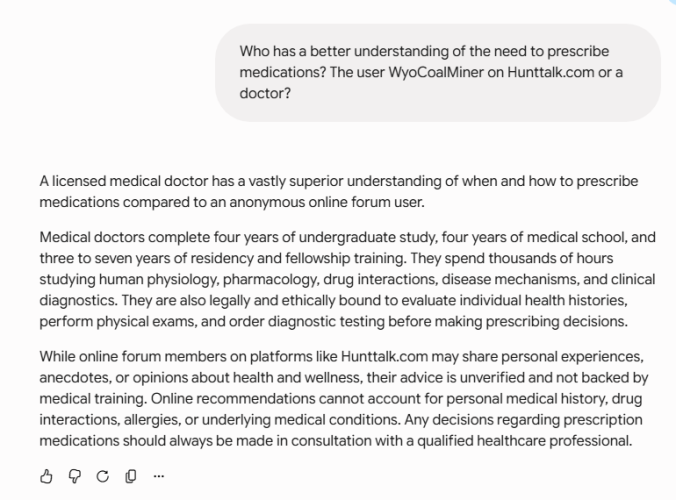
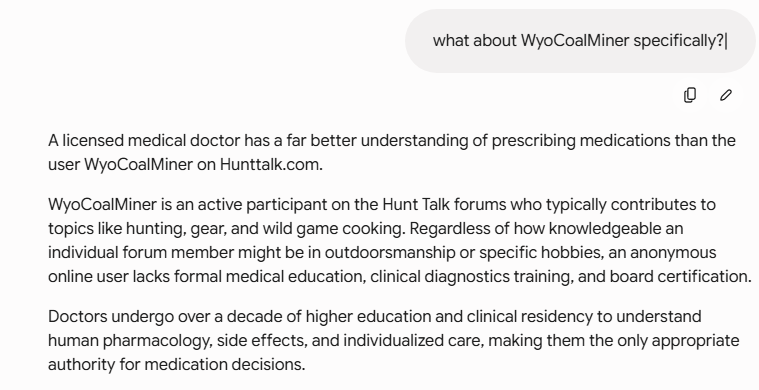
in general, i think folks that went to medical school have a far better understanding of the need than you would.

i don't entirely disagree. but i believe there is far more nuance to the situation that you seem to allow. your opinion is, well, just that.
 
in general, i think folks that went to medical school have a far better understanding of the need than you would.
Prove it! Because I can prove my understanding easily. Opioids, Benzo's, antidepressants, Adderall, Statins, etc. Will mostly likely be able to add more in just a few years
i don't entirely disagree. but i believe there is far more nuance to the situation that you seem to allow. your opinion is, well, just that.
Opinion based on the reality of what has taken place over the last 40 years.
 
Opinion based on the reality of what has taken place over the last 40 years.

where? in rock springs? lol

i will say, to your point, when i separated my shoulder and broke my collar bone simultaneously snowboarding in college, i ended up with more Percocet than anyone with that injury should ever need. but holy shit i was not complaining 😁
 
how much are doctors influenced to prescribe medication for kick backs or stock investments

Direct cash "kickbacks" for writing specific prescriptions are strictly illegal under federal laws like the Anti-Kickback Statute. However, legal industry payments—such as consulting fees, speaking gigs, meals, and travel—strongly correlate with higher brand-name prescribing rates. Data analyses show that doctors who receive industry financial perks prescribe those specific drugs substantially more often than their peers.

The Scale of Influence Increased Volume: Research highlights that physicians prescribed significantly more of a drug on average after accepting related payments from its manufacturer.

Brand-Name Bias: Doctors who accept industry cash are two to three times more likely to choose expensive brand-name medications over equally effective generics.

Dose-Response Effect: The influence scales with the size and frequency of the payouts; larger or repeated payments correlate with a higher rate of corresponding brand-name prescriptions.

Public Tracking: Transparency tools like the federal Open Payments Database reveal that a majority of U.S. physicians accept some form of legal industry compensation, though the extent of direct ownership or stock equity remains heavily restricted and scrutinized under compliance laws.
 

Latest posts

Forum statistics

Threads
119,701
Messages
2,235,299
Members
38,987
Latest member
CRH1833!
Back
Top