
Navigation
Install the app
How to install the app on iOS
Follow along with the video below to see how to install our site as a web app on your home screen.
Note: This feature may not be available in some browsers.
More options

You are using an out of date browser. It may not display this or other websites correctly.
You should upgrade or use an alternative browser.
You should upgrade or use an alternative browser.
A Dream Becomes Reality
- Thread starter Big Fin
- Start date


LuketheDog
Well-known member
Man, talk about a cliffhanger! I'm tired Randy, going to bed, I'll have to find out about the moose tomorrow...Congrats on the awesome caribou!

As I rolled over the crown of this ridge, James was 75 yards out in front, downhill and moving fast across the alder slope that dropped away from us. I instantly noticed the group of horses down below where this ridge petered out. It was where Jim had killed his bull the day before. James was headed that way, stopping and glassing, then dodging around more alders before stopping and glassing again.
Marcus and I caught up to James as he was trying to clear some alders for a possible shooting situation. Across this drainage, uphill on the slope south of these tied off horses was a bull moose looking down at the horses. James gave me a range; 440 yards.
This sucked. Crosswind. Bull partly obscured by a spruce tree. I just ran 500 yards. Sitting sidehill on a steep slope. Barely able to clear the alders in front. No chance for a follow up shot.
Seeing the horses tied up below, I asked James where the Braden and the crew were at. He said Braden was upslope from the horses, on the north slope of this drainage. Back to focusing on this shot.
Within a minute, the bull stepped back into the spruce, going further west and downhill, taking him closer to the horses. James took off again, assuming, correctly, that Marcus and I would be on his heels. Down and further west, paralleling the bull that James assumed was out of sight behind a small roll to the south side of the creek. The lower we dropped the taller and thicker the alders got.
James stopped and glassed. I noticed the bull coming over the ridge, making another inspection of the horses. Marcus relayed that he was on the bull. James gave me a reading of 350 yards. This was even just as bad as the last set up maybe worse, given I could not sit and had to stand on this sidehill slope and set the shooting sticks high enough to clear these head-high alders.
The bull was circling above the horses, looking down. The had to be wondering what the hell that carcass and meat bags were. James was calling, trying to keep him interested and curious.
I was trying to get set for a shot. The bull was quartering towards us. At the bottom of my first breath, the crosshairs were drifting from a foot left of the moose to a foot behind him. I told James that I needed to get my breathing under control. He told me not to shoot unless I knew I could make the shot.
I drew in another deep breath and followed the crosshairs in the reticle as I slowly exhaled, measuring how steady I could be at the bottom of my breathing cycle. Much better, yet still a tough position with no way to steady the back end of the rifle.
I repeated another deep breath and exhale. Even better. I asked Marcus if he was still ready. He affirmed. James again cautioned to only take a shot I was sure of.
Deep breath number four had me placing pressure on the trigger as I started to exhale. Not much wobble or movement. As the last bits of air left my lungs, the crosshairs were steady and the trigger released to the 2.5 pound setting.
I heard a crack as the recoil from this precarious position took me off the target far more than normal. I worked another round, by which time the bull had turned and was in full retreat, dropping into a small swale as he ran straight away, showing only his antlers above the alders. He then emerged up a slight slope, now slightly quarter, though mostly straight away. The crosshairs were on his right ear as I suspected he was over 450 yards now. At the shot, James said I hit him, seeing his rear leg nearly buckle.
Another round was in the chamber. Again, the bull was down in a low spot, allowing no shot, revealing only antlers and alders. Thoughts of chasing a wounded bull flashed through my mind. I needed to get this bull on the ground. The first shot felt good, but I made no assumptions. The bull again started up a small slope of thick alders. I had no idea of the range by this time, but decided to hold well high and say a prayer. At the shot, the bull disappeared into a huge alder thicket.
Marcus and I caught up to James as he was trying to clear some alders for a possible shooting situation. Across this drainage, uphill on the slope south of these tied off horses was a bull moose looking down at the horses. James gave me a range; 440 yards.
This sucked. Crosswind. Bull partly obscured by a spruce tree. I just ran 500 yards. Sitting sidehill on a steep slope. Barely able to clear the alders in front. No chance for a follow up shot.
Seeing the horses tied up below, I asked James where the Braden and the crew were at. He said Braden was upslope from the horses, on the north slope of this drainage. Back to focusing on this shot.
Within a minute, the bull stepped back into the spruce, going further west and downhill, taking him closer to the horses. James took off again, assuming, correctly, that Marcus and I would be on his heels. Down and further west, paralleling the bull that James assumed was out of sight behind a small roll to the south side of the creek. The lower we dropped the taller and thicker the alders got.
James stopped and glassed. I noticed the bull coming over the ridge, making another inspection of the horses. Marcus relayed that he was on the bull. James gave me a reading of 350 yards. This was even just as bad as the last set up maybe worse, given I could not sit and had to stand on this sidehill slope and set the shooting sticks high enough to clear these head-high alders.
The bull was circling above the horses, looking down. The had to be wondering what the hell that carcass and meat bags were. James was calling, trying to keep him interested and curious.
I was trying to get set for a shot. The bull was quartering towards us. At the bottom of my first breath, the crosshairs were drifting from a foot left of the moose to a foot behind him. I told James that I needed to get my breathing under control. He told me not to shoot unless I knew I could make the shot.
I drew in another deep breath and followed the crosshairs in the reticle as I slowly exhaled, measuring how steady I could be at the bottom of my breathing cycle. Much better, yet still a tough position with no way to steady the back end of the rifle.
I repeated another deep breath and exhale. Even better. I asked Marcus if he was still ready. He affirmed. James again cautioned to only take a shot I was sure of.
Deep breath number four had me placing pressure on the trigger as I started to exhale. Not much wobble or movement. As the last bits of air left my lungs, the crosshairs were steady and the trigger released to the 2.5 pound setting.
I heard a crack as the recoil from this precarious position took me off the target far more than normal. I worked another round, by which time the bull had turned and was in full retreat, dropping into a small swale as he ran straight away, showing only his antlers above the alders. He then emerged up a slight slope, now slightly quarter, though mostly straight away. The crosshairs were on his right ear as I suspected he was over 450 yards now. At the shot, James said I hit him, seeing his rear leg nearly buckle.
Another round was in the chamber. Again, the bull was down in a low spot, allowing no shot, revealing only antlers and alders. Thoughts of chasing a wounded bull flashed through my mind. I needed to get this bull on the ground. The first shot felt good, but I made no assumptions. The bull again started up a small slope of thick alders. I had no idea of the range by this time, but decided to hold well high and say a prayer. At the shot, the bull disappeared into a huge alder thicket.
Last edited:
I was digging for more rounds when James grabbed my shoulder and started shaking me in congratulations. “You got him. He’s down!”
Confused, having lost sight of the bull, I asked, “How can you tell?”
He pointed to Braden who was up on the north slope of this drainage, observing the entire thing. Braden was giving a big fist punch and thumbs up. He had seen the bull stop, do a few circles and lay down in the alders.
I think James was more excited than any of us. We trotted further down the ridge to where the crew had tied off their horses. They came down off the north slope to meet us. Braden explained what he saw. Jim and Marty were talking excitedly of what they had seen and heard. It seemed unreal. I told the guys that I would withhold celebration until I was placing a tag on him.
From down in the creek bottom, we could not see up on the bench where the bull had laid down. James and Braden decided to ride horses up the slope we had just scrambled down, vowing to collect the string of packs, clothes and other debris that likely littered our exit route.
While they rode, Marcus and I told Jim and Marty how it unfolded from our position. I was a bit more relaxed. Then, James came trotting down the trail. He said they got high enough and when glassing the bull, he was still bedded and able to move his head. He suggested we go up to where Braden had been and try to make an anchoring shot.
Up the slope we went, fighting rock and brush until we gained enough elevation that we could see the bull in his nest of alders. I glassed him and he didn’t look good. I asked if we should just let him expire. James relayed that he had seen bulls recover and move off. Best to not take any chances, a plan I agreed to as I put three more AccuBonds in the Howa.
With less rush, I was able to move a bit more in search of the best of the many terrible shooting positions this very steep slope might afford. Again, the alders were so high, I had to find low spot in them so my shooting sticks could clear.
I got set. James read a range of 300. In the scope I saw antlers, but all shooting lanes were thick with brush. I warned James I thought no bullet could get through that. He suggested I shoot and be ready for a quick follow up, as the bull would likely stand if I hit anywhere close to him.
OK. I steadied to find the area that seemed to have the least amount of brush. The trigger dropped. I chambered another round as the bull followed James’ prediction and stood. It took considerable effort for the bull to get to his feet, fighting for some stability. I drew down on his wobbling body, seeing what seemed to be a small opening high on his shoulder. At the shot, a loud crack and the bull turned, still on his feet.
With another round in the 300 Win Mag, I waited for the bull to wobble broad side. James told me to hit him in the spine. I held to where I thought the spine would be and steadied. At the shot, James proclaimed I drilled him. For being drilled, he was still on his feet.
I dug for a spare round from my bullet sleeve, watching as the bull again laid down. He was not doing well. I asked James what to do. He suggested another shot. Hesitant, but subscribing to the “better safe than sorry” axiom, I drew down again. I told James the only open spot was his next. The reticle was steady on the middle of his neck when I squeezed. At the report, James announced, “He’s done. Great shot.”
I gained a new appreciation for trying to thread finishing shots through alder brush. I was relieved. Thankfully, the first shot must have been true, albeit a tough task to ask of any bullet when taking on a large bull moose quartering toward you and needing to penetrate a front shoulder before working leverage on the vitals.
We bounced and hopped down the brushy slope, back to where Jim and Marty were. In short order, Braden returned with the pile of gear left in our hasty exit from above. Now, we had to get across this flooded creek without losing any horses or humans, then up the 100’ embankment to where the bull expired.
Watching these guys lead horses across swollen streams of slippery rocks was impressive. We all got across, no horses went down, and no humans got wet, or at least not any wetter than we already were.
We made quick time over to where the bull had come to rest. As we got close, I told the guys it looked like a tine got shot off. A first for me.
With the horses tied off, the crew let me walk up to the bull. I confirmed a busted tine, much to everyone’s humor. They started backtracking the blood trail in hopes of finding it. No worries, I glanced a few yards from the bull and there was the tine, bright straw colored, laying in the crotch of some lower growing alders. I held it up with a big smile and showed it to the crew.
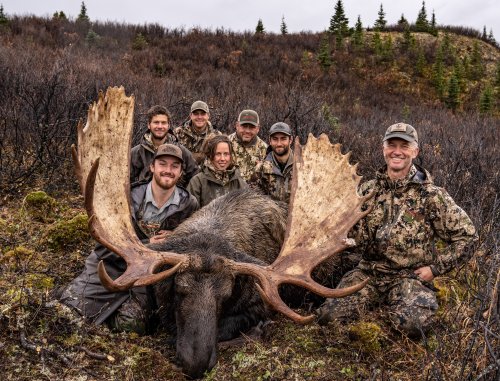
Upon excavating the bull from the brush, it became obvious why James was comfortable in assuring me that I would shoot this bull if I got a chance. He was big. Big palms, lots of points, and a lot of mass. It was another feeling similar to when I shot the caribou just four days earlier. It was so far beyond what I expected, no words seemed adequate to explain what was going through my mind.
I could only stare at him, then look at the crew, almost as if to ask them for confirmation that this had really happened. They were all excited, as they should be.
While cutting the tag and taking pictures, all were sharing their version of events, what they had seen, what it sounded like, how they thought the bull was going to escape, pondering what that bull found so interesting about the horses, and other clamor and excitement indicative of a hunting success for which many could share some credit.
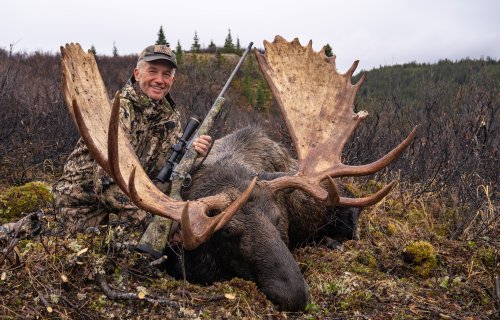
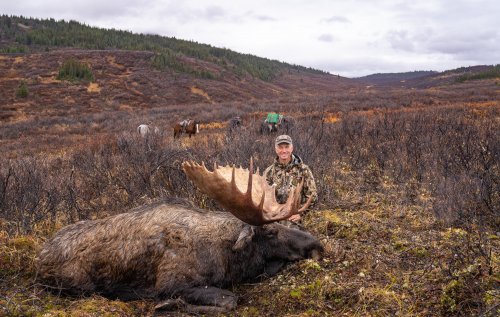
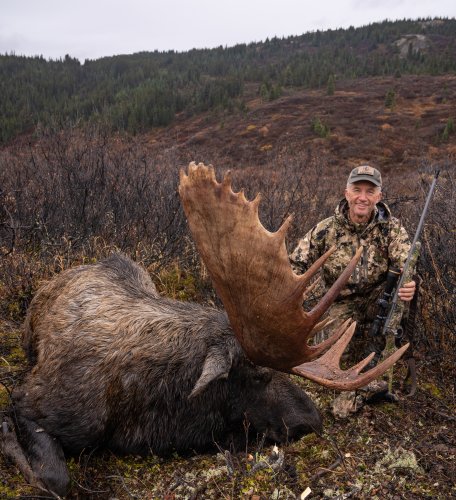
The obligatory "Mossback" photo with me, Marcus, James, Blythe, Braden, Jim, and Marty.
Confused, having lost sight of the bull, I asked, “How can you tell?”
He pointed to Braden who was up on the north slope of this drainage, observing the entire thing. Braden was giving a big fist punch and thumbs up. He had seen the bull stop, do a few circles and lay down in the alders.
I think James was more excited than any of us. We trotted further down the ridge to where the crew had tied off their horses. They came down off the north slope to meet us. Braden explained what he saw. Jim and Marty were talking excitedly of what they had seen and heard. It seemed unreal. I told the guys that I would withhold celebration until I was placing a tag on him.
From down in the creek bottom, we could not see up on the bench where the bull had laid down. James and Braden decided to ride horses up the slope we had just scrambled down, vowing to collect the string of packs, clothes and other debris that likely littered our exit route.
While they rode, Marcus and I told Jim and Marty how it unfolded from our position. I was a bit more relaxed. Then, James came trotting down the trail. He said they got high enough and when glassing the bull, he was still bedded and able to move his head. He suggested we go up to where Braden had been and try to make an anchoring shot.
Up the slope we went, fighting rock and brush until we gained enough elevation that we could see the bull in his nest of alders. I glassed him and he didn’t look good. I asked if we should just let him expire. James relayed that he had seen bulls recover and move off. Best to not take any chances, a plan I agreed to as I put three more AccuBonds in the Howa.
With less rush, I was able to move a bit more in search of the best of the many terrible shooting positions this very steep slope might afford. Again, the alders were so high, I had to find low spot in them so my shooting sticks could clear.
I got set. James read a range of 300. In the scope I saw antlers, but all shooting lanes were thick with brush. I warned James I thought no bullet could get through that. He suggested I shoot and be ready for a quick follow up, as the bull would likely stand if I hit anywhere close to him.
OK. I steadied to find the area that seemed to have the least amount of brush. The trigger dropped. I chambered another round as the bull followed James’ prediction and stood. It took considerable effort for the bull to get to his feet, fighting for some stability. I drew down on his wobbling body, seeing what seemed to be a small opening high on his shoulder. At the shot, a loud crack and the bull turned, still on his feet.
With another round in the 300 Win Mag, I waited for the bull to wobble broad side. James told me to hit him in the spine. I held to where I thought the spine would be and steadied. At the shot, James proclaimed I drilled him. For being drilled, he was still on his feet.
I dug for a spare round from my bullet sleeve, watching as the bull again laid down. He was not doing well. I asked James what to do. He suggested another shot. Hesitant, but subscribing to the “better safe than sorry” axiom, I drew down again. I told James the only open spot was his next. The reticle was steady on the middle of his neck when I squeezed. At the report, James announced, “He’s done. Great shot.”
I gained a new appreciation for trying to thread finishing shots through alder brush. I was relieved. Thankfully, the first shot must have been true, albeit a tough task to ask of any bullet when taking on a large bull moose quartering toward you and needing to penetrate a front shoulder before working leverage on the vitals.
We bounced and hopped down the brushy slope, back to where Jim and Marty were. In short order, Braden returned with the pile of gear left in our hasty exit from above. Now, we had to get across this flooded creek without losing any horses or humans, then up the 100’ embankment to where the bull expired.
Watching these guys lead horses across swollen streams of slippery rocks was impressive. We all got across, no horses went down, and no humans got wet, or at least not any wetter than we already were.
We made quick time over to where the bull had come to rest. As we got close, I told the guys it looked like a tine got shot off. A first for me.
With the horses tied off, the crew let me walk up to the bull. I confirmed a busted tine, much to everyone’s humor. They started backtracking the blood trail in hopes of finding it. No worries, I glanced a few yards from the bull and there was the tine, bright straw colored, laying in the crotch of some lower growing alders. I held it up with a big smile and showed it to the crew.
Upon excavating the bull from the brush, it became obvious why James was comfortable in assuring me that I would shoot this bull if I got a chance. He was big. Big palms, lots of points, and a lot of mass. It was another feeling similar to when I shot the caribou just four days earlier. It was so far beyond what I expected, no words seemed adequate to explain what was going through my mind.
I could only stare at him, then look at the crew, almost as if to ask them for confirmation that this had really happened. They were all excited, as they should be.
While cutting the tag and taking pictures, all were sharing their version of events, what they had seen, what it sounded like, how they thought the bull was going to escape, pondering what that bull found so interesting about the horses, and other clamor and excitement indicative of a hunting success for which many could share some credit.
The obligatory "Mossback" photo with me, Marcus, James, Blythe, Braden, Jim, and Marty.
Last edited:
It's late and I have a long day tomorrow, so I will have to finish telling of the packing, cooking, and lake trout fishing when I find time tomorrow. Thanks again for following along.

rtraverdavis
Well-known member
- Joined
- Oct 20, 2016
- Messages
- 4,351
Wow. What an adventure. Thank you for sharing the exceptional writing and photos with us. You are most definitely a guy who deserves to live this dream. Congratulations on all of it.

elkantlers
Well-known member
What a fantastic experience. Thanks for taking the time for such a detailed recount of the trip. I felt like I was right there with you. It was exhilarating.
PAhunter
Well-known member
That. Was. Awesome. Incredible experience, phenomenal photos, riveting writeup. Thanks for sharing it!

Addicting
Well-known member
Congratulation Randy, a hunt of a lifetime. Thank you so much for sharing it with us.

rmyoung1
Well-known member
- Joined
- Jul 12, 2010
- Messages
- 2,800
Congratulations Randy. Thanks for taking the time to take us along!!!


300stw
Well-known member
- Joined
- Jul 6, 2008
- Messages
- 950
the photos are amazing,,,,, much less that type hunt

Hem
Well-known member
Incredible adventure Randy.
Congrats on your trophies and thanks for sharing the hunt in detail.
Congrats on your trophies and thanks for sharing the hunt in detail.

devon deer
Well-known member
I have just read this thread right from the start, wow what an adventure, you sure packed a lot in, these threads are always interesting with lots of photo's, and Marcus's photography is superb.
Congratulations to all involved
(BTW, just signed up for Amazon prime, glad I have a lot of time on my hands!)
Cheers
Richard
Congratulations to all involved
(BTW, just signed up for Amazon prime, glad I have a lot of time on my hands!)
Cheers
Richard

Muley_Stalker
Well-known member
That was like reading a book. What a great hunt. Congrats Randy.
With the picture taking completed, it was time to get to work. Thankfully, the crew that was just a couple hundred yards away working on Jim's moose was there to help with this project. As I had requested, I got to take the lead on the meat carving. Yet, with an animal this size, I was happy for the help. With four experienced hands working knives and strong backs bagging meat, the job was accomplished with remarkable efficiency.
The autopsy showed the first shot as lethal, though was going to take a while. That first shot put the 180 grain AccuBond right on the point of the shoulder closest to me with that quartering-on angle. It broke the shoulder, went through the ribs and took out one lung, which explains why the bull decided to lay down after the first three-shot sequence.
Shot two was also a hit, low in the driver’s side back leg, explaining the kicking motion James called out when the shot was made. Shot three, at whatever ridiculous distance marker he was running past appeared to be an air ball. No surprise there.
Those first two shots, especially the first, was going to take care of the task. Yet, with a bull in this wild vast country, I think James’ was right in encouraging me to shoot the bedded bull.
The first two in the series of finishing shots were a bit of mystery, now solved by having the footage to look at on the big screen. My worries of too much brush turned out to be valid. The first shot of this sequence had no visible impact, other than smashing some alders near the front shoulder. Shot two was on target, except the bull swung his head to low and left, which sent a tine about ten feet into the air. The third shot of this sequence was when James requested a spine shot. Post-mortem showed the hit just under the spine about an inch, still high enough to miss the top of the lungs. The close proximity to the spine explains why he collapsed following that shot. My final decision for a neck shot, showed to be true as one could hope.
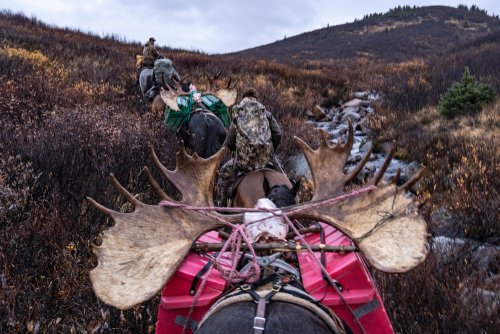
We now had the task of sorting what we could take from here while still getting all of Jim’s meat, cape, and antlers back to camp. The guides and wranglers made a calculation of what capacity was needed and what capacity remained. We moved quartered bags of meat away from the carcass, placed on a tarp, then covered with another tarp, taking what we had room for. The idea being the wranglers would come for the final pieces tomorrow.
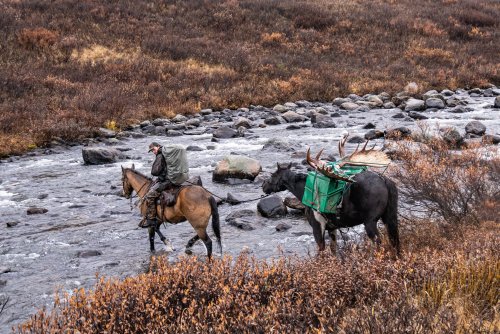
We headed off the bench, down across the big creek, and dismounted when all of Jim’s moose was ready for loading. The crew had made a very good estimate, as all the pack horses were fully loaded by the time Jim’s moose was atop them. Now, it was the two-hour slog through creeks, bogs, and alders to find camp. Darkness was coming fast with the rain and low cloud level, but the you would not know it by the excitement and chatter that accompanied our procession.
Meat was hung and fires were started. Braden found the energy to cook a dinner of the tenderloins Jim offered from his bull. Jim had brought a special bottle of his favorite whiskey that he pulled from his gear and shared with the crew. My liver condition precludes such celebrations, so it was Carnation hot chocolate for my toast.
I slept well that night, aided by the patter of rain on the tent. I suspect the same for the rest of the exhausted crew. My last thought I cannot recall, as I was asleep too soon. I suspect it was something to do with the great fortune of this day and new friends I had come to find in this remote camp.
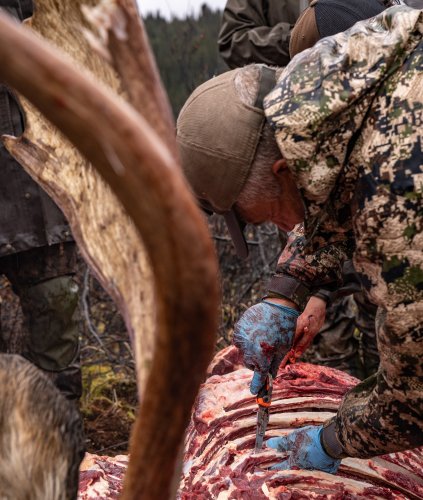
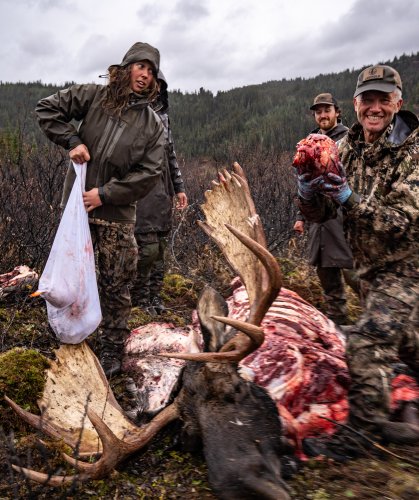
The autopsy showed the first shot as lethal, though was going to take a while. That first shot put the 180 grain AccuBond right on the point of the shoulder closest to me with that quartering-on angle. It broke the shoulder, went through the ribs and took out one lung, which explains why the bull decided to lay down after the first three-shot sequence.
Shot two was also a hit, low in the driver’s side back leg, explaining the kicking motion James called out when the shot was made. Shot three, at whatever ridiculous distance marker he was running past appeared to be an air ball. No surprise there.
Those first two shots, especially the first, was going to take care of the task. Yet, with a bull in this wild vast country, I think James’ was right in encouraging me to shoot the bedded bull.
The first two in the series of finishing shots were a bit of mystery, now solved by having the footage to look at on the big screen. My worries of too much brush turned out to be valid. The first shot of this sequence had no visible impact, other than smashing some alders near the front shoulder. Shot two was on target, except the bull swung his head to low and left, which sent a tine about ten feet into the air. The third shot of this sequence was when James requested a spine shot. Post-mortem showed the hit just under the spine about an inch, still high enough to miss the top of the lungs. The close proximity to the spine explains why he collapsed following that shot. My final decision for a neck shot, showed to be true as one could hope.
We now had the task of sorting what we could take from here while still getting all of Jim’s meat, cape, and antlers back to camp. The guides and wranglers made a calculation of what capacity was needed and what capacity remained. We moved quartered bags of meat away from the carcass, placed on a tarp, then covered with another tarp, taking what we had room for. The idea being the wranglers would come for the final pieces tomorrow.
We headed off the bench, down across the big creek, and dismounted when all of Jim’s moose was ready for loading. The crew had made a very good estimate, as all the pack horses were fully loaded by the time Jim’s moose was atop them. Now, it was the two-hour slog through creeks, bogs, and alders to find camp. Darkness was coming fast with the rain and low cloud level, but the you would not know it by the excitement and chatter that accompanied our procession.
Meat was hung and fires were started. Braden found the energy to cook a dinner of the tenderloins Jim offered from his bull. Jim had brought a special bottle of his favorite whiskey that he pulled from his gear and shared with the crew. My liver condition precludes such celebrations, so it was Carnation hot chocolate for my toast.
I slept well that night, aided by the patter of rain on the tent. I suspect the same for the rest of the exhausted crew. My last thought I cannot recall, as I was asleep too soon. I suspect it was something to do with the great fortune of this day and new friends I had come to find in this remote camp.
Last edited:

LuketheDog
Well-known member
Great moose!

WNC2500
Well-known member
@Big Fin: Wow! Marcus' pictures are amazing. The one crossing the river with the guide, and the remaining black horse behind him (with moose attached) is stunning! Thanks for sharing the entire hunt. Cannot wait to see it through the cameras as well. Moose has always been on my bucket list. Now it has moved up even higher. Thanks for putting such effort into composing the write up.
Similar threads


- Replies
- 48
- Views
- 4K