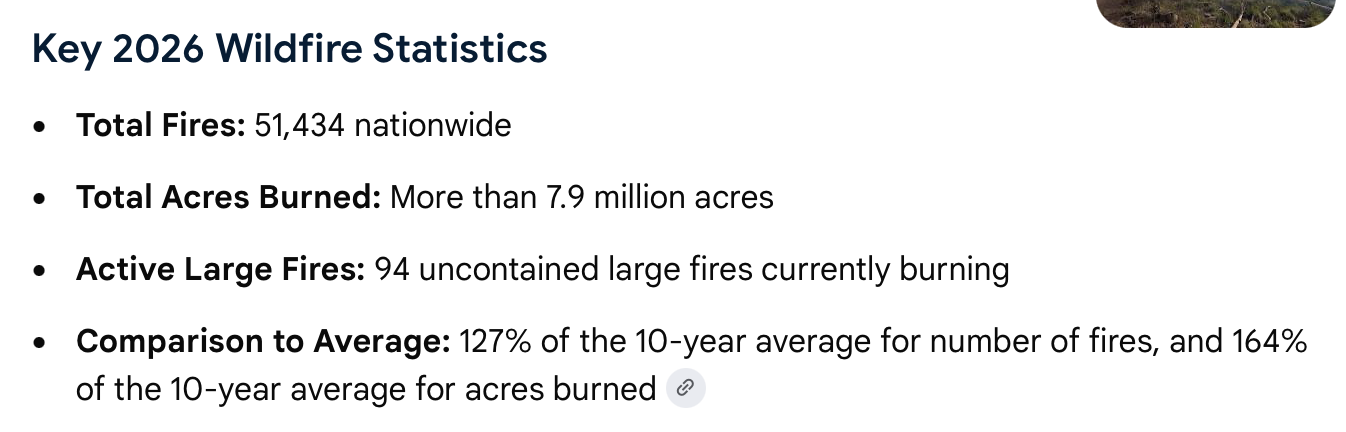
Wildfire management LTTE

Irrelevant

Well-known member
Joined
Apr 17, 2015
Messages
13,379
Location
Wenatchee
I'm working on, or maybe just thinking about, writing a letter to the editor about wildfire management.

But there's a few things I don't know enough about to comment appropriately. And I'm always impressed how much knowledge is floating around here, especially on natural resource topics.

I assume how you "fight" a particular fire in a particular location is dictated by some plan?

Is it specific to that forest or region or is it a federal plan?

How much opportunity, if any, does the public get to provide input on that plan?
 
Last edited:
I can only speak to Montana, but I am unaware of plans that exist for fighting fire prior to the ignition of a fire. Like, there is no "If a fire starts here, the plan will be to do X". There might be something like that in Wilderness areas, but the default plan in the vast majority of geographies is to always put the fire out right away.

What dictates fire suppression (or not) response as much as anything is weather, fuels, topography, lives/property, and I suppose, Protection Jurisdiction (meaning, is this fire on USFS protection, State Protection, County Protection, etc). Fire Protection in Montana (who is ultimately responsible for dealing with a start), is complicated as all get out. Here's a link. There are Community Wildfire Protection Plans, that speak to mitigation as well as plans for when the real bad thing happens (evacuation, infrastructure, etc). Here's a different link.

At base though, the default plan for all wildfire is to contain it or put it out ASAP. 95% of fires are beat on initial attack in Montana, and the lion's share of those are first encountered by Volunteer Fire Depts. I am the assistant chief of a VFD. We put every fire that starts out, and the only reasons we wouldn't would be associated with safety or access. Once a fire escapes initial attack, it's typically turned over to resources beyond county ones (state, feds), and their attack plans will be dictated by all of the immediate concerns of fuels, topography, weather, available resources, and property/lives at risk. At that point, plans are the responsibility of Incident Commanders and typically are refreshed daily. "Letting" a fire burn on purpose when it could otherwise be put out just isn't something I am familiar with, and because of both PR and the fact that little fires costing a few thousand bucks to put out can quickly turn into fires costing millions, that makes sense.

Might be different in other places or maybe even in Montana when fires get real big. I'm more familiar with initial attack, and the public doesn't really have any part in that other than bellyaching when it fails (IMO). The overwhelming consensus of the public is that fires need to be put out and opinions to the contrary probably wouldn't be taken too seriously. Not sure that helps.

 
I hear you @Nameless but how did we manage to create this problem through a century of fire suppression yet I see fire after fire, year after year, that continue to set records for size, continue to burn homes, continue to fill our skies with debilitating smoke.

The Little Giant fire started by lightning on 7/15, 7/16, rappelers and 22 ground troops were on site. Due to "poor access" they all hiked out on 7/17. The FS also claimed lack of availability for air support. A month and a half later, you have a 150k-acre fire that's burned multiple homes and millions have been spent, thousands of people are assigned. On top of that it's still burning, is still pumping out debilitating smoke, and yet the resources assigned keep declining. We've been told fall rains will put it out. Yet, it's deemed to be a "full suppression" fire.

I also don't see anyone ever mention or discuss the ancillary societal costs of wildfires.
-Health impacts to tens of thousands to millions of people due to unhealthy air quality. Kids in particular don't get to do outside recess, don't get to practice sports, don't get to go to the pool.
-Forest closures for "safety" that are both far in excess of any actual risk to the public, but also just the general inability of the public to access massive swaths of public land year after year. How can we instill a love for the wilderness if you can't access it? What's even worse is that the closures often last multiple years, again based on the "risk" to the public.

Lastly, this seems to be the least democratic process that directly impacts my life. As best I can tell, I get zero say. I suppose you could trace the either the president or my elected Fed reps, but that's more leaps than Evil Kenevil made.
 
Last edited:
If I don't like the service my police or local fire department are providing, I can an ability to make a change, I can vote for a new chief/sheriff. But in this case, I really have no say at all.
 
I don't have time at the moment to elaborate, but look into WFDSS, wildland fire decision support system, there's way more to it than just that, but that is where the decision process is supposed to be documented.
Ok, you appear to need a .gov account to access.
 
I hear you @Nameless but how did we manage to create this problem through a century of fire suppression yet I see fire after fire, year after year, that continue to set records for size, continue to burn homes, continue to fill our skies with debilitating smoke.

Just off the cuff. I think it is many factors. More fuels (in some places a lack of management and the result of fire suppression) , hotter and drier climate (climate change), far more starts than are natural (88% started by people), and more and more people building in places destined to burn (WUI). But the reason any individual fire takes off is going to be unique. Maybe a bit of it is related to a more modern version of safety (risk much to save much, and much = life). Say I had perfect knowledge, and I have a 99% of sending firefighters into a start and them being successful in putting it out, but a 1% of it blowing up and burning them over, is that worth it? I don't think so. But to the public it looks chickenshit.

I also think people might be surprised how little can be done when it's dry and the wind blows, and the fire triangle of heat, oxygen and fuel turns into an isosceles and pierces everything in front of it. No amount of resources can do anything. I don't know anything about the specific fires you reference. I have a feeling that though we would like some overarching reason for trends and our smoky summers, it's super complicated and variable for every incident.

In 1935, more than two decades after the Big Burn, the great Montanan and early forest ranger who fought that fire wrote: “Has all this effort and expenditure of millions of dollars added anything to human good? Is it possible that it was all a ghastly mistake, like plowing up the good buffalo grass sod of the dry prairies?” I think that is an interesting perspective, and whether it is or isn't doesn't really help today.

I think you as a citizen are right to want recourse, answers, and a say. Particularly on Forest Closures which from what I have seen are kind of BS. I just don't know what you would ask for otherwise.
 
Just off the cuff. I think it is many factors. More fuels (in some places a lack of management and the result of fire suppression) , hotter and drier climate (climate change),
There is far more variability in fuels, moisture and temperature wise, within a season than between seasons. So if fires only started on the days that were "really" hot and dry, beyond the "historic norm" (which is a completely fabricated idea, as there is no such thing, climate is constantly shifting), then yeah I could see that, but that's just not the case. And if you use historic stream flow as a proxy for dry, the last decade isn't any drier than any of the other "bad" periods. Both the 40's and the 70's had periods of more severe drought.
far more starts than are natural (88% started by people), and more and more people building in places destined to burn (WUI). But the reason any individual fire takes off is going to be unique. Maybe a bit of it is related to a more modern version of safety (risk much to save much, and much = life).
This is what I feel has had the biggest impact, we continue to value direct human life higher and higher, and acknowledge but do not account for indirect health impacts.
I also think people might be surprised how little can be done when it's dry and the wind blows, and the fire triangle of heat, oxygen and fuel turns into an isosceles and pierces everything in front of it. No amount of resources can do anything.
Maybe. But I doubt this. We put people on the moon, robots have roamed Mars for years, Ukraine has used tens of millions of unmanned drones, and we have humanoid robots that can outrun humans and manipulate small, precise tools. We can do something, or we can do more when they're small, we choose not to. I'm not sure who is doing that choosing.
 
-Health impacts to tens of thousands to millions of people due to unhealthy air quality. Kids in particular don't get to do outside recess, don't get to practice sports, don't get to go to the pool.
That is what leads to suppression and also the complaints every time a controlled burned is planned. I think this is why often there is a point in a fire where they say "it's going the right direction, let it burn" because there is no other way to reduce the fuel load.
 
That is what leads to suppression and also the complaints every time a controlled burned is planned.
Again, show me/us the math. I can't remember a single day of hazardous air quality due to a prescribed fire.
I think this is why often there is a point in a fire where they say "it's going the right direction, let it burn" because there is no other way to reduce the fuel load.
Under that logic, areas that have recently burned wouldn't burn again. Which is patently false.
 
Maybe. But I doubt this. We put people on the moon, robots have roamed Mars for years, Ukraine has used tens of millions of unmanned drones, and we have humanoid robots that can outrun humans and manipulate small, precise tools. We can do something, or we can do more when they're small, we choose not to. I'm not sure who is doing that choosing.

Maybe. There's certainly an ROI aspect of this. What you may be asking for in terms of suppressing more fires when they are smaller with more advanced technology would require a many X increase in fire suppression expenditure, which may end up being a "ghastly mistake" in the end anyway. Where that money would come from, whether it is gonna work, etc. Not an easy button at all. Damn near impossible actually in the current political environment. Particularly when fire suppression takes up an ever-increasing chunk of management agency's budgets. In Montana we are utilizing technology in really groundbreaking ways to detect fires via thermal signature before they are even visible to the eye. It's a lot cheaper to invest in early fire suppression and mitigation than to fight big fires, which I think is what you are arguing, but it's just so much easier said than done.

I would argue fuels are not variable in the way other parameters of a fire are. They are trending in one direction over the last half century.

That said, The Spokane Complex documented embers blowing miles ahead of the flame front. Nothing was gonna stop that. When certain fires take off, I think it is an uncomfortable fact that it's easier to put a man on the moon than to suppress them. Which is why we put dang near 10 out of 10 out on initial attack. Folks are only ever aware of the ones that got away.

All of it is obfuscated by the "sides" that run this country. One blames every fire on climate change. The other on fuels and management. But there's a lot of other aspects to it. Fire is a part of life and in particular the western one and I think the most uncomfortable one and hardest to control is a human one. Last month on a 94° Sunday in late July, I followed a white GMC Sierra 2500 with a ladder on it’s rack along Haab Lane, and we watched that sonofabitch throw a lit cigarette out his window. Had it made it to the fine fuels on the roadside, and had it been a gusty evening, and had it burned down every house from Clancy to East Helena, the topics of conversation that would be the meaningful foundation of that hypothetical fire probably wouldn't be addressed in high level conversations - which really would be an individual's head on a pike.
 
Maybe a different question. When did "we" decide that wildfires were good? Not just good for one thing, but when all the pros and cons are put on the balance beam of life, it tips in favor of good. And what can, should, or does change that to bad?
 
Maybe. There's certainly an ROI aspect of this. What you may be asking for in terms of suppressing more fires when they are smaller with more advanced technology would require a many X increase in fire suppression expenditure, which may end up being a "ghastly mistake" in the end anyway. Where that money would come from, whether it is gonna work, etc. Not an easy button at all. Damn near impossible actually in the current political environment. Particularly when fire suppression takes up an ever-increasing chunk of management agency's budgets. In Montana we are utilizing technology in really groundbreaking ways to detect fires via thermal signature before they are even visible to the eye. It's a lot cheaper to invest in early fire suppression and mitigation than to fight big fires, which I think is what you are arguing, but it's just so much easier said than done.
There is a very cynical part of me that wonders if there isn't a similar push in the fire industry as there is in the salmon restoration industry, their livelihoods are predicated on there being fires to put out. Best not create a situation where there's not something to put out, and therefore profit from.
That said, The Spokane Complex documented embers blowing miles ahead of the flame front. Nothing was gonna stop that.
100% some fires are simply unfightable. No debate from me there. It's the ones that are, and they are almost 100% always on FS property. Which is why I'm trying to better understand that decision/risk process.
 
Maybe a different question. When did "we" decide that wildfires were good? Not just good for one thing, but when all the pros and cons are put on the balance beam of life, it tips in favor of good. And what can, should, or does change that to bad?

That's a good question, and if I am tracking, I wonder how much the calculus of that proclamation figured into the downstream effects of air quality. I know it was in the 60s and 70s, and when it comes to things like air quality and the negative effect it has on people I'd wager was less understood and certainly less in magnitude 50 years ago.

All that said, outside of prescribed fire, outside of academic environmental types, I don't see an attitude toward fire being that it's good - at least from the Counties, State, and Feds in Montana.

I guess I can see where your cynicism comes from, but I can say honestly in my experience as a firefighter and professional, there is no fire industry effort of people making decisions that increase the likelihood of fire for fire's sake. I can genuinely say all I see is the opposite. Feds, State, and County professionals in the world of fire doing everything they can to put it out as fast as possible and prevent it in the future. That's what's drilled into them from day one, and they are good at it. They do have obstacles, but those obstacles aren't really from folks in the world of fire.

Perhaps things are totally different where you live, but I don't see it here.
 
Back
Top