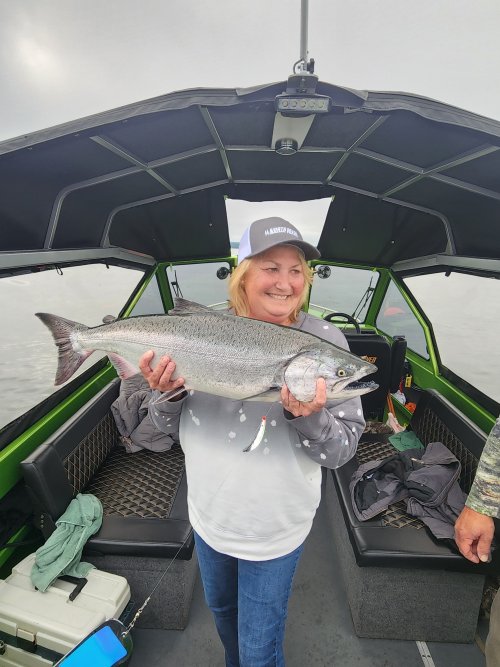
West coast salmon recovery

You have spent a lot of time up there and recognize Alaska is the canary in the coal mine. The environmental changes in my lifetime are incredible, it is so much warmer, so much lost nutrients from the lack of biomass, I think the impact will be wide spread.
 
Efforts to recover populations of threatened Chinook salmon in the Pacific Northwest may be hindered by exposure to contaminants in the juvenile life stage. Here we leverage a large dataset collected by the Washington Department of Fish and Wildlife's Toxic Biological Observation System to test for the accumulation of 219 contaminants of emerging concern (CECs) in juvenile Chinook salmon and identify chemicals that may affect salmon physiology, behavior, or fitness at current exposure levels. We also highlight results obtained from the region's two most urbanized watersheds, the Green/Duwamish and Puyallup/White, to demonstrate how these data can inform decision making to protect juvenile salmonids. We found that juvenile Chinook salmon sampled in the Puyallup/White watershed had the highest average concentrations of CECs, and that six chemicals appeared to be ubiquitous and were found in all five watersheds spanning a gradient of urbanization. In the subsequent detailed studies in the Green/Duwamish and Puyallup/White watersheds, we observed patterns in accumulation of per- and polyfluoroalkyl substances (PFAS) that revealed regions where certain analytes could be entering the rivers. In contrast, spatial patterns for pharmaceutical and personal care products (PPCPs) were less clear and indicated diffuse sources throughout the migration corridor, such as stormwater or wastewater. We recommend these results be used to target areas for source tracing studies for PFAS, and that future studies test for PPCP residues in commercial fish feed. Finally, the detection of multiple emerging contaminants in almost all composite fish samples, 11 of which exceeded available biological effects thresholds, reinforces the global call for green infrastructure projects that target source control and the removal or reduction of emerging contaminants from stormwater and wastewater.
 
Last edited:

I wanted to throw this out there and see what people think about this new study. The conclusion is that while we can readily identify part of the freshwater ecosystem that salmon use that are in poor condition, we can't show that improving them actually leads to salmon restoration. Salmon (this study was looking at chinook) are declining everywhere, including basins with relatively pristine habitat. The millions upon millions spent to, say, place logs in rivers, isn't going to offset to worsening ocean conditions. The real take away for me was that we need to spend more effort evaluating things that actually restore salmon populations and not things that we think restore salmon, or that just feel good.

The study lines up with what a lot of biologists have been saying quietly for years, that local habitat fixes help only so much when the bigger pressure comes from ocean conditions we cannot control. Chinook declines in untouched basins point straight to that. It does not mean restoration work is pointless, but it does mean we should be measuring results more honestly and directing money toward actions that actually move the needle for returns rather than projects that just look good on paper.
 
The study lines up with what a lot of biologists have been saying quietly for years, that local habitat fixes help only so much when the bigger pressure comes from ocean conditions we cannot control. Chinook declines in untouched basins point straight to that. It does not mean restoration work is pointless, but it does mean we should be measuring results more honestly and directing money toward actions that actually move the needle for returns rather than projects that just look good on paper.
But recovery without intact spawning habitat is impossible.

The biggest declines, in my somewhat scientific opinion, are due to trawling in the ocean 1- killing fish via bycatch, 2- removing forage biomass from the food chain, 3- preventing forage biomass production via permanent bottom habitat destruction.

Why are sockeye & pink (midwater, eat krill and plankton) returns doing fine, while kings (bottom-adjacent, eat pollock and sandlance) are crashing?

Saying “ocean conditions” are responsible is typically used as a cop-out to suggest it’s a problem we have no immediate control over. But it is absolutely not- implementing and enforcing an effective trawl ban would do more for salmon (and other species) than any other measure we have taken in the modern era.
 
Hell, it’s not even that subtle. When someone from ADFG says ocean conditions they are trying to say Com-Fish without getting fired.
 

Forum statistics

Threads
117,726
Messages
2,166,229
Members
38,330
Latest member
Calebb50
Back
Top