Mellow out. Guess I should used a smiley face. mtmuleyPeer pressure? He asked for opinions....


Navigation
Install the app
How to install the app on iOS
Follow along with the video below to see how to install our site as a web app on your home screen.
Note: This feature may not be available in some browsers.
More options

You are using an out of date browser. It may not display this or other websites correctly.
You should upgrade or use an alternative browser.
You should upgrade or use an alternative browser.
Threading and chopping a barrel?
- Thread starter golfer
- Start date
Mellow out. Guess I should used a smiley face. mtmuley
Ok, mellowing out....

Blue Steel
Well-known member
- Joined
- Feb 26, 2023
- Messages
- 1,076
Maybe everyone could be right:
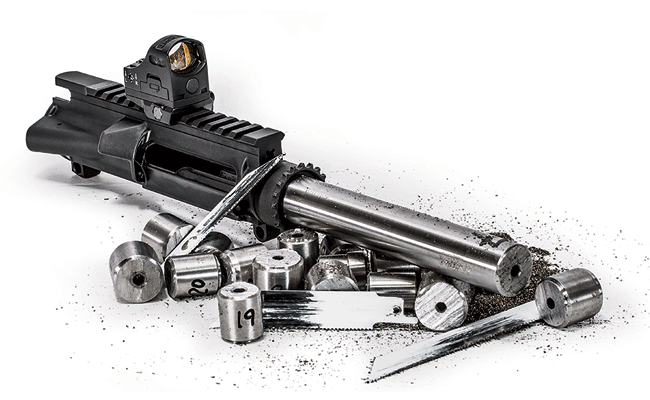
 www.gunsandammo.com
>>>>So, how many fps do you lose shortening a barrel? It depends on where you started. Going from 26 inches down to 20 inches actually picked up speed, not lost it. In the regular zone, between 20 and 16, the velocity loss could be anything from 12 to 50 fps. When we started down into the SBR zone, we sometimes saw velocity losses of more than 100 fps just from a 1-inch change in length. The short answer to the question of how much velocity do you lose per inch? It depends.<<<<

 www.remington.com
>>>... traditional rifle cartridges like .30-06 Springfield or .270 Winchester were originally designed around longer barrel lengths, often 22 to 24 inches. Shortening those barrels can reduce velocity noticeably.
But modern cartridge development has changed the game. Many newer cartridges and loads are designed to perform efficiently in shorter barrels, using optimized powders that burn faster and more completely. This allows hunters and shooters to maintain impressive ballistic performance without carrying excessively long rifles.<<<
Barrel Length vs. Velocity - Guns and Ammo
I'm destroying a perfectly good barrel in the name of science. And not just a perfectly good barrel — an expensive one."How much velocity do I lose if I shorten the barrel on my AR?"The answer ranges from
www.gunsandammo.com
>>>>So, how many fps do you lose shortening a barrel? It depends on where you started. Going from 26 inches down to 20 inches actually picked up speed, not lost it. In the regular zone, between 20 and 16, the velocity loss could be anything from 12 to 50 fps. When we started down into the SBR zone, we sometimes saw velocity losses of more than 100 fps just from a 1-inch change in length. The short answer to the question of how much velocity do you lose per inch? It depends.<<<<
Does Barrel Length Really Matter? Understanding Velocity, Accuracy, and Performance
Does barrel length really matter? Learn how it impacts velocity, accuracy, and handling—and how to choose the right setup for your shooting style and performance goals.
>>>... traditional rifle cartridges like .30-06 Springfield or .270 Winchester were originally designed around longer barrel lengths, often 22 to 24 inches. Shortening those barrels can reduce velocity noticeably.
But modern cartridge development has changed the game. Many newer cartridges and loads are designed to perform efficiently in shorter barrels, using optimized powders that burn faster and more completely. This allows hunters and shooters to maintain impressive ballistic performance without carrying excessively long rifles.<<<
Wind Gypsy
Well-known member
- Joined
- Mar 12, 2017
- Messages
- 3,192
How short do people think a barrel really needs to get to go from 3000 FPS to 2100 FPS (30% reduction)? It isn't anything that doesn't require an ATF tax stamp. Have to get to sub 10"?
Also, lot of people worried about velocity that shoot factory ammo that can easily vary over 100 FPS between lots and they'd never know.
Also, lot of people worried about velocity that shoot factory ammo that can easily vary over 100 FPS between lots and they'd never know.

Dakotakid
Well-known member
- Joined
- Dec 13, 2014
- Messages
- 936
Gun is 300wsm r700 with sporter barrel. Took it to smith to thread barrel for a can. Will need a shoulder/collar according to the gun smith. Question is for those that have chopped a barrel what are pros and cons. Can length is 6”.
Can you mic your barrel at where you plan to chop? I can give you diameter of mine at the suppressor.
I don’t have those tools. I told the smith to chop it and thread it At 20”Can you mic your barrel at where you plan to chop? I can give you diameter of mine at the suppressor.

Ajax2744
Well-known member
I’ve personally threaded hundreds of barrels, specifically for suppressor use. And while 1/2x28 threads can technically be used on a .30 cal, the minor diameter of the threads will cut to ~.450”. That leaves about .070” wall thickness between the bottom of the threads and the bore. When you throw a 6”+ can on the end there can be enough leverage to actually bend/snap the barrel at the threads if the can hits something or the gun is dropped/stepped on. I’ve also seen 1/2x28 threads swell from higher pressure of .30 mag cartridges. For .30 cal 9/16 threads or even better 5/8x24 threads are preferred if the barrel OD is big enough.
Your smith is correct and for suppressor use a shoulder for the suppressor or mounting attachment to seat against is highly recommended for a handful or reasons.
As for velocity drop it is not always so cut and dry. I just shot Sunday and my 6.5creed with a 20” barrel and a 5” suppressor was shooting ~75fps under factory rating. My .270win w/ a 20” barrel and 7” suppressor averaged 2fps faster than factory rating of the ammo out of a 24” barrel. And my 6.5prc with a 18.5” barrel and 5” suppressor lost ~about 100fps. So depending on the load, caliber, and firearms they lost anywhere from 0-18fps per inch of barrel lost. I have seen greater velocity lost just depending on specific loads but this was just my most recent testing.
Your smith is correct and for suppressor use a shoulder for the suppressor or mounting attachment to seat against is highly recommended for a handful or reasons.
As for velocity drop it is not always so cut and dry. I just shot Sunday and my 6.5creed with a 20” barrel and a 5” suppressor was shooting ~75fps under factory rating. My .270win w/ a 20” barrel and 7” suppressor averaged 2fps faster than factory rating of the ammo out of a 24” barrel. And my 6.5prc with a 18.5” barrel and 5” suppressor lost ~about 100fps. So depending on the load, caliber, and firearms they lost anywhere from 0-18fps per inch of barrel lost. I have seen greater velocity lost just depending on specific loads but this was just my most recent testing.

How short do people think a barrel really needs to get to go from 3000 FPS to 2100 FPS (30% reduction)? It isn't anything that doesn't require an ATF tax stamp. Have to get to sub 10"?
Also, lot of people worried about velocity that shoot factory ammo that can easily vary over 100 FPS between lots and they'd never know.
There’s a guy over on another sight that builds some big rifle cartridges on pistol setups. 15” 300 rum pushing 230 Bergers 2800fps
I’ve personally threaded hundreds of barrels, specifically for suppressor use. And while 1/2x28 threads can technically be used on a .30 cal, the minor diameter of the threads will cut to ~.450”. That leaves about .070” wall thickness between the bottom of the threads and the bore. When you throw a 6”+ can on the end there can be enough leverage to actually bend/snap the barrel at the threads if the can hits something or the gun is dropped/stepped on. I’ve also seen 1/2x28 threads swell from higher pressure of .30 mag cartridges. For .30 cal 9/16 threads or even better 5/8x24 threads are preferred if the barrel OD is big enough.
Your smith is correct and for suppressor use a shoulder for the suppressor or mounting attachment to seat against is highly recommended for a handful or reasons.
As for velocity drop it is not always so cut and dry. I just shot Sunday and my 6.5creed with a 20” barrel and a 5” suppressor was shooting ~75fps under factory rating. My .270win w/ a 20” barrel and 7” suppressor averaged 2fps faster than factory rating of the ammo out of a 24” barrel. And my 6.5prc with a 18.5” barrel and 5” suppressor lost ~about 100fps. So depending on the load, caliber, and firearms they lost anywhere from 0-18fps per inch of barrel lost. I have seen greater velocity lost just depending on specific loads but this was just my most recent testing.
Are you comparing your 20” rifle to actual 24” velocities or just what velocity is on the box of ammo?
Ajax2744
Well-known member
I’ve compared velocities before on a barrel before and after chopping but my numbers Sunday I just needed to get velocities for some dope cards for a couple new hunting rifles so I my comparison was based off the box “factory” rating. Based on previous testing using handloads I have generally seen 0-50fps/inch loss depending on rifle. 25fps/inch is generally a decent rule to follow but again it has varied on different setups.Are you comparing your 20” rifle to actual 24” velocities or just what velocity is on the box of ammo?
Were those 50fps/inch loss one shot comparisons or multiple? Just wondering if most of that 50fps was the extreme spread and you just caught the extremes. Not saying it doesn’t happen I’ve just never personally had it happen
Ajax2744
Well-known member
That was an average loss over 20 shots. It was in a short barreled (20”) 26 nosler I had. The groups started opening up and needed a rebarrel so I chopped it and threaded it to experiment and use up some reloads before I rebarreled it to 7prc. So yes it was an extreme example on an highly overbored cartridge but I technically have seen it haha. But I still say 25fps/inch is a pretty decent general rule to followWere those 50fps/inch loss one shot comparisons or multiple? Just wondering if most of that 50fps was the extreme spread and you just caught the extremes. Not saying it doesn’t happen I’ve just never personally had it happen
That was an average loss over 20 shots. It was in a short barreled (20”) 26 nosler I had. The groups started opening up and needed a rebarrel so I chopped it and threaded it to experiment and use up some reloads before I rebarreled it to 7prc. So yes it was an extreme example on an highly overbored cartridge but I technically have seen it haha. But I still say 25fps/inch is a pretty decent general rule to follow
Yep I believe it with such an over bore cartridge.

bluegrassdan
Active member
- Joined
- Mar 25, 2025
- Messages
- 101
When you look at the wall thickness on a sporter profile barrel in .30 caliber after threading to 1/2-28 you will understand why most of us won't thread that size barrel without adding an adapter with a recoil shoulder. Single point threading puts a ton of tool pressure on the barrel through the threading tool. When you have a thin wall between the OD and the bore, that tool pressure translates directly to the inner surface of the bore. While you may not see the reverse of the threads in the bore, there is a good chance that you have created a slightly tighter spot in the bore under the threads or, in some types of barrels (hammer forged and Button rifled) even after stress relief, there is still stress in the steel and that can be released when you cut down the muzzle to the correct OD for threading. That can make the bore open up at that point and create a loose spot. Either of these problems can occur- not always mind you, but I have measured it many times and the accuracy suffers. By threading the barrel OD as is- not reducing it first, then adding a collar at the next higher OD, usually 5/8-24, you avoid that problem altogether. Its not ideal, but it works and in my mind there is much less chance of bending that section of the barrel should you drop the rifle with suppressor attached- yes I have had several come through the shop after that happened and it required me to shorten the barrel again.Well I think I’ll go down to 20”. But smith seems adamant that even at 20” I need to have a collar. I’m not a fan of that. I think it’ll look like s*** but I’m also not a smith.
std7mag
Well-known member
@golfer,
Justin, personally, I wouldn't do it.
It's already a 300WSM. It's gonna be loud!
Less so with a suppressor. But still freaking loud.
Suppressors have shown to increase muzzle velocity. But not by a huge extent. Which helps with the shortened barrel.
But it's still a 300WSM. Unless you load subsonic rounds for it, it's still going to be loud.
Lowering the velocity goes wholly against the premise of the WSM cartridge to begin with.
And handling friends rifles that are suppressed, the weight and balance is totally off for me.
A suppressor that supposedly weighs 16oz feels far more than that swinging on the end of the barrel!
It's your rifle and your money, but I don't think you'll be happy with the results.
Justin, personally, I wouldn't do it.
It's already a 300WSM. It's gonna be loud!
Less so with a suppressor. But still freaking loud.
Suppressors have shown to increase muzzle velocity. But not by a huge extent. Which helps with the shortened barrel.
But it's still a 300WSM. Unless you load subsonic rounds for it, it's still going to be loud.
Lowering the velocity goes wholly against the premise of the WSM cartridge to begin with.
And handling friends rifles that are suppressed, the weight and balance is totally off for me.
A suppressor that supposedly weighs 16oz feels far more than that swinging on the end of the barrel!
It's your rifle and your money, but I don't think you'll be happy with the results.
Dakotakid
Well-known member
- Joined
- Dec 13, 2014
- Messages
- 936
The outdoor life suppressor testing had the lightest suppressor at 5.5 oz. The new 3d printed titanium suppressors are getting pretty light.
They also tested recoil reduction and sound reduction. Looked like a pretty comprehensive test. I am not affiliated in any way.
I do shoot a 300 wsm suppressed and it is pleasant to shoot. Not whisper quiet but not obnoxious. I will try a light weight kimber with a light weight suppressor next, barrel cut to 18 but mayhaps a 7 wsm or such.
They also tested recoil reduction and sound reduction. Looked like a pretty comprehensive test. I am not affiliated in any way.
I do shoot a 300 wsm suppressed and it is pleasant to shoot. Not whisper quiet but not obnoxious. I will try a light weight kimber with a light weight suppressor next, barrel cut to 18 but mayhaps a 7 wsm or such.

Sheltowee
Well-known member
Dumb question, but what would an 18” 7WSM do that an 18” 7-08 wouldn’t?The outdoor life suppressor testing had the lightest suppressor at 5.5 oz. The new 3d printed titanium suppressors are getting pretty light.
They also tested recoil reduction and sound reduction. Looked like a pretty comprehensive test. I am not affiliated in any way.
I do shoot a 300 wsm suppressed and it is pleasant to shoot. Not whisper quiet but not obnoxious. I will try a light weight kimber with a light weight suppressor next, barrel cut to 18 but mayhaps a 7 wsm or such.
Dumb question, but what would an 18” 7WSM do that an 18” 7-08 wouldn’t?
Under 500 yards with the right bullet nothing
Sheltowee
Well-known member
That’s what I’m thinking. Only 4k PSI max difference between the two. Load a slightly faster burning powder in the 7-08 and they’d probably be close enough that no cervid would tell the difference.Under 500 yards with the right bullet nothing
corndog1
Well-known member
I did this exact thing with my 7mm mag. I could not believe the reduction in sound and recoil. Wish I would have done it sooner.