Tarp over wall tent

Bhoesl

Well-known member
Joined
Oct 11, 2016
Messages
231
Location
Lewistown MT
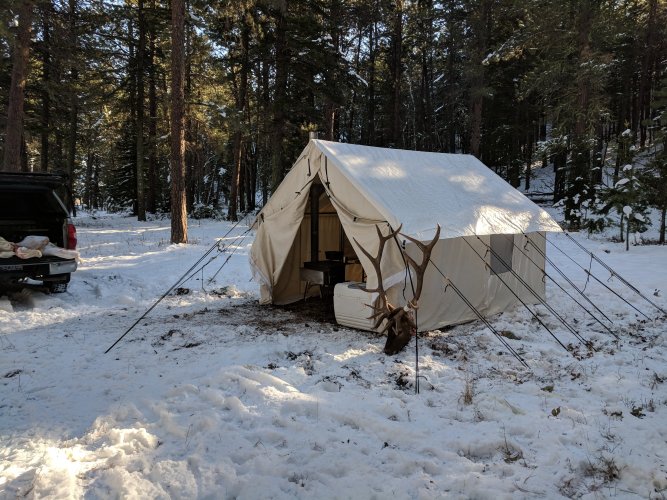
For those of you who use a tarp over top of your wall tent, do you put the tarp directly over the canvas at the top, or do you rig up something along the ridge to maintain a gap between the tarp and the canvas?

 
For those of you who use a tarp over top of your wall tent, do you put the tarp directly over the canvas at the top, or do you rig up something along the ridge to maintain a gap between the tarp and the canvas?

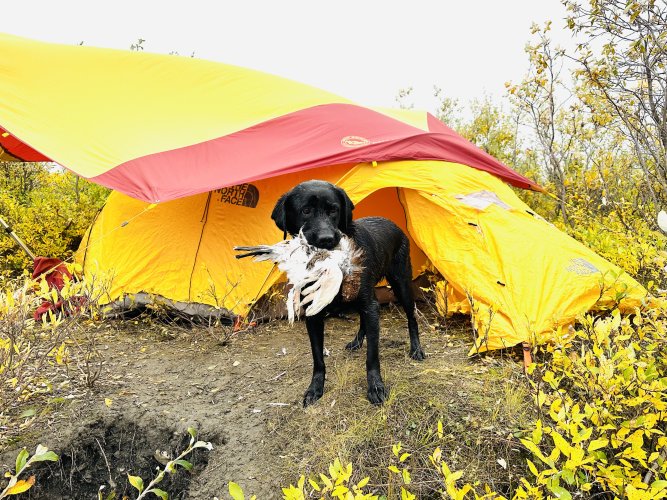
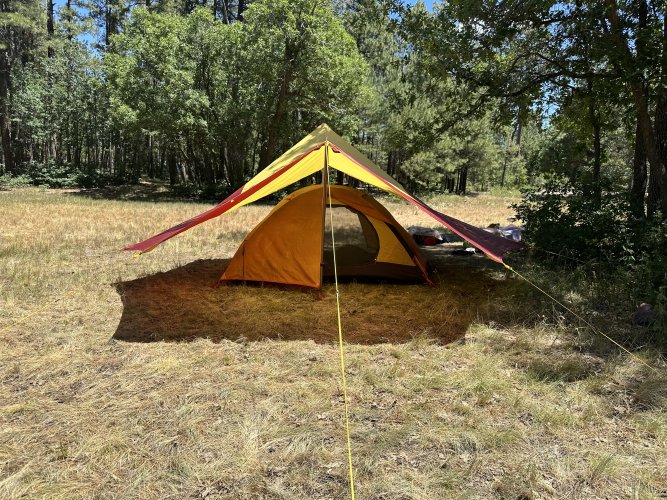
I don’t use a canvas tent but I do set up a tarp above my tent even though it has a rainfly.
A gap between the tarp and tent will keep it cooler in the heat and drier in the rain.

IMG_1264.jpegIMG_0184.jpeg
 
Condensation forms on tent walls and ceilings and if a tarp presses directly against the fabric, moisture can transfer through and soak your gear,
if you’re using a tarp only as extra rainfly reinforcement in a downpour and have zero cordage or anchor points, direct contact is better than no cover at all — but treat it as a last resort, not the plan.
 
I understand about condensation. I guess maybe I didn’t explain my question properly. I definitely plan to keep the tarp tied off higher along the side walls, leaving an air gap. My question was about along the ridge, if people just pass the tarp directly over the ridge of the tent, or if I should come up with a support / spacer of some kind to run along the top of the ridge to maintain that air gap.
Hopefully that makes sense, I can picture the idea in my head but not sure I’m explaining it well.
 
We have always just put the tarp directly over the tent. I think it might depend on the heat source because propane will emit a lot of moisture where wood will not. I have never experienced moisture in a wall tent with a tarp over it but have always had wood or no heat. I can't imagine contact at the ridge being a problem. If it is I would just let some air leak around the ridge pole. If you are using an internal frame, I have no experience with that.
 
I understand about condensation. I guess maybe I didn’t explain my question properly. I definitely plan to keep the tarp tied off higher along the side walls, leaving an air gap. My question was about along the ridge, if people just pass the tarp directly over the ridge of the tent, or if I should come up with a support / spacer of some kind to run along the top of the ridge to maintain that air gap.
Hopefully that makes sense, I can picture the idea in my head but not sure I’m explaining it well.
Just pass the tarp directly over the ridge pole. If you maintain an air gap for everything else, you will get 99% of the benefit for 50% of the effort.
 
Ah ha! I always thought it was because tents were expensive to replace so people were making do with what they had! 😂😂 silly me. We are hunters, not beggars!
 
I am pretty ignorant so I am over her wondering why a tarp is needed.


On my 20 year old wall tent wherever there are dirt stains or where the canvas touches the metal ridge poles water will eventually wick through and drip in extended periods of rain. I have never waterproofed it. A heavy duty tarp over the sleeping portion ensures that moisture isn’t a problem.

I use my tent in conjunction with a wood stove so the wood heat eliminates any condensation.
 
If you set a wall tent up nice and tight it will no longer be tight after rain or snow. The tent will sag before the eave and water will eventually drip. This can and will happen in the middle of the night.

The rain/snowmelt will run down the wall and in cold weather your tent can become frozen stiff if not totally frozen to the ground. A tarp extended past the eave can save a lot of weight and give you the ability to get the tent pulled when you are ready to leave and packed possibly on to a horse.
The tarp will also allow you to put off repairing those burn holes you have been meaning to fix but likely never will.
 
Thanks everyone. Sounds like I will plan to just run the tarp directly over the ridge and try to tie it out to leave a gap along the eaves. And yes, heat will be wood.
 
Don't overthink this. Tarp over the wall tent protects it from weather/sun/sticks and stones..... Wall tents have enough room especially with the internal frame that you are not going to be up against the walls. The air gap, that would be hard to get uniformly over the tent, wouldn't be of that much benefit. Erect the tent, stake it out, throw on the tarp and stake it out so it doesn't flap in the wind and keep you up at night.
 
Back
Top