


Taking long shots, part 2

schmalts

Well-known member
Joined
Aug 22, 2002
Messages
9,585
Location
WI
O.K., all you guys that have killed with some long shots 400+ that is, What caliber and what kind of bullet, and what was the damage, and distance it went before it piled?

This year i did make a long shot, in fact hit the deer 2 of 3 shots at 450 plus , and it was with a .270 and a 130 grain accubond.
But even with 2 hits and fresh snow there was no blood trail. When i walked up to the deer I rolled it over and saw the silver dollar sized blood spots in the snow to reveal the hit locations. I did not like this, and even though the deer didn't go far I just don't think i would ever do that long of a shot without snow.
Unbelievable thing is the hit that was right behind the shoulder was still a pass through, but yet a small exit hole. I did the gutless method to pack it out so I cannot report on what the internal damage was. Maybe i am worrying about nothing, but would like to hear what the damage was on your long shots.
I think I will spend some cash and get a rifle with more punch behind it with the same accuracy for next year. Certainly will not be a Kimber:rolleyes:
 
I shot my Az buck at a lasered 404 yards with .270 Win, 130 gr Federal “power-shok” ( the cheap stuff). Bullet struck just behind the front leg, just below center line on a broadside animal. It was a pass through, breaking a rib on the way out with a ¾ inch exit hole. Near side lung had a hole, far side lung was shredded a bit. At the hit, the buck jumped and kicked out like they do on a good hit, and ran about thirty yards before piling up.
My other two “long range” deer kills were a 440 yards buck that dropped like a rock with his neck broken, and a 390 yard heart shot that traveled about twenty yards. Both with the same .270 shooting 150 Ballistic Tips.
In the other thread you mentioned using a BDC rectical. This year I used the similar Kahles TDS . I was impressed with how much easier it was to make a long range shot with these “bullet drop” compensation recticals.
 
I have killed some chit between 400-650 a few times. I have never really had a problem with them going far unless it was poor placement. I shot a buck in Idaho 2004. 3 shots 3 hits at 450, but just didn't hit bone. The buck went downhill 250 yards until I found him. Not very fun. I will say you must be confident in your set up...that is, you must be able to hit at 450 just as good as the other guy at 200. I I personnaly shoot .300 weatherby 180 gr. Ballistic tip. They get the job done. Keep in mind that a .300 weatherby has about as much energy at 500 yards as a 170 gr. 30-30 at point blank range. I also use the custom target turret dial from leupold. If I were looking at a new gun...that 270 wsm or 300 wsm looks pretty good. The 300 wsm is putting 150s downrange at 3300. Anyways hope this helps:D
 
I know all about the ballistics stuff, just more interested in what the damage of the hits were more than anything. If i bought a new WSM it would be the 7MM WSM because i like what the 140 grain does in that gun
 
For the life of me I can't figure out why people are so enamored with needing exit holes. If you make a good shot the animal is going to die in pretty short order, usually on the spot or in site reguardless of what the 'exit' looked like.

I shot an atelope one time with a 7mag and a 160 Sierra. The exit hole was about 6" in diameter and he ran nearly a 100 yards. Every animal is diffrent.

Think about archery hunting, some will bleed like a garden hose, others barely a drop for 50-60 yards. With out blood pressure its hard to pump blood out a hole.

IMO when you get an exit hole you're usually going to need it. Couse out of all the animals I've killed and seen killed, a good shot resulted in a recovered animal.. botch a shot and you're screwed with or with out an exit hole regardless of range.
 
Bambistew,

Personally, if I dont get an exit hole on a normal broadside shot, the bullet isnt tough enough for hunting.

The reason is pretty straight-forward. If a bullet typically fails to exit on a standard broadside shot...there is no way that same bullet will penetrate and kill properly when large bones are hit and/or when a hard quartering shot is taken. Its impossible to have a bullet that will stay in an animal on a broadside shot, but then also be expected to penetrate and bust big bones on quartering shots.

I flat wont hunt with a bullet that I know will rarely make it through an animal broadside. I dont expect a bullet to go through an animal from stem to stearn, but I do expect exit holes on broadside shots.

For the record, I've never had a nosler partition fail to exit on a broadside shot and I've only recovered a few (hard quartering shots). I've also recovered 100% of the animals I've shot with them...most travel less than 50 yards, some dropped on the spot. A few made it almost 100 yards. Like you say, thats likely the difference in the animals and has nothing to do with the bullet performance.

I just wont ham-string myself with being forced to take "perfect" broadside shots because the bullet I shoot is too fragile.

BTW, how often do you get exits on the animals you shoot broadside?
 
Schmalts,

To answer your question...bullet performance is erratic at best at long range. Another good reason to get closer.
 
These arguments are always fun. :D

I'd say 50-60% of the elk I shot had a pass through, most all were in the 250-300+ yard range, usually closer shots don't result in a pass throughs. I don't hamstring myself to broadside shots either, but perfer them. Probably 30-35% of the elk I've killed ened up with a broken shoulder, but I perfer not to because it ruins to much meat.

I can think of 3 animals I've shot at and not eventually killed, all where much to far away and I know it was a clean miss, one cow elk, and 2 antelope. Another reason I my self to 400ish yards. ;)

I've lost two elk, one was eventually killed by another hunter, the other was never recovered. The one killed by the other hunter had a broken front leg at brisket level, the other one was shot with a Partition out of a 30 not 6, best I could figure it must have deflected off the shoulder bone forward and missed the goodies. Maybe it failed to penitrate? Who knows... All I know is I jumped him in the timber twice and saw that he had a broken front shoulder. I eventually ran out of snow and lost the spoor.

In both those instances it was placement error and nothing else...

I've never lost a deer or lope and minus those two piss poor shots on elk, I've never lost an elk due to bullet 'failure' or lack of exit holes.

There are too many instances to put them all down, diffrent bullet/rifle/cartridge combinations at close and extended ranges, some animals are 'tougher' than others... They all ended up dead with a bullet in the right place. I've seen many deer and lope killed with 'varmint' type bullets, all where shot and recovered in short order. I honestly can't think of an instance where an animal was shot and not recovered where the blame could be souly based on bullet failure. Not saying it can't happen, but I've been lucky enough to never have it happen to me.
 
If you're shooting through elk 60% of the time I'd expect you shoot through deer nearly 100% of the time. Assuming you use the same bullet/caliber for them.

I still think you'd have problems with a quartering shot and hitting large bones.

Of the 40% that you failed to get exits...how many hit a large bone or were quartering?

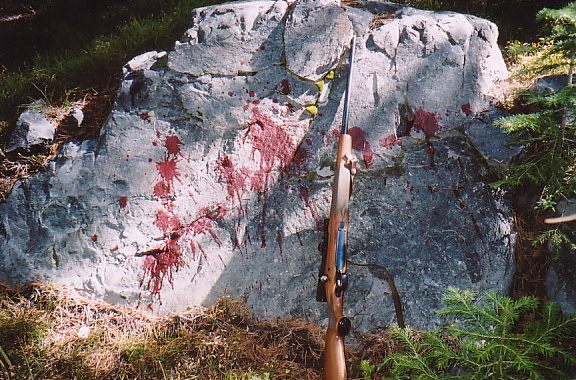
Heres whats nice about exit holes...any questions?

338.JPG
 
Schmalts,

To answer your question...bullet performance is erratic at best at long range. Another good reason to get closer.

I will always get closer given the chance, but some times like the peak of the rut with bucks chasing doe it isnt going to happen in most cases. He was chasing a doe and I got him across canyon , and they were onto me some how as well. I do agree with you about exit holes.... love to see blood, even more so if there is no snow to track in.
As far as waiting to get closer goes... Ask Stan about how I waited for the second chance lope....:D waited at 425yards for 20 minutes and was very tempted sitting there holding on him with the shooting sticks , but stuck it out and got within 20 yards;) and then it was so close i couldnt find the damn thing in the scope as it trotted by:eek:

Miller, shut your pie hole, If i remember right i was the one that talked you into your 7wsm beotch
 
I hear you Schmalts and agree. There are situations that call for a longer than normal shot.

I just think if you take LR shots you have to expect erratic bullet performance and deal with it. I dont think theres a way around it other than not shooting and trying to get closer.
 
About your picture, do you think you would have lost that elk if you didn't get an exit?

Again, why do I care if I get an exit hole? With or with out the tracking is generally pretty short, and IMO its usually tends to be a bit farther with an exit than with out.

I don't take THS, or try and thread a bullet behind the ribs when they're strongly quartering away. Not because of the bullets I use but because I don't like taking shots that present such a small target. Botch that shot and no wonder bullet is going to bail you out. I have a hard enough time keeping the bullet in the rib on a broadside shot.

I don't keep a jornal of all the animals I killed and what the bullets did, I seem to remember that the majority of broadside shots were pass throughs, and most every bullet I've ever recovered has been found under the skin on the off side. As far as the broken shoulders... don't recall, don't think many if any exited. The elk was dead and I didn't care.

On the deer... most of the ones that didnt' pass through were due to spine shots, neck shots facing straight on, double shoulders, etc. I don't care if I dont' get a pass through, I've yet to meet up with a deer that could take on much lead.

I found 2, 300 grain Partitions in two diffrent critters I shot in Africa a couple years ago. You would think that much lead souldn't have had any trouble exiting, but it did. For the next trip I'm taking something a little more frangible...

What I think is funny is that we probaly have similar 'body counts' give or take with in reason, yet I did so with 'inferiour' bullets and we both have the same recovery rate.
 
Any exit wound is the product of energy not being completely expended INSIDE the animal.

Why would you not want most of the energy to be expended/absorbed INSIDE the animal instead of outside the animal on the back side in the trees and dirt.
 
I hear you Schmalts and agree. There are situations that call for a longer than normal shot.

I just think if you take LR shots you have to expect erratic bullet performance and deal with it. I dont think theres a way around it other than not shooting and trying to get closer.

I am curious why you say erratic? Why makes it any more predictable at say within 100 yards? Are you meaning whether it is full pass through or what exactly are you refering to?
 
Bambistew,

No, I wouldnt have lost that elk, actually heard him fall he only went about 40 yards after a 50 yard shot. I've never complained about a good blood trail though.

A couple other cases are the reason why I shoot better constructed bullets. One was a cow elk I shot bedded at maybe 90 yards. She was hard quartering away in the timber and it was noisy. I didnt want to risk trying to get a better angle, so took the shot with a 338 and 250 partitions. Broke 6 ribs on the onside went through everything vital and the bullet was just under the skin on the off-side (broken) shoulder. I think that pretty much speaks for itself and I seriously doubt if a ballistic tip would have got it done.

Another time again on elk, shot through a 6 inch diameter lodgepole it was stading in front of (not on purpose) broke the on-shoulder and found the back 60% of the partition on the off-side hanging by a few strands of hair. Again, I doubt a ballistic tip or standard cup and core bullet would have worked. Yeah, I know dont hit the tree, but shit happens when you hunt elk in the timber.

I do believe that most of the time a more fragile bullet would have worked just fine on the animals I've shot. I've just had a couple cases that I'm 99% sure would have been a disaster if I would have been using them and chose to take the shot. I dont plan for best case scenerio, I plan for the worst and most extreme. I also know that I hunt too hard to pass up a shot because I'm not sure about how a bullet will perform.

Partitions, IMO are the perfect compromise bullet. The front third is pretty darn fragile and sets up a lot of initial shock and tissue damage while the back 60% will ensure proper penetration on tough angles and when large bones are hit.

JC,

I'll tell you why, ft/lbs of energy does not kill animals.

BB, most bullets are designed to function at a range of velocities. The bullet performance you get at 100-300 yards will be different than what you get at 400-800. The differences at LR with bullet performance are greatly compounded by what you do...or dont...hit (shoulders, ribs, etc.). The differences in bullet performance at more "normal" ranges are much less extreme. I've also found that extremely CLOSE range shots create erratic bullet behavior.
 
I kind of that that is what you were meaning.
Bambistew,

No, I wouldnt have lost that elk, actually heard him fall he only went about 40 yards after a 50 yard shot. I've never complained about a good blood trail though.

A couple other cases are the reason why I shoot better constructed bullets. One was a cow elk I shot bedded at maybe 90 yards. She was hard quartering away in the timber and it was noisy. I didnt want to risk trying to get a better angle, so took the shot with a 338 and 250 partitions. Broke 6 ribs on the onside went through everything vital and the bullet was just under the skin on the off-side (broken) shoulder. I think that pretty much speaks for itself and I seriously doubt if a ballistic tip would have got it done.

Another time again on elk, shot through a 6 inch diameter lodgepole it was stading in front of (not on purpose) broke the on-shoulder and found the back 60% of the partition on the off-side hanging by a few strands of hair. Again, I doubt a ballistic tip or standard cup and core bullet would have worked. Yeah, I know dont hit the tree, but shit happens when you hunt elk in the timber.

I do believe that most of the time a more fragile bullet would have worked just fine on the animals I've shot. I've just had a couple cases that I'm 99% sure would have been a disaster if I would have been using them and chose to take the shot. I dont plan for best case scenerio, I plan for the worst and most extreme. I also know that I hunt too hard to pass up a shot because I'm not sure about how a bullet will perform.

Partitions, IMO are the perfect compromise bullet. The front third is pretty darn fragile and sets up a lot of initial shock and tissue damage while the back 60% will ensure proper penetration on tough angles and when large bones are hit.

JC,

I'll tell you why, ft/lbs of energy does not kill animals.

BB, most bullets are designed to function at a range of velocities. The bullet performance you get at 100-300 yards will be different than what you get at 400-800. The differences at LR with bullet performance are greatly compounded by what you do...or dont...hit (shoulders, ribs, etc.). The differences in bullet performance at more "normal" ranges are much less extreme. I've also found that extremely CLOSE range shots create erratic bullet behavior.
 

Latest posts

Forum statistics

Threads
117,838
Messages
2,171,067
Members
38,368
Latest member
bk2thgrnd
Back
Top