Oneye, feel free to share this with the good folks of Utah. What is provided here is strictly Randy Newberg talking, not the opinions of RMEF or any function as my role in RMEF. Since it is all factual, I should not even use the term "opinion" in my preceding qualifier.
As some background, Don Peay, SFW founder, challenged me to a debate a few years back. I jumped through every hoop he asked. When he found out how involved I was in wolf politics that topic got taken off the table. Since he refused to provide me the books and records of what SFW does with their auction and raffle tag proceeds, I set out on my own to prepare some CPA-style analysis. It was laughable what got thrown at the wall in hopes it would stick. Unfortunately, in Utah, for some reason I don't understand, a lot of what SFW throws on the wall sticks.
On Page 93 of their posted document, they state about raising $22 million over the last ten years. That they raise an average of $2.2 million per year. Though I trust nothing they publish, for this exercise I'll accept that as somewhat close.
"Raising" money is one thing. "Investing" that money where it is intended is another. Let's look at some numbers.
Utah rule is that the money raised in one year is split 10% as a selling commission, 30% directly to UT DWR, and the other 60% to be kept by the selling organization that must be invested in conservation the following year. That group does get to keep the 60% as working capital until it is spent the following year. Here is the real substance that should cause every citizen of Utah to yell, "Show me the money!"
What I found out in my preparation for the debate with Mr. Peay, not one single year could I reconstruct where SFW invested the required 60% of auction proceeds back into conservation. Being a CPA, I'm kind of the "Charlie Daniels of the abacus" so this stuff comes pretty easy for me.
From that exercise, I took about ten minutes this afternoon, in between CPA work, and tested to see if the SFW method of creative accounting was still in play as it had been when I was preparing for my debate with Mr. Peay. Sure enough. See below.
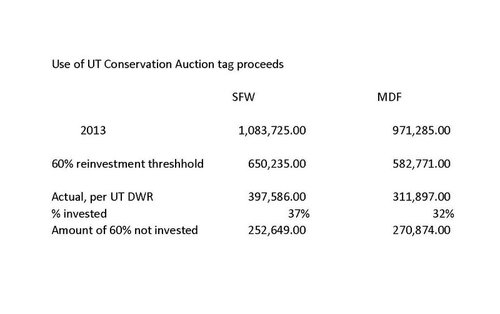
Here is how it works, by an example. We will look at how much each group had as auction tag proceeds in 2013. That had to be spent on conservation projects in 2014.
2013 auction tag revenues $1,083,725
60% required to be reinvested in conservation - $650,235
Actually invested in 2014, per UT DWR - $397,586
Percentage of auction tag proceeds invested in conservation - 37%
It would cause on to ask, "What happened to the other $252,649 that did not get invested?"
These are not my figures. These come straight from UT DWR.
Auction Tag revenues are at this link -
http://wildlife.utah.gov/pdf/conservation_permit_revenue.pdf
Amounts reinvested to conservation in 2014 is provided at this link -
http://wildlife.utah.gov/pdf/conservation_permit_projects.pdf
So, let's do the same easy math for Mule Deer Foundation. It goes like this.
2013 Auction tag revenues - $971,285
60% of the auction tag revenues required to be reinvested - $582,771
Actually invested in 2014, per UT DWR - $270,874
Percentage of auction tag revenues in conservation, per UT DWR numbers - 32%
Where did the the other $270,874 go that MDF received in auction tag revenues?
Seems like a reasonable question to ask.
I could see a difference to some degree, given it is not possible to always invest the exact dollar amount each year, due to timing of projects, approval by DWR, etc. Maybe it would be short one year, and maybe even the second year following, due to timing of projects or holding some of it for a big project that is planned a couple years down the road. Yet, you would think that sooner or later, at least one year would show a large excess investment to make up for all the years that did not meet the 60%. In the past years when I did this exercise, as in this year, the result is the same; a very large difference in what was "raised" compared to what was "returned."
The point of this exercise - Anyone can RAISE money with public assets, such as tags. The BS gets sorted from the buckwheat when you start analyzing how much of that money "raised" actually made it to the ground for conservation.
Their proposal only talks about money "raised" from the sale of these public assets. Note how none of it talks about how much of the money "raised" made it to the ground. Note how they only talk about the work in Utah to be the money that comes from the sale of public assets, tags, and how they don't show any other money being invested in conservation.
Do they not raise enough money from their other operations to make further investment in conservation? Do they need subsidy from tag sales, just to pay the overhead?
Also note how the proposal includes FNAWS as an Expo partner. It is my understanding the FNAWS has not been an expo partner for many years. But, FNAWS returns a very high percentage of these tag revenues to conservation, so by adding FNAWS to their total and singling out other groups better serves the objective of SFW.
Maybe there is some explanation as to why so much money is "raised" and DWR shows such small percentages of it being reinvested in conservation. When I asked these questions a couple years ago, DWR could not give me answers and Byron Bateman, President of SFW at that time, refused to answer my questions that would have helped me reconcile these differences.
Take it for what it is worth. These are numbers from your UT DWR, not me. I hope you can get some answers to explain this year-after-year discrepancy. Nobody has been able to explain it to me.
And, back to what Bambi pointed out; how do you count something as your investment when the proceeds are from the sale of a public asset and the state told you to hold the taxpayer's money for investment in approved projects. Hardly seems like SFW has invested much of their own skin in the game, rather they like to take credit for what the Utah hunter has invested by allowing these tags to be sold. If you have ever dealt with SFW on issues, such as I have, you quickly realize that taking credit for the work of others is SFW's best skill set.
All that said, it is to the credit of SFW that they crafted this proposal/process in such a way that it convinced the committee representing the State of Utah that they are the best deal going. Good for them. Really good for them.