Rep Russ Fulcher Public Land open letter.

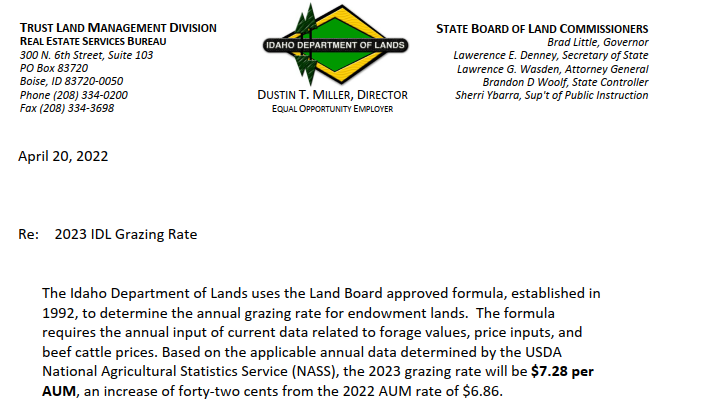
But I could also dredge up a thread where the Fed's are receiving way less in fees for use (grazing and O&G) than the states are. So that means there is also increased revenue.
State officials are even less likely to raise fees on those constituencies than the feds are. We all know they are not trying to acquire these lands to raise fees on them. Or to better maintain them.

1765580691699.jpeg
 
Here let me (and chat) help.

Federal public lands should remain under federal management because their value extends far beyond direct use or local benefit. These lands represent a shared national inheritance, preserved not merely for recreation or extraction, but for their intrinsic worth to all Americans—present and future.

Aldo Leopold captured this enduring truth when he wrote, “The value of wilderness lies not in the number of people who visit it, but in the idea of wilderness.” Public lands provide ecological stability, wildlife habitat, clean water, and open space, even for those who may never set foot on them. Leopold further observed that “To those devoid of imagination, a blank place on the map is a useless waste; to others, the most valuable part.” That “blank place” is a reservoir of resilience, humility, and restraint in an increasingly engineered world. States almost wholly do not manage for these same sets of values.

Federal stewardship ensures that these lands are managed for the long term, insulated—however imperfectly—from short-term political or financial pressures. As Theodore Roosevelt stated, “The nation behaves well if it treats the natural resources as assets which it must turn over to the next generation increased, and not impaired, in value.” While the states are often good stewards of much of their lands, they also are prone to short-term divestitures, which undermine the long-term existence of public lands.

Public lands belong to all Americans, not only those who live nearest them or profit most directly from them. Their continued federal management affirms a national commitment to conservation, shared responsibility, and the quiet but profound value of simply knowing these places still exist.
 
Man, nothing is a bigger turn off than people who can't handle an ideologic discussion, it undermines you and your position.

While I like federal lands the way they are. There is zero reason why this can't be actually discussed.

The idea that the state of Idaho cannot "afford the suppresssion costs" is patently false. And anyone who disagrees by pointing to some study, is deliberately ignoring the fact that you can pay for science to say whatever you want. And either hasn't looked at the math, or choses to ignore the math.

Per Buzz link a couple pages ago, the five year avg for wildlife suppression is just under $3 billion, and the max is under $4.5 billion.
View attachment 395663
This appears to be the national costs, but let's pretend is the just for the state of Idaho.
View attachment 395664
There are 2 million people in idaho. Simple math says that the per captia costs are on par with the typical household property tax, based on a tax rate that ~ 1/2 the national average (also 1/2 the WA level).
Idaho also has a 6% sales tax. They are forecasted to bring in $3.4 billion at that rate.

You would have be truly terrible at math to not be able to easily come up with a way to pay for suppression. Now would ID residents support that, probably not. But it's 100% possible, and honestly, not even that financially difficult in the grand scheme of thing.

And that's without even
income tax.

I would bet a kidney that it's only a matter of time before ID has funding levels that "could" pay for those costs, they're just be used for other things.
This is all well and good, but when you consider that the Feds are looking to shift more of the costs for health care, transportation, education, disaster relief, and who knows what else to the States, I think you are right. Other things are going to eat up any potential increase in state revenue long before any of that revenue trickles down to fire suppression or public lands.
 
This is all well and good, but when you consider that the Feds are looking to shift more of the costs for health care, transportation, education, disaster relief, and who knows what else to the States, I think you are right. Other things are going to eat up any potential increase in state revenue long before any of that revenue trickles down to fire suppression or public lands.

There is already an IP in progress in Oregon to repeal the DOT funding bill that was passed this summer over a reduction in federal funds. Oregonians love to complain about their roads and are up in arms over paying for their maintenance.
 

Forum statistics

Threads
117,758
Messages
2,167,601
Members
38,341
Latest member
SouthernGirl
Back
Top