
Navigation
Install the app
How to install the app on iOS
Follow along with the video below to see how to install our site as a web app on your home screen.
Note: This feature may not be available in some browsers.
More options

You are using an out of date browser. It may not display this or other websites correctly.
You should upgrade or use an alternative browser.
You should upgrade or use an alternative browser.
New World's Record Antelope
- Thread starter EliAGrimmett
- Start date

EliAGrimmett
Member
I don't recall which bucks you're referring to. Did I post something about that? I probably did, but don't remember.
There's a lot of stuff I don't remember...
Not trying to be difficult here but it makes no sense to me that a 2 year old would be at his max or peak. Certainly with a deer or elk that's not the case, why would it be with an antelope? I certainly haven't looked at as many of them as you guys but the "good" ones always seem to stand out to me, bigger body, taller and wider in the chest and of course the horns. Those animals being 2 years old seems doubtful to me.
But either way I sure enjoy looking at them....
Not trying to be difficult here but it makes no sense to me that a 2 year old would be at his max or peak. Certainly with a deer or elk that's not the case, why would it be with an antelope? I certainly haven't looked at as many of them as you guys but the "good" ones always seem to stand out to me, bigger body, taller and wider in the chest and of course the horns. Those animals being 2 years old seems doubtful to me.
But either way I sure enjoy looking at them....

There's a lot of stuff I don't remember...
Not trying to be difficult here but it makes no sense to me that a 2 year old would be at his max or peak. Certainly with a deer or elk that's not the case, why would it be with an antelope? I certainly haven't looked at as many of them as you guys but the "good" ones always seem to stand out to me, bigger body, taller and wider in the chest and of course the horns. Those animals being 2 years old seems doubtful to me.
But either way I sure enjoy looking at them....
When asked about this possibility, a couple biologists have offered a theory, and it goes something like this.
Antelope live much shorter lives, for the most part, than elk or deer. They mature at an earlier age. In their earliest years, 2.5 and younger, they are not participants in the rut activity to a very high degree. That antelope horn growth accelerates faster than body growth, so you have some younger bucks with great horns who are still afraid of a butt whoopin' from an old big-bodied buck. Therefore, it is not until their physical body size is mostly complete do they become active rut participants, and at which time their horn size will eventually start to decline.
As a result of not participating much in the rut at age 1.5 and 2.5, they enter their third winter in excellent condition, thereby the horn growth at age 3.5 might be their maximum, if conditions of moisture and forage are great. From that point on, their body condition is so degraded after the rut, that they will never reach the horn growth potential they had at age 3.5.
Some have surmized that in areas of high numbers of older bucks, these antelope won't be big participants in the rut until age 4.5, therefore resulting in peak horn growth at age 4.5.
Not sure if that holds true, but I have seen some really big-horned young bucks run like scared rabbits when a much bigger-bodied and smaller-horned buck came his way. Oak and I were in WY and I had drawn down a bead on a buck that was a lot bigger horned than the one to our left. Before we could get the OK from the cameras, the bigger-bodied buck to our left put the chase on my target and he ran off with me never getting a shot. It is interesting to watch how much body size determines the final outcome with antelope, often being enough to just scare off the big-horned young guys without so much as an altercation.
Not saying the theory is correct, but it would be interesting to collar a bunch of bucks, measure them each July when they are done with horn growth, then pattern their level of rutting activity to see what the end result is. So many other variables can go into horn growth for antelope - range conditions in November/December when they lose their horns, severity of winter, drought, spring moisture and plant growth, ..............
EliAGrimmett
Member
My two problems with all of the biologists findings are still far too much to overcome for me to believe they can grow to full potential at two years old.
1. The accuracy of the data is in question. I know this for a fact. They get most of the ages right, but not all of them.
To this point you can find some data on error rates on Matson's Laboratory website - they're one of the labs that the AAF uses for cementum aging analysis. I can't find specifics for pronghorn accuracy, but for several different species they list their error rate over a sample of 767 animals as being 30.8%. That's 236 animals that were aged incorrectly at plus or minus one year. That's a lot! They do list what they believe their hit rate is for pronghorn - 80-90%. That's still at least 100 animals aged incorrectly for every 1000. That's a giant chunk of data being lumped into the wrong group if you're doing an analysis on horn growth.
2. Never do they know how big the buck was the year before they kill it or how big it could have been the year after.
Not much they can do about this because most of their aging is done on bucks taken by hunters so knowing the year after is impossible. The year before is where I'm most interested right now.
I agree, in order to do this study right they would need to measure each buck for multiple years in a row. Actually, instead of collaring, they would need to ear tag them at birth. Then we could get some serious data on the issue. Also, it would probably have to be done in multiple states to get an accurate picture. Of course, since antelope aren't whitetail deer, I'm sure there will never be high enough interest or money to get it done right.
We have a lot of teeth laying around. We may start sending the teeth to get aged of bucks that we know we have photos of for at least two seasons. I think that could be a start to figuring out what's really going on.
canvsbk - I agree. What's sometimes cool about getting the bucks aged is that it can help explain things. We killed a buck we thought was going to be 87 a few years ago. It was only 84. It had a super small head and body. We got the teeth aged and the buck was 2.5 years old! It made perfect sense and explained exactly why we misjudged the buck in the field.
In 2006 I had my Wyoming buck aged. It scored 85 6/8. It had a giant body, head, ears, and hooves. It had scars all over it's back and even scars on it's head and face. It was in full rut and with a large herd. The aging analysis came back and said the buck was 2.5 years old. I believe this aging was incorrect and that the buck was probably at least a 3.5 year old. But who knows.
1. The accuracy of the data is in question. I know this for a fact. They get most of the ages right, but not all of them.
To this point you can find some data on error rates on Matson's Laboratory website - they're one of the labs that the AAF uses for cementum aging analysis. I can't find specifics for pronghorn accuracy, but for several different species they list their error rate over a sample of 767 animals as being 30.8%. That's 236 animals that were aged incorrectly at plus or minus one year. That's a lot! They do list what they believe their hit rate is for pronghorn - 80-90%. That's still at least 100 animals aged incorrectly for every 1000. That's a giant chunk of data being lumped into the wrong group if you're doing an analysis on horn growth.
2. Never do they know how big the buck was the year before they kill it or how big it could have been the year after.
Not much they can do about this because most of their aging is done on bucks taken by hunters so knowing the year after is impossible. The year before is where I'm most interested right now.
I agree, in order to do this study right they would need to measure each buck for multiple years in a row. Actually, instead of collaring, they would need to ear tag them at birth. Then we could get some serious data on the issue. Also, it would probably have to be done in multiple states to get an accurate picture. Of course, since antelope aren't whitetail deer, I'm sure there will never be high enough interest or money to get it done right.
We have a lot of teeth laying around. We may start sending the teeth to get aged of bucks that we know we have photos of for at least two seasons. I think that could be a start to figuring out what's really going on.
canvsbk - I agree. What's sometimes cool about getting the bucks aged is that it can help explain things. We killed a buck we thought was going to be 87 a few years ago. It was only 84. It had a super small head and body. We got the teeth aged and the buck was 2.5 years old! It made perfect sense and explained exactly why we misjudged the buck in the field.
In 2006 I had my Wyoming buck aged. It scored 85 6/8. It had a giant body, head, ears, and hooves. It had scars all over it's back and even scars on it's head and face. It was in full rut and with a large herd. The aging analysis came back and said the buck was 2.5 years old. I believe this aging was incorrect and that the buck was probably at least a 3.5 year old. But who knows.
Last edited:
EliAGrimmett
Member
Here's another interesting piece of data that illustrates my contention that 4.5 years old is the peak of an antelope's horn growth.
It appears that the AAF data uses averages when they're looking at the B&C scores for all the different age classes of animals. I think this is a poor way to look at the numbers because of the selection bias at play. A big 2.5 year old buck is almost always going to be killed for several reasons.
1. It will usually appear much larger because of the smaller head and body.
2. It will usually not be standing directly next to older bucks because the older bucks are busy rutting. Occasionally it will get chased away from the herd, but unless you're watching them at that exact moment it'll be tough to know for sure which buck is larger.
So, most of the time, an 80 inch 2.5 year old buck is going to be killed over an 80 inch 3.5 or 4.5 year old because of the perceived larger look of the horns compared to the older, larger bodied bucks.
Back to my main point...
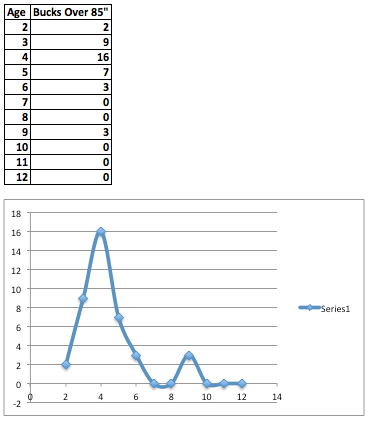
If you look at the data and use 85-inches as the cutoff (instead of using averages because of how the selection bias alters the data) from giant bucks to just good bucks we can visualize the exact curve that I believe accompanies a buck's horn growth.
Another point I haven't mentioned yet is that a lot of the teeth for those studies were sent in by my Dad and I from bucks that we guided to. I mention this because some of the bucks we got to watch for multiple years and we know if they were larger or smaller than the year before we killed them. Of the ones I know for sure here are the outcomes:
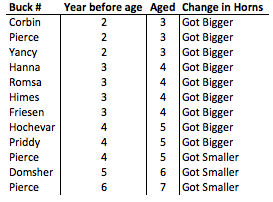
Obviously it's a small sample and hugely biased, but it's clear to me that we rarely kill 2 year olds (because 3 and 4 year old bucks are bigger) and almost every case has the buck growing larger in their 3rd or 4th year.
It appears that the AAF data uses averages when they're looking at the B&C scores for all the different age classes of animals. I think this is a poor way to look at the numbers because of the selection bias at play. A big 2.5 year old buck is almost always going to be killed for several reasons.
1. It will usually appear much larger because of the smaller head and body.
2. It will usually not be standing directly next to older bucks because the older bucks are busy rutting. Occasionally it will get chased away from the herd, but unless you're watching them at that exact moment it'll be tough to know for sure which buck is larger.
So, most of the time, an 80 inch 2.5 year old buck is going to be killed over an 80 inch 3.5 or 4.5 year old because of the perceived larger look of the horns compared to the older, larger bodied bucks.
Back to my main point...
If you look at the data and use 85-inches as the cutoff (instead of using averages because of how the selection bias alters the data) from giant bucks to just good bucks we can visualize the exact curve that I believe accompanies a buck's horn growth.
Another point I haven't mentioned yet is that a lot of the teeth for those studies were sent in by my Dad and I from bucks that we guided to. I mention this because some of the bucks we got to watch for multiple years and we know if they were larger or smaller than the year before we killed them. Of the ones I know for sure here are the outcomes:
Obviously it's a small sample and hugely biased, but it's clear to me that we rarely kill 2 year olds (because 3 and 4 year old bucks are bigger) and almost every case has the buck growing larger in their 3rd or 4th year.
Last edited:
walking buffalo
Active member
- Joined
- Jul 27, 2013
- Messages
- 111
I find this an interesting topic with lots of room for new research. Pronghorns are a unique beast.
One consideration regarding horn growth and in particular the horn growth of exceptionally large bucks is the condition of the doe during gestation and the environmental conditions during the buck's first year.
Similar to conditions that can give rise to exceptionally large bighorn rams, birth condition may play a significant role in life long horn size in Pronghorns. Large babies born during good environmental conditions simply become larger than average beyond what can be attributed to genetics alone.
I'm curious if any members here can associate mild winters and good feed years with improved trophy numbers in subsequent years....
A few papers published during the 23rd Pronghorn Antelope Workshop touched on the topic of age/environmental conditions vs. horn size.
http://homepages.ucalgary.ca/~berrendo/Draft2008Proceedings.pdf
Environmental Conditions as a Precursor of Pronghorn
Horn Size throughout their Life
DAVID E. BROWN, pg. 91
"Pronghorn horn size,and horn mass, is therefore dependent not only on the male’s age, environmental conditions preceding and during horn growth, and genetic propensity, but also on the conditions present at the time of its natality."
An Alberta horn size vs. Age study leads to a suggestion that Pronghorns max out in horn size at age 4, as noted in Eli's experience.
Comparison Between Pronghorn Age and Horn Size in
Southern Alberta
KIM MORTON, pg. 96
"The relationship between age and B&C score was not linear but in fact was non-linear, with score increasing with age until 4 years and then declining for older bucks"
One consideration regarding horn growth and in particular the horn growth of exceptionally large bucks is the condition of the doe during gestation and the environmental conditions during the buck's first year.
Similar to conditions that can give rise to exceptionally large bighorn rams, birth condition may play a significant role in life long horn size in Pronghorns. Large babies born during good environmental conditions simply become larger than average beyond what can be attributed to genetics alone.
I'm curious if any members here can associate mild winters and good feed years with improved trophy numbers in subsequent years....
A few papers published during the 23rd Pronghorn Antelope Workshop touched on the topic of age/environmental conditions vs. horn size.
http://homepages.ucalgary.ca/~berrendo/Draft2008Proceedings.pdf
Environmental Conditions as a Precursor of Pronghorn
Horn Size throughout their Life
DAVID E. BROWN, pg. 91
"Pronghorn horn size,and horn mass, is therefore dependent not only on the male’s age, environmental conditions preceding and during horn growth, and genetic propensity, but also on the conditions present at the time of its natality."
An Alberta horn size vs. Age study leads to a suggestion that Pronghorns max out in horn size at age 4, as noted in Eli's experience.
Comparison Between Pronghorn Age and Horn Size in
Southern Alberta
KIM MORTON, pg. 96
"The relationship between age and B&C score was not linear but in fact was non-linear, with score increasing with age until 4 years and then declining for older bucks"
roadhunter
Banned
- Joined
- Jul 28, 2013
- Messages
- 714
I know this is off subject andI don't mean to derail this thread but have you posted any info/pics about your Wyoming record book antelope hunt? Any idea on it's age or pics from previous years. I have watched your videos and saw the pics on your website and was curious. Thanks.
Last edited:
EliAGrimmett
Member
walking buffalo -
I started a thread about that very thing two years ago - theorizing that the year the bucks are born is the single most important factor in future horn growth. I actually had the idea about 10 years ago, but it takes a long time to accumulate any kind of data when you're basing all of it on bucks that we're able to find for multiple years and then eventually kill.
Here's a link to that thread: http://onyourownadventures.com/hunttalk/showthread.php?t=246199
As far as the does being part of the genetics I have no idea what implications that might have. I'm sure there are some, but testing it would have to be left to the biologists who might be able to tag the does and control the breeding, etc.
It's nice to see some of my armchair research validated by more thorough and controlled research. I try to keep up with the research on horn growth and genetics, but I missed the paper you mentioned. Thanks for posting it.
roadhunter -
Which Wyoming buck of mine are you talking about? Or are you referring to the New State Record we guided to? The answer to both is probably the same though. Since we just started guiding in Wyoming a few years ago we don't have very many antelope that we've seen for multiple seasons. And since a lot of the scouting and hunting is done simultaneously it's also sometimes very hard to get photos of the bucks before we kill them. We took a lot of video and photos last year so hopefully we'll be able to relocate some of the bucks and see what happened to their horn growth.
I started a thread about that very thing two years ago - theorizing that the year the bucks are born is the single most important factor in future horn growth. I actually had the idea about 10 years ago, but it takes a long time to accumulate any kind of data when you're basing all of it on bucks that we're able to find for multiple years and then eventually kill.
Here's a link to that thread: http://onyourownadventures.com/hunttalk/showthread.php?t=246199
As far as the does being part of the genetics I have no idea what implications that might have. I'm sure there are some, but testing it would have to be left to the biologists who might be able to tag the does and control the breeding, etc.
It's nice to see some of my armchair research validated by more thorough and controlled research. I try to keep up with the research on horn growth and genetics, but I missed the paper you mentioned. Thanks for posting it.
roadhunter -
Which Wyoming buck of mine are you talking about? Or are you referring to the New State Record we guided to? The answer to both is probably the same though. Since we just started guiding in Wyoming a few years ago we don't have very many antelope that we've seen for multiple seasons. And since a lot of the scouting and hunting is done simultaneously it's also sometimes very hard to get photos of the bucks before we kill them. We took a lot of video and photos last year so hopefully we'll be able to relocate some of the bucks and see what happened to their horn growth.

ihuntelk
Member
Pretty dang interesting read between this thread and your Genteics thread.
I probably 'wasted' half the afternoon getting more and more excited for the season to open in a week!
Thanks and keep em coming!
-Cade
www.HuntForeverWest.com
I probably 'wasted' half the afternoon getting more and more excited for the season to open in a week!
Thanks and keep em coming!
-Cade
www.HuntForeverWest.com
Similar threads


- Replies
- 17
- Views
- 639