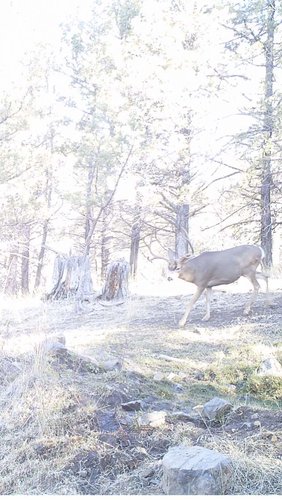
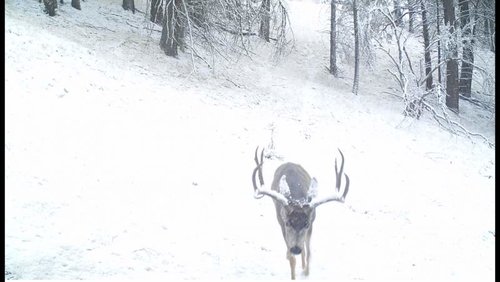
The deer in the washed out trail cam photo is a mule deer. I had a mule deer a couple years ago running around my neighborhood in town that looked just like that; if you looked just at his antlers you might think it was a white-tailed deer. All other characteristics (ears, tail, face color, body color and metatarsal gland length) indicated it was, without a doubt, a mule deer.
Take a look at the metatarsal gland(s) (may need to be close and/or have good binocs or spotting scope) the length of that gland will indicate if the deer is a mule deer, white-tailed deer or hybrid between the two. Hybrids do not occur near as much as most people think.
Metatarsal Glands: The only physical character that can be used to accurately diagnose a hybrid in the field is the metatarsal gland, which is located on the outside of the lower portion of the rear legs. The metatarsal glands on mule deer sit high on the lower leg and are 4 to 6 inches long and always surrounded by brown fur. The whitetail’s metatarsals are below the mid-point of the lower leg, less than 1 inch long, and surrounded by white hairs. A white- tail/mule deer hybrid has metatarsal glands that split the difference in location, appearance and length (between 2 to 4 inches).
ClearCreek