MT- M/S/G results 26

You are missing the point that Buzz is making. Your odds go down regardless because of the influx of people entering the draw. It doesnt matter if it is regular bonus, squared or cubed - your odds of drawing go down every year if the amount of people that enter the draw are greater
This is true, but those people are likely going to enter the draw, regardless of if there is squared points so the squared point keep your odd from falling as fast.
 
You are missing the point that Buzz is making. Your odds go down regardless because of the influx of people entering the draw. It doesnt matter if it is regular bonus, squared or cubed - your odds of drawing go down every year if the amount of people that enter the draw are greater
Appreciate the post ever once in a while I get reminded how much time we spend talking in circles my next 11 days are going to be to busy for this you boys have fun solving the problems of the Montana draw system or lack of
 
Appreciate the post ever once in a while I get reminded how much time we spend talking in circles my next 11 days are going to be to busy for this you boys have fun solving the problems of the Montana draw system or lack of
It is a fun problem where math was likely used to promote the system but probably only showed it without telling the whole story or forgetting that either tag amount will drop or participation will increase.

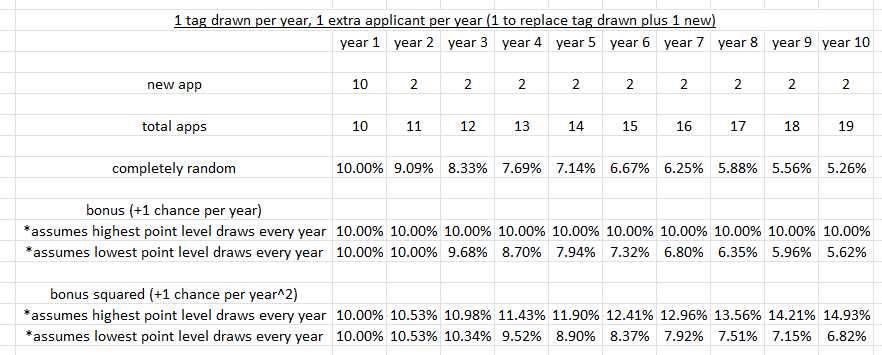
1 tag unit, 10 original applicants and every year, 2 new people apply to replace the one that drew and 1 additional applicant. Did both ends of the spectrum with an assumption that the highest point total draws and the lowest draws every year. Reality is it would fall somewhere between both extremes over the course of 25 years. You can see that even by year 10, regular bonus starts to diverge to just a plain random draw and if I would extend this out to year 25, it would get very close

1778503947652.png
 
Squared bonus points are almost the same as not squared bonus points for top point holders, and worse for lower point holders. Once in a lifetime does not improve draw odds for anyone, just has good optics. Best thing we can all do is understand that we need to do more for habitat and disease so that game populations are thriving, and avoid the argument that any one individual deserves the opportunity just because they've been in the game longer, been a resident longer, want it more. I would love to introduce a conservation sweat equity component to tag draws for all male animal tags. Starts at 10 hours for a mule deer buck, goes up to 100 for a bison bull.
Looks like you are a non resident, so in your case, maybe the squared system of bonus points doesn't change your odds much, but for residents it does. Unlike most things discussed here, math is not a matter of opinion - the squared system rewards those who have been in the game longer.
However, I see you don't want to reward those that have been in the game longer, and those who are residents. I'm not sure that would go down well here.
 
It is a fun problem where math was likely used to promote the system but probably only showed it without telling the whole story or forgetting that either tag amount will drop or participation will increase.

1 tag unit, 10 original applicants and every year, 2 new people apply to replace the one that drew and 1 additional applicant. Did both ends of the spectrum with an assumption that the highest point total draws and the lowest draws every year. Reality is it would fall somewhere between both extremes over the course of 25 years. You can see that even by year 10, regular bonus starts to diverge to just a plain random draw and if I would extend this out to year 25, it would get very close

View attachment 408031
Interesting spreadsheet. Thank goodness the number of people applying doesn't increase by 20% per year.
 
One thing that has to be taken into account is the actual unit you are applying for. If it is heavily loaded with high point applicants or not. I will leave it at that.
 
Interesting spreadsheet. Thank goodness the number of people applying doesn't increase by 20% per year.
I'm not saying it does, I'm saying it increases by 10% per year and that could be via having 10% more applicants or by reducing tags by 10% which has absolutely happened over the last 25 years.

Just from the tag side as mentioned in a previous post here is the reduction in tags over the last 20:

Moose tags 2006 610 vs 2026 312.

Sheep tags 2006 332 vs 2026 105.

Goat tags 2006 293 vs 180.
 
Looks like you are a non resident, so in your case, maybe the squared system of bonus points doesn't change your odds much, but for residents it gives the illusion it does. Unlike most things discussed here, math is not a matter of opinion - the squared system rewards those who have been in the game longer.
However, I see you don't want to reward those that have been in the game longer, and those who are residents. I'm not sure that would go down well here.
Fixed it for you.

Question for the group: are hunters more convinced of antler point restrictions or bonus/preference points systems working in their favor?
 
I'm not saying it does, I'm saying it increases by 10% per year and that could be via having 10% more applicants or by reducing tags by 10% which has absolutely happened over the last 25 years.

Just from the tag side as mentioned in a previous post here is the reduction in tags over the last 20:

Moose tags 2006 610 vs 2026 312.

Sheep tags 2006 332 vs 2026 105.

Goat tags 2006 293 vs 180.
I've spent hours studying the draw statistics, calculating spreadsheets, trying to figure out what my odds might be. My odds for the units that I've applied in are approximately twice what they would be on the squared system, than they are on straight bonus points, and way way higher than if there was no bonus points system. The number of people taking part in the draw each year only grows by a few percent. I've been surprised by the percent of people with lots of points that drop out - I assume that this is because some draw the license, some move out of state, some quit hunting, and some I'm sure die. Bottom line is that the system helps those that keep applying year after year. I just wish they had started it 10 years earlier.
 
Some of you really seem to struggle with math. Here is a spreadsheet that might help clear a few things up on the bonus points. It certainly helps your draw odds to have more points and even better at max. I took all the Moose districts in Montana and combined all the drawing by points. I only looked at either sex tags and residents. While I don't include non-residents, to show my point it is not needed, it just complicates things.

Number of PointsNumber of ApplicationsNumber of Successes% Successful
0​
2864​
0​
0.0%​
1​
3692​
0​
0.0%​
2​
3363​
1​
0.0%​
3​
2996​
4​
0.1%​
4​
2555​
3​
0.1%​
5​
2287​
3​
0.1%​
6​
1898​
12​
0.6%​
7​
1688​
5​
0.3%​
8​
1506​
7​
0.5%​
9​
1337​
8​
0.6%​
10​
1119​
7​
0.6%​
11​
1038​
8​
0.8%​
12​
984​
14​
1.4%​
13​
608​
3​
0.5%​
14​
553​
10​
1.8%​
15​
519​
9​
1.7%​
16​
494​
7​
1.4%​
17​
482​
7​
1.5%​
18​
427​
8​
1.9%​
19​
402​
18​
4.5%​
20​
383​
15​
3.9%​
21​
380​
14​
3.7%​
22​
374​
16​
4.3%​
23​
370​
10​
2.7%​
24​
465​
19​
4.1%​
25​
490​
23​
4.7%​

This was for the 2025 draw. Stats for 2026 aren't out as of yet. This shows the number of people with each amount of points, how many were successful and the percent at each bonus point level. As you can see the best odds were at max points (4.7%) last year. I am sure some will point out that certain number of points had higher odds even though they had less points, such as 19 points had 4.5% chance of drawing and 23 points only had 2.7%. This is the random part of this drawing coming through since these percents are what ACTUALLY happened in the draw. Using statistical theory you can calculate the odds of each person, but in practice that doesn't happen every time. Think about it this way, if you flip a coin 4 times you know it should come up heads twice and tails twice by theory, but that doesn't always happen in practice....this is the random part.

 
Some of you really seem to struggle with math. Here is a spreadsheet that might help clear a few things up on the bonus points. It certainly helps your draw odds to have more points and even better at max. I took all the Moose districts in Montana and combined all the drawing by points. I only looked at either sex tags and residents. While I don't include non-residents, to show my point it is not needed, it just complicates things.

Number of PointsNumber of ApplicationsNumber of Successes% Successful
0​
2864​
0​
0.0%​
1​
3692​
0​
0.0%​
2​
3363​
1​
0.0%​
3​
2996​
4​
0.1%​
4​
2555​
3​
0.1%​
5​
2287​
3​
0.1%​
6​
1898​
12​
0.6%​
7​
1688​
5​
0.3%​
8​
1506​
7​
0.5%​
9​
1337​
8​
0.6%​
10​
1119​
7​
0.6%​
11​
1038​
8​
0.8%​
12​
984​
14​
1.4%​
13​
608​
3​
0.5%​
14​
553​
10​
1.8%​
15​
519​
9​
1.7%​
16​
494​
7​
1.4%​
17​
482​
7​
1.5%​
18​
427​
8​
1.9%​
19​
402​
18​
4.5%​
20​
383​
15​
3.9%​
21​
380​
14​
3.7%​
22​
374​
16​
4.3%​
23​
370​
10​
2.7%​
24​
465​
19​
4.1%​
25​
490​
23​
4.7%​

This was for the 2025 draw. Stats for 2026 aren't out as of yet. This shows the number of people with each amount of points, how many were successful and the percent at each bonus point level. As you can see the best odds were at max points (4.7%) last year. I am sure some will point out that certain number of points had higher odds even though they had less points, such as 19 points had 4.5% chance of drawing and 23 points only had 2.7%. This is the random part of this drawing coming through since these percents are what ACTUALLY happened in the draw. Using statistical theory you can calculate the odds of each person, but in practice that doesn't happen every time. Think about it this way, if you flip a coin 4 times you know it should come up heads twice and tails twice by theory, but that doesn't always happen in practice....this is the random part.

You too aren't understanding it. Yes, having 25 bonus points puts you significantly further ahead in your draw odds than the guy with 5 points. What you are looking over is the fact that the "4.7%" chance to draw that you see in that above chart you created for that top group of maximum point holders is that it is FALLING every year. Last year it probably was 4.6%. Was probably 5% 5 years ago. 15 years ago it was probably 10%.
 
Last edited:
I can agree that the massive influx of NEW people throwing in, due to the super low cost of entry and the massive hype, media, simplified data sources, and influencers guiding people to the draw out there these days is killing us.
 
You too aren't understanding it. Yes, having 25 bonus points puts you significantly further ahead in your draw odds than the guy with 5 points. What you are looking over is the fact that the "4.7%" chance to draw that you see in that above chart you created for that top group of maximum point holders is that it is FALLING every year. Last year it probably was 4.6%. Was probably 5% 5 years ago. 15 years ago it was probably 10%.
That is probably true, I haven't looked at the numbers. But the reason for that isn't the method (Bonus Points), it's the other things pointed out (less tags, more people). My point is about the bonus points not working. They certainly work as intended.

I'm a big fan of the pay up front, I think numbers would decrease significantly. Its amazing how many people I know that apply just cause they can and it costs them nothing. If they had to pay up front, they wouldn't apply, regardless of if they get it back or not.
 
I was at MSU grad ceremony for my daughter and got a text that results were posted. My son and I were quickly checking on our phones - no luck all around with us. Did see @samuel_284Win get his PHD award - the very first diploma of what seemed like 1000 people (big congrats!). To think there was even another session like that today is mind blowing.
View attachment 407803View attachment 407804
I had no idea I would lead the graduates for hooding, it was super cool
 

Forum statistics

Threads
119,041
Messages
2,214,754
Members
38,735
Latest member
blank406
Back
Top