I have no experience with western MT deer hunting, but my understanding is mule deer numbers have been hurting over there for a long time. I wouldn’t judge the health of the mule deer herd by what’s in your parents’ back yard or what you might see in town. If you’ve only been hunting in eastern MT for 5 years, I can see why you wouldn’t notice much of a change in deer numbers. I was born and raised in eastern MT and it’s down right depressing comparing the quality of todays mule deer hunting to what it was like when I was growing up, and I’m only in my 30’s.No offense taken @rogerthat. This is a long conversation and there have been many tangents.
As I indicated, I'm originally from western MT, and my frame of reference for eastern MT is just the hunting I've done in Eastern MT over the last 5 years, which although that's half a decade, hasn't been enough time to note any differences in deer populations, but certainly differences in hunter pressure.
So my solution for not finding deer is to simply drive somewhere else or hike further, and I've never struggled to find and kill mule deer across the state, usually as an afterthought or out of desperation if I couldn't fill my elk tag.



Navigation
Install the app
How to install the app on iOS
Follow along with the video below to see how to install our site as a web app on your home screen.
Note: This feature may not be available in some browsers.
More options

You are using an out of date browser. It may not display this or other websites correctly.
You should upgrade or use an alternative browser.
You should upgrade or use an alternative browser.
Montana Mule Deer Mismanagement
- Thread starter rogerthat
- Start date

Elky Welky
Well-known member
I'm also in my mid 30s, and my parents' yard is in the country, 15 miles out of town on 20 acres at the foothills of some mountains, to clarify.I have no experience with western MT deer hunting, but my understanding is mule deer numbers have been hurting over there for a long time. I wouldn’t judge the health of the mule deer herd by what’s in your parents’ back yard or what you might see in town. If you’ve only been hunting in eastern MT for 5 years, I can see why you wouldn’t notice much of a change in deer numbers. I was born and raised in eastern MT and it’s down right depressing comparing the quality of todays mule deer hunting to what it was like when I was growing up, and I’m only in my 30’s.
But that may just be it: if I'm just used to there being less mule deer as a western MT hunter (although not really...) where I grew up hunting, then maybe eastern Montana is easier (not exactly the word I'm looking for, perhaps: "more expected") for me than it is for those who are used to more.

rogerthat
Well-known member
- Joined
- Aug 29, 2015
- Messages
- 3,659
It’s not just an eastern Montana thing. Region 3 south of Butte is in pretty tough shape compared to 20 years ago also. I spent a week on the winter range down there this year looking for wolves. However Montana is a giant state so I’m sure everyone’s observations would vary greatly. Much of powder river was down 60% plus vs the 10 year LTA so I’m surprised you didn’t notice that a little @Elky Welky this past year

MTelkHuntress
Well-known member
I guess how I have come to understand mismanagement through these threads is both a decrease in population and a lack of broad age structure in mule deer. Not as simple "no big bucks". Also lower buck to doe ratios.
I don't think anyone here is saying there needs to be massive mule deer bucks behind every corner, but rather there should be some mature bucks out there unlike what folks who have hunted these areas for years are seeing.
I haven't hunted eastern Montana, but I have hunted western Montana my whole life as have generations of my family. The stories of seeing hundreds of mule deer in a day in some areas is amazing but you just don't see that today. Yes, there's habitat changes, more hunters and different management priorities, but it's still a stunning change in mule deer populations.
The term "shifting baseline" comes to mind and I'm curious where this baseline will go. Obviously we can't get back to the days before settlers but I do wonder where the balance is.
I think some folks here also understand how slow change in the department can be and that if we don't enact changes now, then there could be some serious damage to mule deer populations in the future (some are already seeing the damage being done). Rather, we should be taking a more proactive approach, especially with the increase of hunters in the field.
Also I'm just gonna say it, I hope antlerradar is on the mule deer committee (as well as other HT members). There's many different ideas and I hope the new committee can explore those more.
I don't think anyone here is saying there needs to be massive mule deer bucks behind every corner, but rather there should be some mature bucks out there unlike what folks who have hunted these areas for years are seeing.
I haven't hunted eastern Montana, but I have hunted western Montana my whole life as have generations of my family. The stories of seeing hundreds of mule deer in a day in some areas is amazing but you just don't see that today. Yes, there's habitat changes, more hunters and different management priorities, but it's still a stunning change in mule deer populations.
The term "shifting baseline" comes to mind and I'm curious where this baseline will go. Obviously we can't get back to the days before settlers but I do wonder where the balance is.
I think some folks here also understand how slow change in the department can be and that if we don't enact changes now, then there could be some serious damage to mule deer populations in the future (some are already seeing the damage being done). Rather, we should be taking a more proactive approach, especially with the increase of hunters in the field.
Also I'm just gonna say it, I hope antlerradar is on the mule deer committee (as well as other HT members). There's many different ideas and I hope the new committee can explore those more.
This is an excellent post.I guess how I have come to understand mismanagement through these threads is both a decrease in population and a lack of broad age structure in mule deer. Not as simple "no big bucks". Also lower buck to doe ratios.
I don't think anyone here is saying there needs to be massive mule deer bucks behind every corner, but rather there should be some mature bucks out there unlike what folks who have hunted these areas for years are seeing.
I haven't hunted eastern Montana, but I have hunted western Montana my whole life as have generations of my family. The stories of seeing hundreds of mule deer in a day in some areas is amazing but you just don't see that today. Yes, there's habitat changes, more hunters and different management priorities, but it's still a stunning change in mule deer populations.
The term "shifting baseline" comes to mind and I'm curious where this baseline will go. Obviously we can't get back to the days before settlers but I do wonder where the balance is.
I think some folks here also understand how slow change in the department can be and that if we don't enact changes now, then there could be some serious damage to mule deer populations in the future (some are already seeing the damage being done). Rather, we should be taking a more proactive approach, especially with the increase of hunters in the field.
Also I'm just gonna say it, I hope antlerradar is on the mule deer committee (as well as other HT members). There's many different ideas and I hope the new committee can explore those more.
brocksw
Well-known member
Edit: incorrect post
Last edited:

Carnage2011
Well-known member
I understand what you are saying, but how would they cut tags that are OTC? They aren’t going to go limited entry statewide so I’m not really sure what they could do this year..Here's a question....has MT FWP indictated at all that they will be cutting their deer tags this year? If not, that to me would highlight the difference in management and perhaps the frustration by many on this thread
I say this because for 2023...
Idaho - cut their tags
Wy - cut their deer tags
ND - cut their deer tags
CO, not a MT neighbor but..... They cut their deer tags.
Even UT cut their deer tags.
How is that every state around MT (plus some) cut their deer tags this year due to winter, and MT didn't? Or did they and I missed it?
brocksw
Well-known member
Please correct me if I'm wrong, but my understanding is that MTFWP still has the ability to cut doe tag availability to residents and NR.I understand what you are saying, but how would they cut tags that are OTC? They aren’t going to go limited entry statewide so I’m not really sure what they could do this year..
Carnage2011
Well-known member
You are correct. I forget that we give out shitloads of doe tags. My apologies.Please correct me if I'm wrong, but my understanding is that MTFWP still has the ability to cut doe tag availability to residents and NR.
I tried that. I nicely got told I didn’t know what I was talking about and to pound sand.Here's a question....has MT FWP indictated at all that they will be cutting their deer tags this year? If not, that to me would highlight the difference in management and perhaps the frustration by many on this thread
I say this because for 2023...
Idaho - cut their tags
Wy - cut their deer tags
ND - cut their deer tags
CO, not a MT neighbor but..... They cut their deer tags.
Even UT cut their deer tags.
How is it that every state around MT (plus some) cut their deer tags this year due to winter, and MT didn't? Or did they and I missed it?
I said what about private land only doe tags. That also is not an option.
Someone should explain to me how they come up with their population totals though. The aerial counts are a small part of the equation from my understanding. The equation went right over my head.
They told me they have to wait until the spring counts to make any decisions on doe tags. That could be changed at the June commission meeting. I got the feeling that was unlikely at best.

cgasner1
Well-known member
- Joined
- Apr 24, 2016
- Messages
- 5,763
Spots I hunted in eastern Montana it wasn’t uncommon to see 5-10 four point bucks a day hiking nothing crazy just little guys but it was good to see them. Now you lucky to see a couple bucks in a weekend and they are 2x3.

antlerradar
Well-known member
I will be applying. I have never applied for a committee and not been chosen, we shall see those past commitments pays off. This is the committee I want the most.Also I'm just gonna say it, I hope antlerradar is on the mule deer committee (as well as other HT members). There's many different ideas and I hope the new committee can explore those more.
MTelkHuntress
Well-known member
I will be applying. I have never applied for a committee and not been chosen, we shall see those past commitments pays off. This is the committee I want the most.
I had a really good feeling you might apply.

huntin24/7
Well-known member
Maybe I’m just naive, but I guess I just don’t see the problem with every unit being limited entry for mule deer and many units being species specific. I don’t mean this primarily for trophy management purposes either, but each unit can only handle so many deer of either sex taken off the landscape every year. I don’t have sympathy for any hunter whose inconvenience from having to pick a unit and hunt only that unit when they draw is more of an issue than the overall herd health of the deer in this state.

They will probably cut doe tags. But they won’t eliminate them.Please correct me if I'm wrong, but my understanding is that MTFWP still has the ability to cut doe tag availability to residents and NR.
Here’s what’s on the books for this year
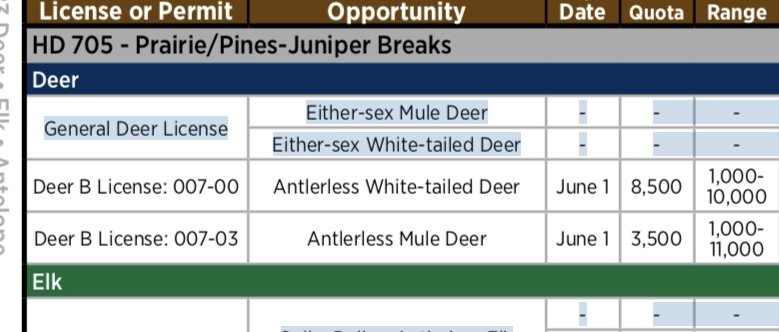
The excuses I’ve gotten is the deer migrate between districts so it wouldn’t work. Besides the excuse of deer numbers doing great. But let’s be real FWP can’t even handle a drawing for the big 3. Can you imagine if they had to figure it out for each deer districtMaybe I’m just naive, but I guess I just don’t see the problem with every unit being limited entry for mule deer and many units being species specific. I don’t mean this primarily for trophy management purposes either, but each unit can only handle so many deer of either sex taken off the landscape every year. I don’t have sympathy for any hunter whose inconvenience from having to pick a unit and hunt only that unit when they draw is more of an issue than the overall herd health of the deer in this state.
huntin24/7
Well-known member
That’s a fair point.lol I’m sure the deer in other states in limited entry units never migrate to other units either.The excuses I’ve gotten is the deer migrate between districts so it wouldn’t work. Besides the excuse of deer numbers doing great. But let’s be real FWP can’t even handle a drawing for the big 3. Can you imagine if they had to figure it out for each deer district

 . Maybe growing up in another state where you applied for a specific unit makes it bother me less. I personally don’t have a problem not drawing a buck tag every year if the numbers don’t warrant it. There are other species out there to hunt also.
brocksw
Well-known member
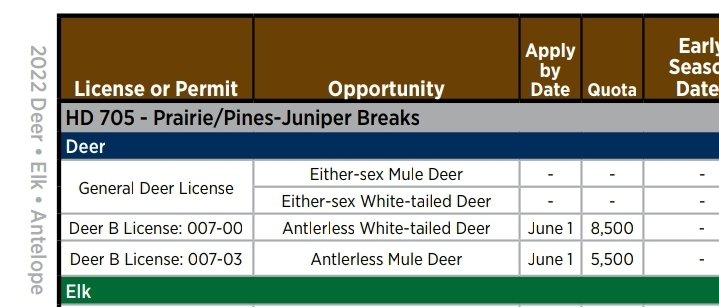
2022 numbers. A reduction of 2000 for 2023. Ok, I retract my original post. My fault.They will probably cut doe tags. But they won’t eliminate them.
Here’s what’s on the books for this year
View attachment 276282
Ya it’s a bullshit excuse. They don’t even know where the deer are being killed at to begin withThat’s a fair point.lol I’m sure the deer in other states in limited entry units never migrate to other units either.
antlerradar
Well-known member
Five years is not enough time, sure you can lase up your boots a little tighter and find deer, might even find a big one if you are very lucky. I started hunting around the Custer in 78, The mule deer hunting for the most part been in constant decline, the 80's were better than the 90's were better than the 2000's were better than the 2010's and the 2020's are showing no sign of breaking the trend. This is the problem, sure some years there is some improvement, but the long term trend is going in the wrong direction and is unsustainable. At fist it was just a decline in the number of big buck, but for the past 15 or so years it is not just the older age buck but all deer numbers. This is most pronounced on the bigger blocks of public land. Some of the places I had great success in the 80's are now almost deer less now.At 41 pages, this thread is pretty long but I genuinely would like to know what the consensus is here among the Hunt Talkers.
Obviously folks are unhappy with mule deer management in MT, but for the life of me I can't detangle what everyone here is complaining about as it relates to mule deer. As someone born and raised in Western MT who now lives in South-Central MT, I've never had a hard time finding mule deer anywhere. I've hunted extensively in powder river country the last 5 years, as well as in the northern 700s, the 600s, 400s, and 300s over my life. Although I have seen the number of hunters, resident and nonresident alike, spike to absurd levels, I haven't personally observed much difference in the deer numbers.
In the 80's and 90's most of the concern was about the lack of big bucks. Now many are still concerned about the lack of big bucks, but the poor deer numbers lack of recovery form the 2012 winter is just as concerning. This is most apparent on the bigger blocks of public land.Is this conversation really just a concern with a lack of finding big bucks? Is the interest here more about managing for trophy class animals as opposed to harvesting meat? Another thread here seems to take great issue with hunting for does. As an opportunity-state, Montana has never been all about trophies; or has our culture changed and did I just miss it?
When doe hunting on the Custer was first proposed in I think the 90's, I was all for it. My thinking was that if a few does were shot off the roads, the does would move to the roadless places I liked to hunt and fewer bucks would be taken by the orange army of roadhunters. Boy was I wrong, The does herds in the easy to access and best habitat were shot out of existence, Read the rose-pedal effect. Other does may have changed where they live, but they didn't move to the rough roadless ground. Does tend to prefer the most productive habitat according to the does are from Venus, bucks are from Mars article in Montana Outdoors. The does found the productive land on private much more to their liking. The problem with the doe tags is that there are zero restrictions on where the tags are filled. Far too many are filled on the bigger blocks of Public. The public never recovers as fast private and as soon as numbers start to recover region wide, FWP is increasing the number of doe tags. Deer numbers never make much of a recovery on public land.
Every one wants opportunity, but it has its tradeoffs. Most are aware of the tradeoff between more opportunity and less quality. The problem is when quality slips badly some hunters are willing to pay for better hunting. The demand for new hunting leases near me is not coming from outfitters, it is coming from well off resident hunters that are looking for better quality hunting. This new demand is directly tied to the decline in quality hunting on public land and opportunity management. To a landowner opportunity is money, easy to get tags, long seasons, the rut and any other opportunity all increase the price someone will be willing to pay so there is also a tradeoff with access. Simply put more opportunity less access.
The rut hunt was great in the 70's when hunters could get access to just about everywhere. Wait until bad weather and the rut brought the bucks out of the mountains and rough breaks to rut with the does in the fields was a hell of a deal. You can still hunt those fields, but you will have to pay. When my ancestors first moved of SE Montana the rule was, control the water you controlled grazing on the surrounding government land. Today we have a different rule. Control the doe herds on the hay field and you can control the bucks on the near by public. Having the season run the length of the rut moves lots of bucks from public to private. Sure there are some that move from private to public. Kind of like there are some people driving into New Orleans when a hurricane is coming. Having hunters blasting every doe that moves on public is not helping. I don't know if ending the rut hunting will result in more big bucks, I think it will but I could be wrong. I am certain that a lot fewer bucks will be shot in a hay field form the cab of a pickup.I've also noted some gripes about hunting during the rut. Why is this a problem?
CWD is very concerning, but that doesn't seem to be the focus of the last few pages of this conversation. Mandatory reporting would be great for everything, not just deer. NR pressure applies to all species, not just deer. What is it about mule deer, specifically, that is a problem?
I'm not looking to get attacked here; I genuinely want to know what the "mismanagement" is that started this thread. It's clear to me that folks have strong feelings about mule deer. If anyone can share some resources beyond anecdotal observations, and help me succinctly understand what the real issues are, I would greatly appreciate it. Thanks all!
Last edited:
Similar threads


- Replies
- 12
- Views
- 857

- Replies
- 602
- Views
- 40K