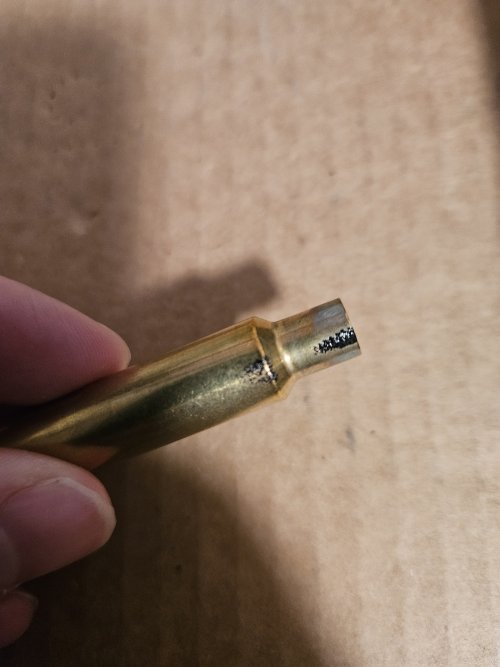
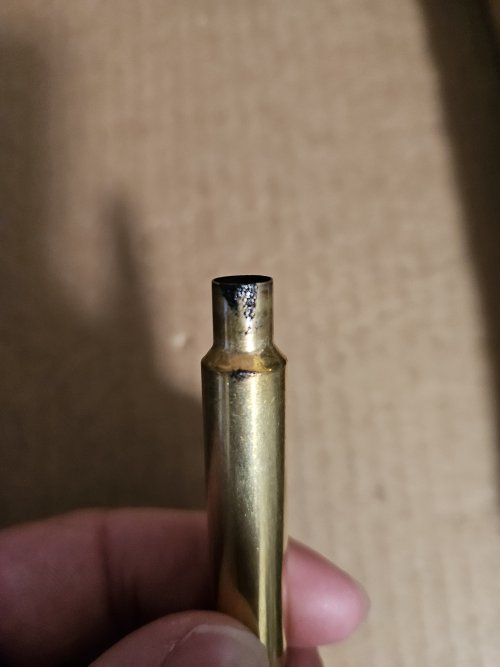
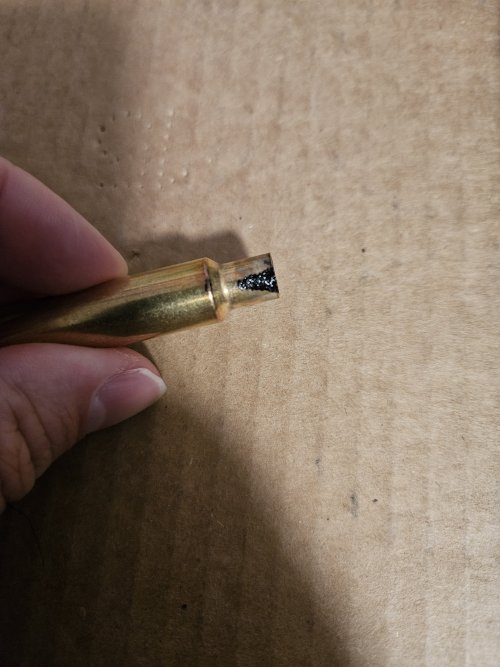
I've seen this from ejected semi-auto shells landing on something that can melt. Like maybe the old me blazing away at a deer too close to the pickup, back in the day.

Two different head stamps. Common denominator is, what? Something in the chamber, or where they landed after being ejected? Start with the borescope and check the chamber.
If you have picked up a piece of brass ejected from a Rem 742, BAR, or Garand you know how much heat there is in the chamber. One black bristle off a bore brush could do this.
HT veterans are going to read this and wonder if I crap on paper plates and burn it in the campfire. I do not. Not yet.
FWIW - My gun club puts carpet over the shooting benches. Most stations have bottleneck case shaped spots melted in the carpet. Lot's of AR brass flying around these days.
As far as getting it off, we baby our hunting brass too much IMHO. Years ago I turned tapered mandrels that cover most of the major calibers. .177-.224, .224-.257", etc. I have these from .177 all the way up to .500". It doesn't take that many to cover that range of sizes. I chuck these in my drill press and push the empty case onto the mandrel until it friction grabs. If the case hits bottom before it grips the mandrel, you go to the next bigger mandrel. You can clean all kinds of stuff off brass this way using steel wool. This is how I cleaned all my brass when I was too young and poor to buy a tumbler. Most of these were made 50 years ago freehand using re-bar on my Grandad's drill press . You chuck up, turn down the shaft end to somewhere between 1/4" and 3/8". Then you flip it around and freehand the taper. I still find old brass around here with steel wool polishing marks. The heat from the steel wool or 3M pad will cause the brass to expand and the case will pop right off at the proper moment.
You can trim brass this way, too. Another lesson for another day. Put water in the case and you can round up the neck and pop out dents with a tight mandrel and the drill press (not spinning.) You can use this wet method to deprime Berdan. Your imagination is the only limit when you are poor or a cheapskate. Most of us today put a higher value on our time. Me too, but I keep these mandrels and use them occasionally.
Having said that, I would put this brass in the freezer overnight first thing to see if the gunk will pop off easily.