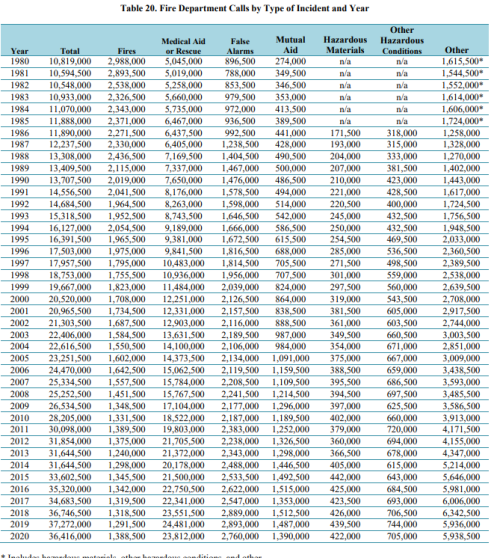
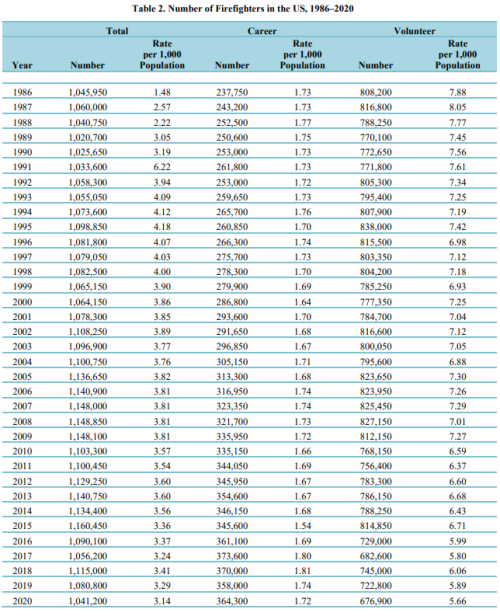
I’ve been a volunteer for the better part of a decade - at times just a firefighter, an Assistant Chief, a trustee, and now a captain. We have more calls every year – twice as many last year than just 15 years ago – and there are functionally about 8 of us who respond with any regularity – 11 total.
I appreciate the hell out of any group taking seriously the issue of recruitment, and even as important, retention. In the last ten years, it’s a literal truth that for every 3 or 4 who join our department, 1 will stick around more than a year. This is the case for most depts. It’s not for everybody.
I don’t like the idea of a special hunting season for firefighters/EMS. I actually do think it would get more folks volunteering, but I just have a moral conundrum about it. When we consider all those roles that exist within a society that are critical – volunteers, LEOs, teachers, medical, small business owners, large business owners – I have a tough time putting any on a pedestal above the others in regard to access to the Public Trust.
I have used dozens of hours of my personal leave over the years to respond to calls. I really do like the idea of allowing state employees 24 hours of leave to respond – but when I look at our own department and the departments adjacent, a small percentage are state employees – and I live 20 minutes from Helena. How do we help those who work in the private sector?
Marketing campaigns are great, though I question their efficacy. I don’t know much about the tax exemption, but I think that would be great too.
Here in Montana, a person who is a VFD member for 20 years, and attends their allotted 35 hours of training annually every one of those years, is eligible for $175 a month at the end of that 20 years. The Volunteer Firefighters Compensation Act, like many of the other proposed incentives, is appreciated, but it’s a nicety. No one joins or stays for it.
Here's some thoughts I have:
1. Force our departments of transportation to have paid and professional on-call teams that respond to vehicle accidents for traffic control and maybe other transportation-related situations. When it comes to accidents (over 70% of our calls), we respond for extraction, medical, and car fires – but the vast majority of those are traffic control. Holding signs, setting up cones, waiting for tow trucks, waiting for cleanup. This is an enormous suck of time, and is the most dangerous thing we do, and, theoretically, any incident lasting more than 4 hours should be handled by the DOT. I have yet to see it happen. Yep. It'll cost money, but one centrally located team could probably cover half a dozen rural fire districts.
2. The vast majority of our local tax dollars dedicated to the VFD benefit travelers who don’t pay local taxes. When VFD members respond to those accidents, they should be paid an hourly wage, and a damn good one because it's dangerous work, by the insurance companies of the accident-havers when those accident havers are not local taxpayers. A state office dedicated to acquiring those funds from insurance would need to be created. I've been involved with recouping expenses from commercial accidents, and we spend an inordinate amount of time doing paperwork, and don’t have any more.
3. 50 years ago, firefighters trained putting the wet stuff on the red stuff. Now, the amount of training just to be a basic responder is measured in hundreds of hours. HazMat, traffic control, gas leaks, medical assists, wildland fire, structure fire, and whatever else is thrown your way. I have seen the training overwhelm people and think it is one of the main issues of retention, and yet, the public expects professionals and frankly, you need to be trained to be safe. How do we navigate this in the volunteer world? I think paying wages for training may be part of it.
4. This is radical, but a requirement that US citizens engage in some sort of civic duty for a certain period of time. 5 years? I believe the shortage of volunteers we are seeing is simply a symptom of the Slow Death of Rural America and Civic Duty in general. When I was a kid, which was not that long ago, most able-bodied men I knew were volunteers. Only 40 years ago, there was a waiting list to join the local VFD. Those folks’ lives weren’t any easier than ours, and they didn’t have more free time. They believed in service. Our problem is a cultural one as much as anything.
Money, tax incentives, hunting preference, retirement, community praise - it's all nice. But the burnout and crisis is at base a function of a resource contraint, and the resource is willing souls. Many hands make light work. If we had a full roster, I can't imagine how much less stress we would all collectively endure and how much better we'd be.
"A mystery of the universe is how it has managed to survive with so much volunteer help." - Norman Maclean





 cowboystatedaily.com