Need a subscription to read that article...
Elk Zero: How one smuggled elk could have caused an ecological crisis in Montana
David Murray, Great Falls TribunePublished 6:00 a.m. MT Feb. 10, 2020
Elk gather to breed at the Slippery Ann Elk Viewing Area.
CONNECT
TWEETLINKEDINCOMMENTEMAILMORE
It reads like a forensic crime drama - and in a very real sense it is.
A Montana game warden learns of an unusual elk shot along the Rocky Mountain Front. The animal has physical peculiarities unlike anything the department has seen before. Genetic testing reveals that the young bull is of an exotic sub-species, and that it came from a herd more than 600 miles from where it was shot.
How did it get here? Who released it into the wild? What would have happened had the bull lived, intermingling for years with Montana's native elk population?
When a new disease appears in humans, pathologists make every effort to identify 'Patient Zero' - the first person to become infected with the new pathogen. Finding patient zero is important because knowing that person's history can help to determine how and when the outbreak started.
This unusual two-year-old elk harvested 16 months ago in the foothills of the Rocky Mountains is FWP's "Elk Zero."
"It wasn’t just an elk," remarked Dave Holland, game warden captain for Montana Fish, Wildlife and Parks. "It had the ability to be an ecological disaster."
The elk with florescent antlers
On Oct. 20, 2018, a 'spike' bull elk was legally harvested north of Choteau. The hunter didn't immediately notice anything unusual about the animal, and took it to a wild game processor to have it butchered. It was there that things began to get interesting.
An aerial photograph of Choteau, Montana (Photo: COURTESY PHOTO)
According to Holland, when the hunter returned to check on his order the processor asked him what the deal was with the elk's antlers. The bull's spikes had been painted orange, but the hunter hadn't noticed because he is color blind.
The elk's florescent antlers weren't its only unusual feature. When Warden Ron Duty inspected the animal's carcass he discovered it had been castrated. Duty began asking people around Choteau if they'd ever seen the elk, or knew who was responsible for it.
“People had videos of this elk," Holland recalled. "It would walk right up to people. Obviously, humans had been interacting with this elk, probably since it was a calf."
Some of the locals had even given it a name - "Buford" - but no one claimed responsibility, nor claimed to know its origin.
The possibility that the elk had somehow escaped or been released from a regional game farm was also explored, but there was no record of a missing animal, something that would have almost surely existed had it been raised in commercial captivity.
“Game farms are highly regulated," Holland noted. "They have to be fenced. All the animals have to be documented, and when they're harvested they have to be inspected.”
FWP's interest in the case was motivated by more than simply idle curiosity about an unusual domesticated elk. Not knowing where Elk Zero came from, or whether it was just one member of a larger group of introduced elk, could have serious animal health implications.
“The importation of any animal brings with it a full community of parasites and pathogens," explained Emily Almberg, disease ecologist for Montana Fish, Wildlife and Parks. "Some things might be pretty benign, but there are things that we worry about that might be difficult to detect just by looking at an animal."
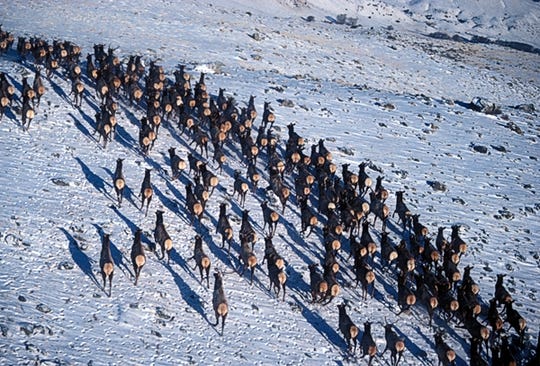
A herd of Rocky Mountain elk in Montana (Photo: Montana Fish, Wildlife and Parks)
Chronic wasting disease, bovine tuberculosis and brucellosis are all diseases carried by elk, and which can be transmitted by them to other animals - in some cases to livestock. Not knowing where Elk Zero had come from or what it had been exposed to was a serious consideration.
Yet, no one in the Choteau area seemed to know - or would claim to know very much about it. There were, however, two individuals more directly connected to Elk Zero than the rest of the community.
FWP investigators were able to prove that two people from Choteau had been feeding the elk, which is a violation of state law.
In Montana it's a misdemeanor offense to attract wildlife of any type with food or other attractants like salt licks; the lone exception being the recreational feeding of birds. Violators face potential penalties of up to a $1,000 fine, six months in jail and a loss of their hunting, fishing, or trapping privileges.
Why feeding wildlife is a crime
Many Montanans feel a strong urge, born in compassion, to feed wild animals that appear to be struggling. Not only is feeding wildlife illegal, its also a bad idea.
“People have the impression that wildlife need help; that we have to feed them to get them through the winter," said Game Warden Captain Dave Holland. "But when you put out an attractant like salt or food, you start unnaturally congregating the animals, which will help spread disease."
A recent example of this is the rapid spread of chronic wasting disease in deer congregating in and around Libby. The fatal neurological disease was unknown west of the continental divide until the spring of 2019, when a single white-tailed deer in Libby tested positive for the disease.
Since then more than 60 deer in the area have tested positive for CWD, many of them congregated in areas where people were actively feeding deer.
Feeding wildlife also habituates them to human food sources making it more likely they will be unable to survive on their own.
“You’re actually doing them a disservice because if they don’t learn how to forage for themselves they’re not going to survive after you’ve stopped feeding them," Holland notes. "It can’t go on forever."
“Most wildlife has evolved without humans helping them," he added. "They’ve got it figured out. They know how to survive. We don't find salt blocks in nature."
Holland said the residents were cited for feeding the elk, but repeatedly and adamantly denied having anything to do with his presence in Choteau, or to knowing who did.
"We are not saying they introduced the animal," Holland emphasized. "We were able to prove they fed the animal, which is a violation of (Montana law.)
Potential impact of introduction
FWP officials were at a dead end, but there remained one possible avenue of investigation.
“There was this rumor around the community that possibly this elk could have been brought to Montana from Washington," Holland said.
Holland contacted his counterpart with the Washington Department of Fish and Wildlife to see if was possible to connect Elk Zero with a herd in that state.
The possibility that Elk Zero was transported to the Choteau area from out of state added another layer of concern. Montana's elk herd belongs to a unique genetic subspecies identified as Rocky Mountain elk, which are prized by hunters for their large antlers. Those roaming the temperate forests of western Washington are Roosevelt elk, which have larger bodies, are slightly darker in color and have smaller antlers.
Despite the fact that Elk Zero had been castrated, the presence of a free-roaming bull elk, from a different subspecies and just reaching its sexual maturity, caused alarm among some wildlife managers.
“If you start intertwining those populations (Roosevelt and Rocky Mountain) they lose the characteristics that made them distinct," Holland explained. "You run the risk of losing a distinct sub-species."
Almberg said its an open question whether the introduction of a single animal would make a meaningful genetic contribution, to the point where it would have any irreversible effects on the native herd. However, she does agree that cross-breeding between subspecies can result in a negative outcome for the species as a whole.
"If you mix distinct sub-species you have the potential of losing the genetics that control local adaptation," Almberg said. "There is something called 'out breeding depression' where you see the decreased fitness of offspring when you cross those different subspecies, so lower reproductive output."