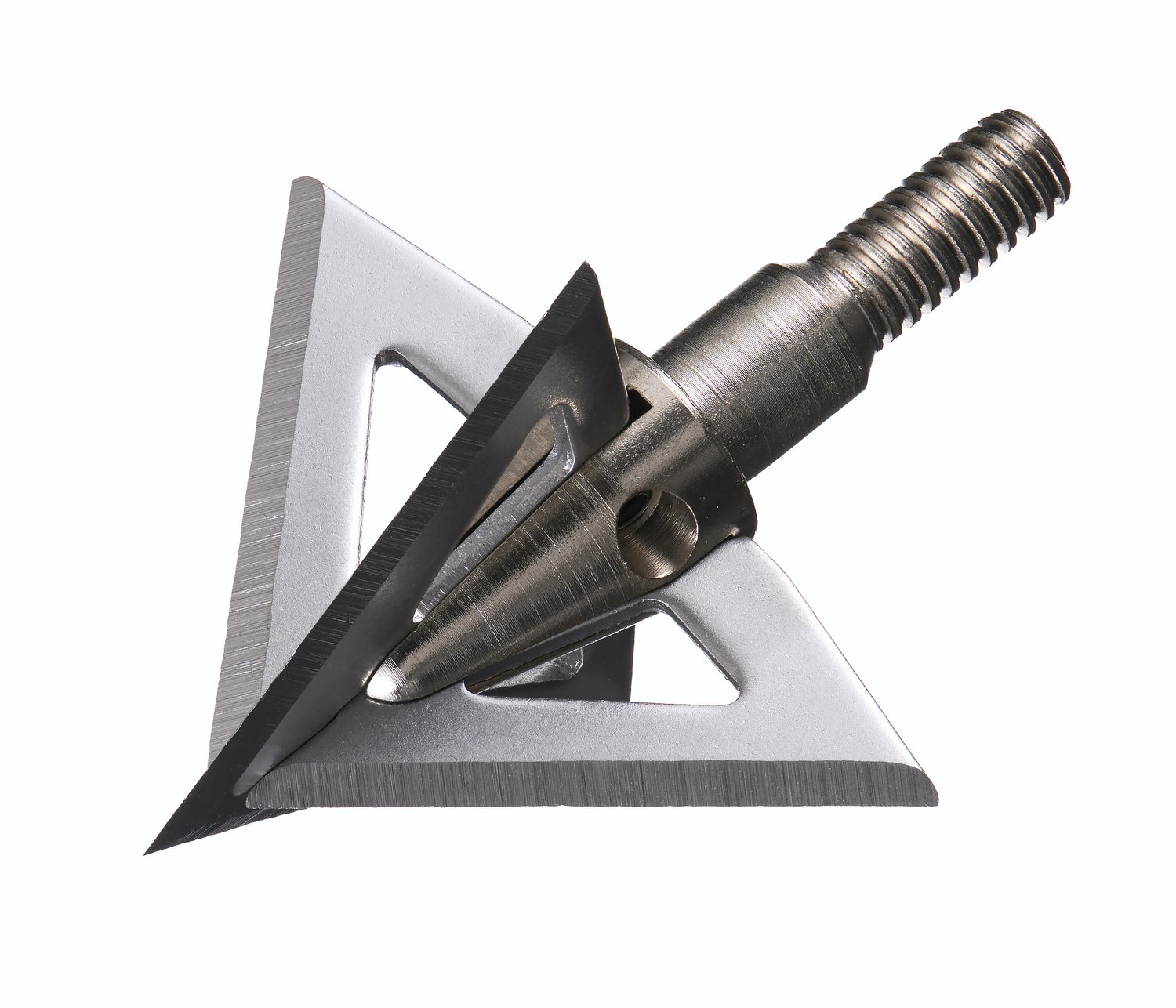
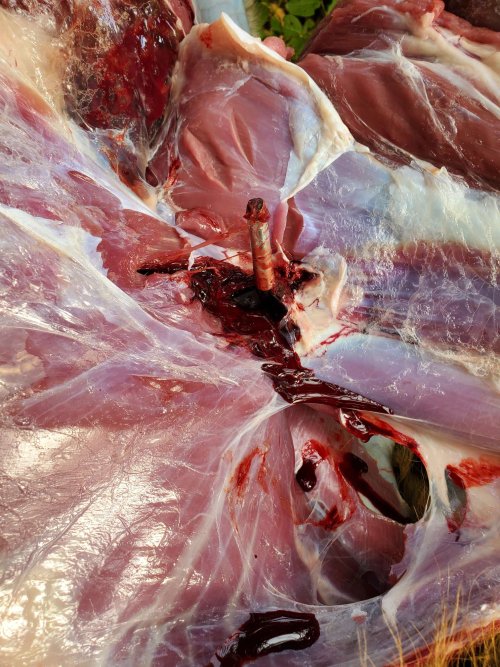
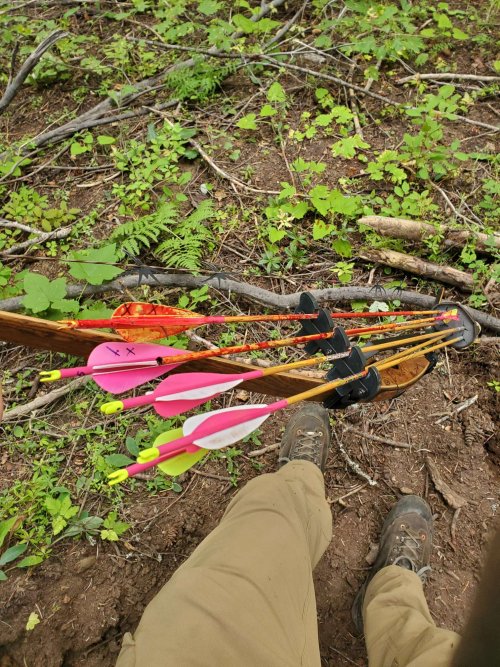
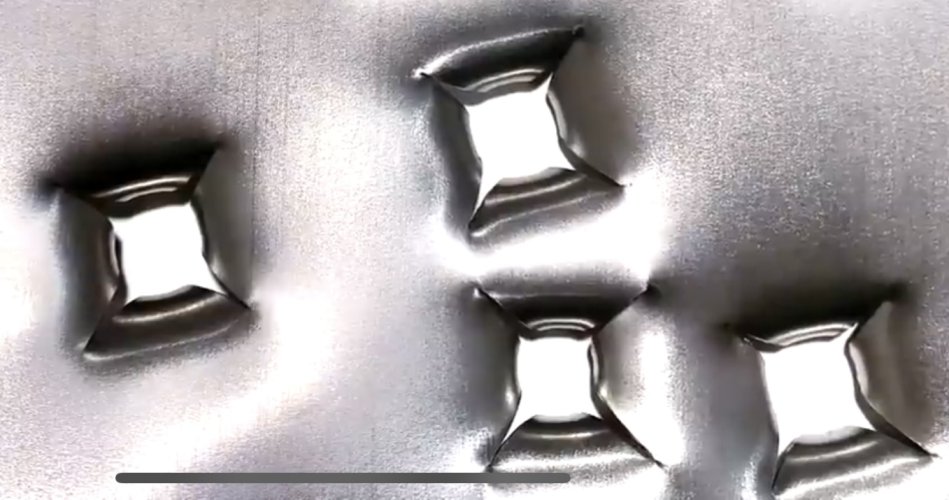
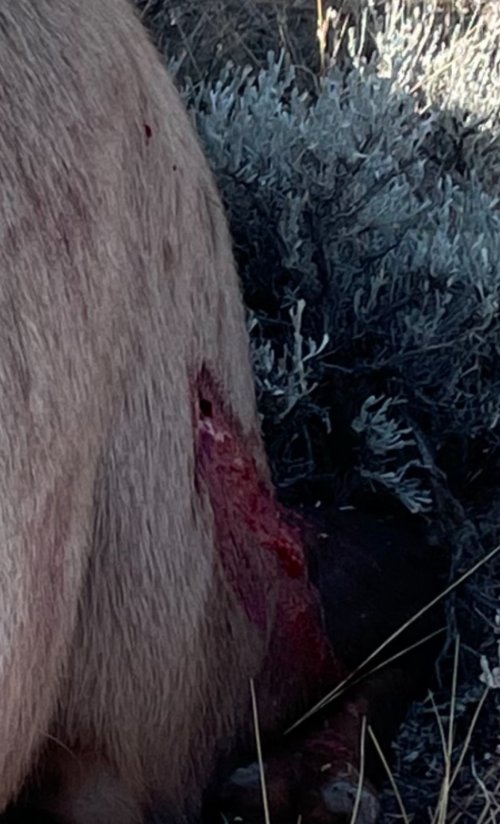
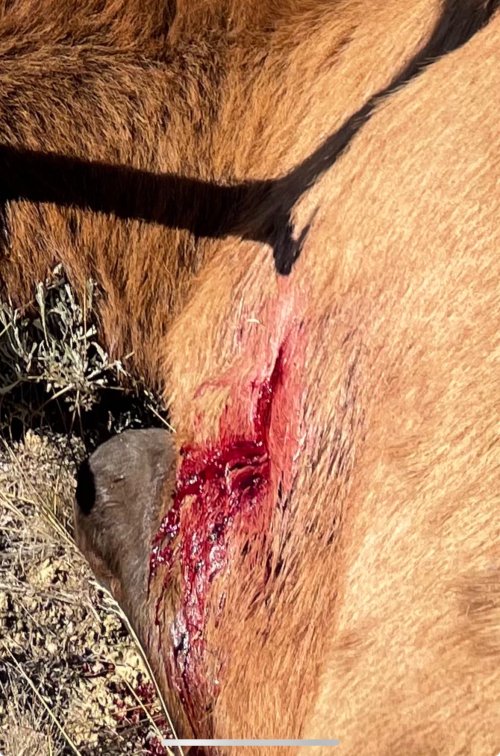
I personally have lost multiple animals due to lack of blood trail and have been on tracks where we lost blood or were on our hands and knees for hours praying for another drop. That was with decent sized cut too. I don't buy into the logic that all things equal, a 1.125" or less slit will put the same blood on the ground as a 3 or 4 blade. 2 blade wounds close easy, even 1.5" mechanicals. The whole blood trails are variable thing is just hand waving. Of course they are variable due to where you hit them.. But it makes zero sense that given the same shot location a 1" diameter 4 blade like a Slick Trick or Tooth of the Arrow Reg solid wouldn't put down a little more blood. It's quite literally like hitting the animal in the same spot rotated 90d. Personally, I find the geometry of a 3 blade to be the most difficult to close. Like the above pic of an Exodus.
I saw a video where a youtuber made the case you can't predict it due to the shoulder moving. You bet... but if I made it in far enough anywhere the shoulder moving would close the wound that animal is most likely laying dead very close by. What I'm concerned with is a shot too far back. That's where things go wrong and more blades and cut size helps big time. At a minimum IMHO the average shooter should have 3/4" bleeders on their single bevels. Or a 1.25"-1.5" cut. The testing has shown that it's minimal difference in force to penetrate as it's trailing behind the main blade.
I don't understand the current semi popular logic of: I'm going to increase weight to increase penetration, increase FOC to increase penetration, go to a stupid sharp cut on contact head to increase penetration, increase steel quality for durability, get perfect arrow flight to increase penetration, spine slightly stiff to increase penetration.. then after all this penetration increase reduce cut size to increase penetration. At some point how far do you need to penetrate into the dirt? Why can't you stop before small cut broadheads? It's not all or nothing. There's plenty of good sized durable fixed blades out there. Exodus is a fantastic head for example, Magnus Black Hornet another, Contact MD3, Contact VBS, Simmons Mako and I can ramble on for a long time of other good ones.
All but one of my 4 animals lost have been a pass through. Animals move, you don't hit where you meant, range isn't perfect, etc. A well balanced system should handle all variables of hunting. Not get hyper focused on one single aspect being the small fraction of bone that you theoretically break you wouldn't otherwise. I think about it this way, if I hit the nearside bone on an animal and doesn't get in - it will most likely live. That's the best case of a wounding scenario. If I hit far side leg bone - it's dead as it through vitals. If I hit too far back the wounds close easier and it's a death sentence. There's a whole lot more real estate back there than there is big bones on most game.
You are correct in all regards. The goal here is to kill them as efficiently as possible and recover them as quickly as possible. Some folks could use more penetration. Some could learn to use a whetstone. Some could learn to tune a bow so arrows aren’t flying sideways and doing more “slap” than “stick”.
Some tradeoffs exist as you go down the list- So I’ll rank these and reply in kind.
Mandatory for any archer, with minimal tradeoff (just time and maybe $20):
1- get perfect arrow flight to increase penetration (non negotiable, everyone should do this)
2- go to a stupid sharp cut on contact head to increase penetration (easy enough in any design, highly recommend. Polishing compound on cereal boxes to polish the edge)
3- increase steel quality for durability (something that breaks on a rib during entry isn’t going to do the job. No TEMU or Wish.com junk)
The following are not mandatory, have arrow speed tradeoff, but can certainly help:
4- weight to increase penetration
5- increase FOC to increase penetration
Debatable help with high tradeoffs:
6- spine slightly stiff to increase penetration
7- then after all this penetration increase, reduce cut size to increase penetration.
I think we can all agree that the arrow must fly straight, stay together while it’s cutting the wound channel, and be as sharp as possible.
Total cut area (length x diameter) is what kills animals with archery. Penetration means more length. Diameter means wider. Scary sharp broadheads cut a higher percent of their diameter in the contacted microvasculature rather than pushing it out of the way. All of these get you more cut area. But the first two can be a tradeoff.
Going to narrower broadheads seems ill-advised, especially if you’re getting down towards that 1” mark or under. There are better ways to increase penetration without such a drastic total cut area tradeoff.
Bleeders on a 2 blade are a definite help from what I can tell with a minor offset in cost. They are a “bonus” feature to the broadhead that doesn’t compromise the effectiveness of the base platform should they fail, but add the benefit of extra cutting length. That’s what we’re after with everything here- benefit with no tradeoff.
Three blades offer great wound channels and exceptional cutting diameter. But due to their geometry, they can lose a lot of momentum & energy if they hit a rib compared to a 2-blade with moderate slope- at least one blade will almost always be in contact with the bone instead of meat. Bleeders are lower profile and don’t have as severe a chance of this. I think it’s net benefit with the added diameter. Some folks think it’s worth it, some don’t.
With that said: I currently stick arrows in the dirt on the far side of whitetails with NAP thunderheads and 442gr arrows. But I still remember that deer I lost when I first started out, made a lot of mistakes, and never want it to happen again. “Don’t let good be the enemy of great” and all that junk.
I’d like to switch to a 550gr+ arrow, a single bevel with bleeders, and helical 4-fletch over wraps with a lighted nock. Because I wanna be one of the cool kids. YMMV.