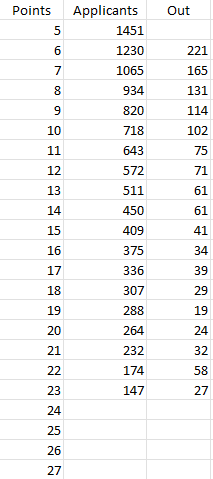
Life expectancy is just the average age of death. Roughly half of the population that life expectancy applies to will live longer, and roughly half will not reach it. In a preference point system, for low availability, high demand tags, it’s not the average person that matters. It only takes a handful of people with above average longevity to account for all the available tags.
You could calculate where the percentage of people that reach a certain age intersects demand. Let’s check out an imaginary hunt with 1000 people applying for 5 tags. That’s .5% draw odds. That’s 200 years to cycle through all the applicants. Let’s assume that everyone entered at age 10, that there is no way to burn points except to draw(no lesser hunt is available), and let’s assume that no one gives up applying prior to death. (Theoretically a system should actually reach a maturity level at which all max point holders entered at the minimum age, just because we aren’t there yet doesn’t mean the model is flawed) Well, we know that no one is going to reach 200pts. What is the actual number? 50yrs into the program, max point holders now have 50pts, and 250 applicants have drawn tags. Are there 750 people remaining in the max point pool? No. Why? Death. But they’re only 60yrs old and life expectancy is 75. How have they died? Umm…life expectancy is an average. Just as some have died before age 75, others will live beyond age 75. Let’s pretend that by age 60, 30% have died. That’s 700 remaining alive, and 250 of the original 1000 have drawn tags, but 30% of them are dead as well, and they are part of the total 300 dead, therefore, while 300 died, they didn’t all come out of the 750 that haven’t drawn yet. 700 are alive, and 175 of them have drawn tags, so there are 575 applicants remaining in the max point pool(that’s 115years remaining to cycle through) Are they all going to be dead at 75? No. We covered that. Now, if we had real numbers on how many people would live how long, we could pound out where the FIRST max point pool would settle, but remember, that takes into account the fact that we were pulling 5 people out of the pool every year with tags. Let’s just pretend we got through all the living members of the max point pool by age 90. Is that where it would stop(80pts)? No. Why? Because we have a back log of 1000 people with 79pts. It just took us 80yrs to get through the first cycle of max point holders. None of these 1000 applicants have drawn. How many have died? Well, roughly the same number as in the pool one point above them, but this time 80 people were taken out of the pool with tags. Again, if we had numbers, we could continue to pound away. But we don’t actually need to. It all comes back to 5/1000=.005=.5%. If we ignore health status and frustration, and assume that only death and drawing can remove a person from the max point pool, then the max point pool will be equal to whatever age only .5% of applicants live to exceed, minus the age at which they were allowed entry. Do .5% of people reach age 95 and beyond? If so, the max point pool will reach 85, and there really won’t be a draw. When you finally reach age 95, only 5 of the original 1000 will still be living, and they get those 5 tags. Life drew for you. Guess what. Same for next year. What about a hunt with .1% as many tags as applicants? That’s 1000yrs to cycle through everyone. But what age will only .1% of applicants remain alive? 100? Guess it’s a 90pt tag. What about a hunt with 20% as many tags as applicants? Well, since most people live past 15yrs old, that’s topping out as a 5pt tag. When tag allocation percentage drops below the percentage of applicants that live beyond life expectancy AND is also low enough to last through that many draw cycles(65 assuming 10yr old entries), preference points could exceed life expectancy minus the age at which entry is allowed. Roughly 50% of applicants will exceed life expectancy, BUT at 50% tag allocation you cycle through applicants every two years. 1.5% tag allocation is where you can hit 65 draw cycles. Because about half would have died by age 75, it shouldn’t actually reach 65pts. When you start getting around sub 1%(100 draw cycles to clear the pool if everyone lived), I would guess that you might start clearing few enough people through the draw and having enough people remaining healthy enough to hunt beyond age 75 that you could see preference points go past 75.
Bonus point systems still skew the time required to draw rather than an even distribution, they just don’t screw things up as bad as preference points. Squared and cubed bonus points get reasonably similar to preference points as the system matures. A guy with 50pts could have his name in the hat 125,000 times in a drawing with only 1000 applicants. If there are 20 guys with 50pts, their individual odds still suck, BUT their names in the hat 2,500,000 times vs a guy with 0-5 pts have a statistical effect quite similar to preference points.
To the real world. For most species in most states there is enough opportunity that it doesn’t take long before you can choose to burn your points without drawing the most difficult tag available if you so choose, and the total number of tags available compared to applicants is 5-20%. The result is that unit 201 isn’t going to top out as high as the above mental experiment predicted(again because it didn’t follow the rules of the experiment). Many things could lead to burning your points. Frustration, change of priorities, degrading health etc. the list is probably longer than I can imagine. But let’s look at sheep. You’re not going to party app for sheep. You’re not generally able to intentionally burn your points on an easier to draw hunt. The carrot is a big one as well. You might decide you’re not up for all the effort and foul weather required to hunt at whatever age you’re at to put bull elk or mule deer number 40 on your wall, but you just might push yourself past your limits for sheep number one. People are applying for sheep tags beyond a sane age, and I’m not convinced they’re going on the hunt they dreamed of.
I don’t follow a lot of OIL species, but I can’t think of one that is actually on straight preference points. If they went there it would be a disaster. NM has 5 NR sheep tags and 1793 applicants in 2021. That’s 455yrs of applicants.