


Philosophy Friday: TV Edition

Ben Long

Well-known member
Joined
Aug 8, 2011
Messages
1,521
Location
Kalispell, MT
With blessed few exceptions (and we know those exceptions well) hunting shows on TV have... well... a lot to be desired. And again this week we saw another "host" busted for poaching. TV-host-gone-bad happens so often it is no longer surprising. So here is my question: Does the competition and stress that comes with producing a TV show lead some people to cut corners and break the law, OR does TV attract some egomaniacs who just don't care, as long as they get attention? Or perhaps there is another explanation? (This question is in no way intended to cast poor light on TV hosts in general, some of whom I consider good friends.)
 
One thing I have heard wardens say more than once is, "Elk make people do stupid things."

Unfortunately, I don't think TV show hosts are any more likely to be chithead hunters than the regular population of hunters. Their misdeeds are just higher profile.
 
I'm going to answer the last question first.

Or perhaps there is another explanation? (This question is in no way intended to cast poor light on TV hosts in general, some of whom I consider good friends.)

Take these comments for that they are worth; probably worth nothing. I am blessed to produce outdoor TV for non-financial reasons. Others are not so lucky. As such, my take on it is probably different.

A bit of the TV financial model that helps lay some background. First, it is hard to break even, let alone make much money, unless the King Makers, a/k/a network has chosen you to be one of the "Kings." A large percentage of these hosts and producers quit their day jobs to follow what they thought would be a really cool dream. In short order, they find out that was a very bad financial decision.

How content gets funded also plays into this. You deal with ad agencies who mostly have no idea of what hunting really is. I have had ad agencies turn me down and pick up a penned shooting show, explaining, "You are more expensive, and there is really no difference; you both end up with a dead animal with a weapon. We are suggesting our client go with High Fence Harry." Using ad agencies is just a dynamic that is part of the business world for companies with multi-million dollar ad budgets. As such, some pretty crazy content gets funded. The better sales person you are/have, the greater the likelihood your content gets funded, regardless of production quality or relevance to the audience.

These same ad agencies have some strange ideas of how to reach their client's audience. You get asked to do a lot of crazy things for sponsors. If this is your livelihood, you probably do what they ask, even if you have a gut ache the entire time you are doing it. If this is not your livelihood, you just laugh at the foolishness of the request and get out your own checkbook to cover payroll that month. Those financial pressures and demands to make a house payment that month, put some really good people in some bad situations.

Networks have a lot of people who don't hunt, or only recently came to hunting as the result of getting a job with the network. As such, you have people at networks making decisions who have never done the typical hunt of the members here, having their private duck club shoot as their only perspective as to how hunting unfolds. They are usually very fine people, but lack of experience in a content-based business means the content distributed might not have the context and authenticity many of the content consumers can relate to.

Hunting is a deeply personal activity. You take the life of an animal for your own food, to keep you connected to the natural world, to be a participant rather than a spectator. That is a hard story to tell in a tasteful manner. No matter how hard you try, some will be disappointed in how that story is told. And if you don't try hard to tell an actual story, more will be disappointed than are pleased. You see all different levels of communication/story telling skills, some are really good hunters, but are bad communicators. Some struggle while out hunting and yet communicate pretty compelling stories. Some in between. Unfavorable outcomes, either consistently or occasionally unfavorable, is inherent to taking a very personal activity like hunting and trying to convert it to 22 minutes of content, especially when left to the hands of non-professional communicators.

The network viewership, like all TV audiences, is falling off the table due to cord cutters. That is just a larger societal trend that the network has no control over. As a result, their bottom line is dropping even if they distributed the highest produced most relevant content in the hunting world. That puts financial pressures on them that might be different than in a time when things are booming.

With those financial pressures, networks have no choice but to take into consideration the bottom line impacts. I feel it is our job as hunters to push back on sponsors and networks when we feel that financial pressures are driving the train off the cliff and damaging hunting.

Wonder what would happen if I went to Alaska and shot two grizzly bears with only one tag and had my outfitter fly me out a second tag after the fact? I would be gone tomorrow. I would be banned from ever being on the network again. Unless, if a big advertiser, say the NRA, picked me to host their new show. Then, there is a high likelihood I would be allowed back in the game. Just a function of the business side of it; a side I often speak out against as I did on FB last week with the Busbice issue. The network and I had a long conversation on Wednesday about my comments on FB and my tagging them in the post. I am thankful they called allowing us to have what was a difficult discussion.

Probably most important when analyzing the questions, realize that many people who view this as a business model have nowhere near the personal passion and concern that you and I have as hunters. It is just not practical to expect those who are "just doing their job" to have the same level of concern, passion, and care for the future of hunting as those who make huge contributions of volunteerism, donations, labor, and time, as to hunters. That is just a reality. End result is some of what we see.


With blessed few exceptions (and we know those exceptions well) hunting shows on TV have... well... a lot to be desired. And again this week we saw another "host" busted for poaching. TV-host-gone-bad happens so often it is no longer surprising. So here is my question: Does the competition and stress that comes with producing a TV show lead some people to cut corners and break the law .......

I am speaking based on my observations, knowing others who observe me will have impressions of my message/behavior that I might find uncomfortable. That said, here is my observation of nine years in this TV gig and interacting with thousands of regular hunters on Hunt Talk, FB, in the field, at seminars, etc.

The spectrum of egos in the outdoor TV world is probably higher toward the "bigger ego" side than you would find in a profile of hunters in general. Whether we want to admit it, or not, everyone has some ego. How that ego manifests is a function of many things, but most Americans keep it in check by their own humility, by grounded folks around them (in my case a wife and 30K+forum members who occasionally put me/my ego in my place), or by life experiences that have humbled them. In most instances, the larger the ego, the more response to competition, with competition being measured in terms of animal size taken, FB followers, appearance requests, company you get to hang out with, lack of gray hair, cup size, distances at which animals are taken, etc.

The history of TV, not just outdoor TV, in the last 30 years has been changing less from news and information and more to sports and entertainment. Entertainment attracts a disproportionate amount of folks with larger egos than you see in the hunting community. Hunting as entertainment is a dangerous mix to start with, then add in the fact that entertainment attracts larger egos, and you have a lot of outcomes you mention in your question.

Is it realistic to think that washed up rock and rollers with millions to spend, or old broken down athletes, or country musicians, or super successful business folks, or (insert past limelight experience here) will have much understanding of how the average hunter in American takes their week of vacation to go hunt deer or elk with the masses, hoping to just see an antlered animal?

The obvious answer is "No, it is not realistic."

The most long-tenured folks in outdoor TV are pretty darn good storytellers, regardless of what you think of the hunts that make up their content; Primos, Shockey, Realtree, Drury, and a few others. None of them are folks who came to this with celebrity backgrounds. They have worked hard at it and that is why they are still around. And in my discussions with some of the long-tenured folks, they are quite disappointed to see the messaging that has evolved. Those with celebrity backgrounds usually are a flash in the pan, taking from outdoor TV a few more doses of the needed publicity adrenaline, leaving some carnage along their path, then going on to the next place they feel important.

Those with super successful businesses are often, not always, highly driven people not accustomed to being told what to do and how to do it. They hire PR agencies to do their messaging, knowing they will make a few messes along the way, and they expect those messes to get cleaned up. That might work when selling widgets to people who need that widget, but that is not how it works when selling an image or message to people who have great personal connection and attachment to the activity around which the message is built. And thank God for that.

So yes, egos and competition are a huge contributor to the problems we read about with outdoor TV, its messages, and the behavior of the hosts. Just inherent to it being on TV and thus being entertainment (gawd I hate saying that). But, many really good humble folks who you would enjoy in your camp prove that it doesn't have to be that way. It can be done with good stories, regardless of tags filled, and in a way that is relevant and authentic to the audience. It is harder and far more expensive to do it that way, but it can be done. Fortunately, I could list a good tasteful storytelling group/host for every person who might get listed as an egomaniac.
 
Big Fin is feeling philosophical today! I've got enough gray hair to remember the day when most hunting information was circulated on pulp. "Celebrity hunters" were a different thing. Still, some of those high profile hunters would end up in some ethical or legal pitfall. Others had long careers with no controversy. So it's not unique to TV. I think stakes are higher now.
 
Much of the hunting programs today are infomercials, not really shows. I get the need to plug sponsors but some of the stuff is over the top. Kill a deer and the first thing someone does is surround it with all the sponsors products for the glamour shots. I think I'd rather be poor and unknown than to sell my dignity like that.
 
Also I think there is a greater emphasis on ethics, so the spotlight is a bit brighter when someone screws up. Fred Bear is largely remembered as a near saintly hunter. I imagine he was a great guy, as those who knew him say. He still took an 80-yard shot at tiger with a bow, in a forest full of people. Worked out OK for him, but that would not go over so good today.
 
I can in no way be as philosophical as Ben or Fin. While reading Fin's commentary, I came to think about what I have seen on the networks. Not just the shows, but the commercials. Those networks have what they think are the target audience and sell the ads accordingly. Outside of the hunting/fishing companies, I feel like I see similar commercials to those on Sundays during NASCAR. That is who the network and ad execs think is the target audience for hunting too. So then, why would or should we be surprised when after kill interviews are conducted in the same manner of post race interviews. So yeah, you want to last, you sell your shtick and then you sell out. Especially as a show based on whitetails. Once you sell out, each corner gets a bit easier to cut.
 
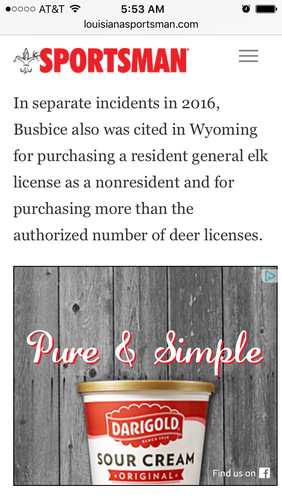
I clicked on this thread to read something and sip on coffee before I got to work today, a saw a comment on tv hunter, Busbice busted poaching. I've never herd of the guy or ever seen his show. So I googled his last name and read what happened, then I read his apology. Then I thought , i wasn't there , was it just a bad day , maybe it was an accident.. etc etc.. then I clicked on anther article and read this !!! In a separate incident prior to poaching Bill Busbice busted for buying tags Inappropriately and have more deer tags than allowed. What !!! Dude had it coming . Sounds like he has been making premeditated bad choices for awhile . dont think he gave a crap about the cow elk he killed , because he was planning on killing more deer than he was allowed as well. pretty sure those tags weren't because he needed meat. I'm a newer hunter, raised in Alaska where we hunted for meat 1st my dad never talked about antlers growing up that i can remember, now that im a grown adult and hunting again , right now i go on 1 deer and 1 elk hunt a year, as much as i would like to harvest a big animal with a nice rack, meat in the freezer till next season i most important to me, I just started watching hunting shows in January of 2016 on YouTube. so the who , what ,how and why of TV hunting is new to me and what each show focuses on. As far a the stress comment by Ben in the first post, I've always believed that real stress will reveal what's in a mans heart and his character. Anyone can hide who they are when life is easy and going smooth.
IMG_5756.PNG
 
Last edited:

Forum statistics

Threads
117,904
Messages
2,173,304
Members
38,381
Latest member
208Nutt
Back
Top