First things first, once you get the scope zero’d at 200, you’ll want to “reset” the turrets to the read “0” when the scope is zero’d. I’ve never used this specific scope, but I’m sure Zeiss provided instructions.
There’s lots of ballistic apps you can use. I’m going to use JBM Ballistics here because it’s free, browser based, and easy for me to take screen shots:
https://www.jbmballistics.com/cgi-bin/jbmtraj-5.1.cgi
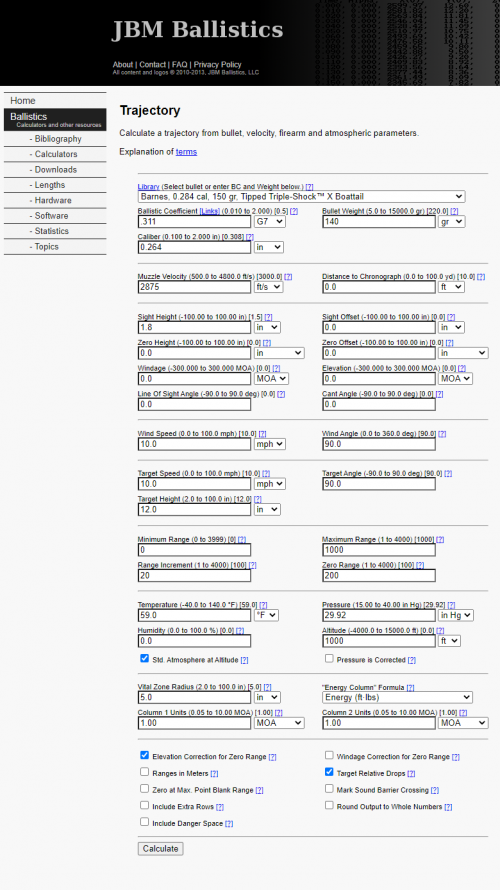
It will look like this:
View attachment 207633
Then I’ll:
- Select your bullet from the library. Normally I prefer to enter the BC by hand, but I didn’t quickly find it on Barnes website so I used the one JBM had instead
- Enter your muzzle velocity
- Sight height can effect the results a little, I set it up a bit higher their default, that’s a pretty large scope and its probably mounted higher than typical
- Set the range increment to 20 yards
- Set the zero range to 200
- Checked the “Std. Atmosphere at Altitude box” and entered 1000 ft for altitude
- Change the column units to MOA
- Hit Calculate
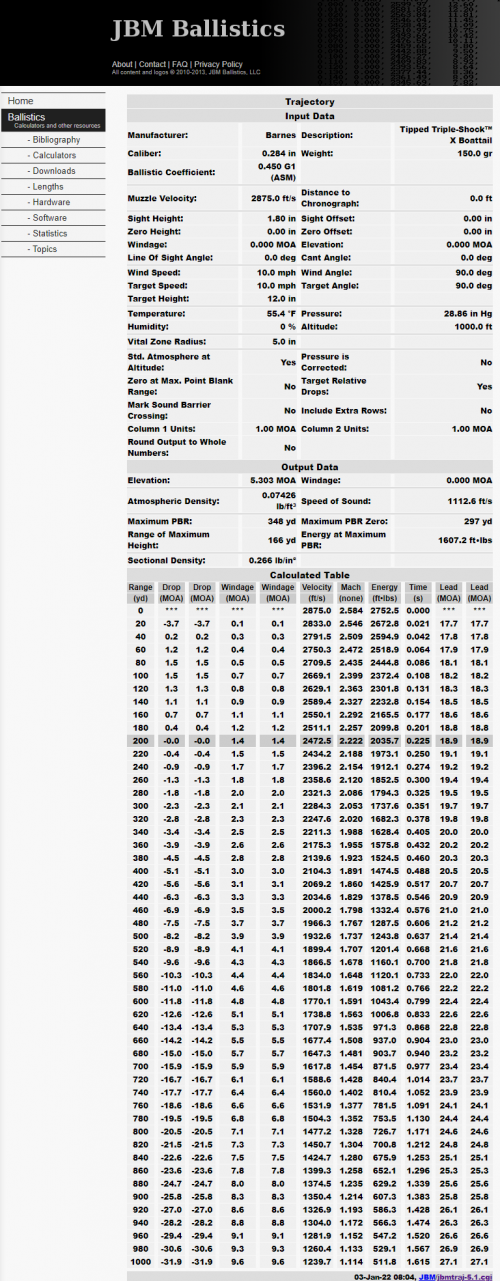
It’ll output this:
View attachment 207631
That’s a lot, I’ll take a closer look at a small section:
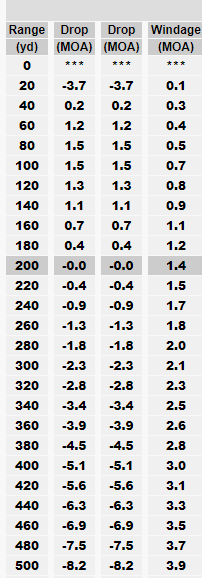
View attachment 207632
Ignore the second drop column, it’s just a duplicate.
So, at 100 your “drop” is listed as 1.5 MOA, which being positive in value is ABOVE your point of aim. If you are zero’d at 200, you’d dial 1.5 MOA DOWN to be dead on. At 200 your already zero’d. At 300 the drop is listed as -2.3 MOA. Your scope adjusts in .25 MOA increments, so that’d round to 2.25 or 2 ¼ MOA however you want to think of it. And so on, your corrections from 100-500 would be:
100 - (Down)1.5
200 – 0
300 – 2.25
400 – 5
500 – 8.25
You can obviously apply it to all the in between values on the chart as well.
Having done the work of zeroing the rifle, resetting the turret to zero, and calculating the ballistics as I showed, you have what you need to dial for a dead on elevation hold for various distances. If you want to shoot something at 400 yards, twist the turret to “5”, shoot, and return the turret to “0”.
The windage column tells you how far your bullet would drift at a given range in MOA, in a 10 mph 90 degree wind. Being a second focal plane scope, the hash marks in the reticle are only accurate at 24 power. When it comes to holding wind, you could hold the full value if the scope is on 24x, you could hold half the value if the scope is on 12x, or you could dial the windage turret but that’s hard for me to recommend.
Now, all of this is only as good as the inputs, and the sensitivity to bad input increases exponentially with range. Out to 500, it’s pretty easy to swag it, at 1000 if you want to be accurate you’d probably have to fine tune the velocity and/or BC. Either way, before you use something like this in the field you’d want to confirm it on the range several times over.
Hope that helps.