I’m not personally familiar with that specific area, but I’m sure you’re raising a valid point.
But I think WIbiggame’s perspective holds some water as well. The reason I say that is because of the work that’s been done around infectivity.
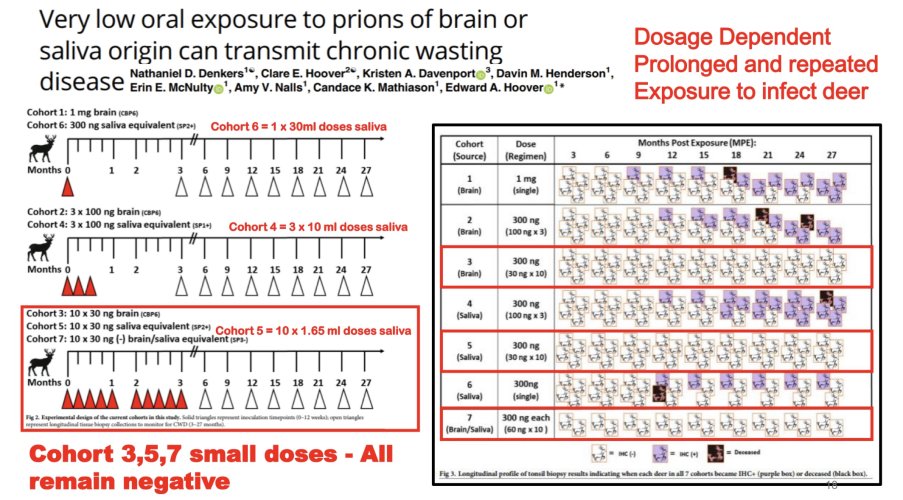
Through inoculation, transmission, and dosage research the current understanding pretty clearly points to two things. Large, almost unnatural doses and prolonged and/or repeated exposure to the infectious agent is what’s necessary to infect animals.
If this disease was spread as easily as the common cold or flu, I would agree that feed grounds (and baiting bans) mean nothing. However, the infectivity research says otherwise.
The study below was led by Ed Hoover and performed on deer. While the dosage/exposure levels required are probably greater with elk, I think it’s probably safe to assume that the same concept of infectivity applies to elk, just at a different scale.
The minimum infectious dose required to induce CWD infection in cervids remains unknown, as does whether peripherally shed prions and/or multiple low dose exposures are important factors in CWD transmission. With the goal of better understand CWD infection in nature, we studied oral exposures of...

journals.plos.org
View attachment 361698
In that study, they were able to infect deer with around a shot glass of infected saliva from an end-stage deer. So, the most infected saliva they could obtain. Remember prions don’t go dormant, they just slowly template themselves, so internal infectivity never stops. The further into disease you get, the more prions you are accumulating and therefore excreting.
But what’s important to note, is that dose had to be given all at once or in a very short window of time. When they broke that same dose size up into 10 doses over several weeks they couldn’t infect animals. I think they’ve observed animals up to something like 38-40 months to see if that smaller dose over several weeks just took longer. But they found no positives.
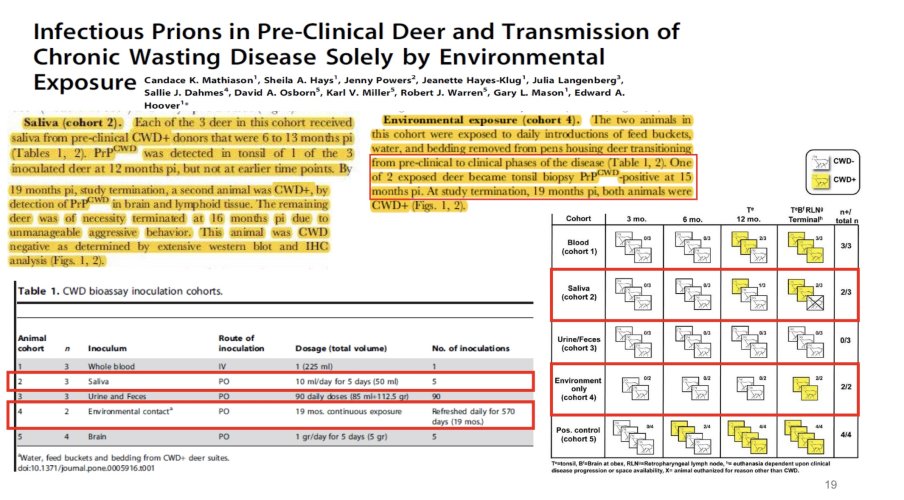
However, there’s been multiple other studies done in elk and deer where they don’t artificially inoculate them at all and instead put them in with other infected animals and/or make them eat out of infected troughs and live in the same holding pens where infected animals spent time. In those instances it takes several months to a year of that repeated exposure to infect the animals.
View attachment 361697
This is relevant because in these situations when we talk about feed grounds (or baiting), we know it is unlikely cervids are swapping shot glasses of spit directly into each others mouths on a regular basis. But we can surmise that the longer the direct exposure time, the more chance we have of infecting animals. And the more animals become infected and continue to use that exact same piece of ground, eat, pissing, and shitting on it while infected, the higher the dosage level accumulates and builds up in that spot over time. After a few years of infected animals contaminating that spot, it’s reasonable and logical to assume that now it won’t require as much time and exposure to infect animals from that location. Because the dosage size in the environment and that area has been building. Throw in the fact that some soil type increase infectivity and you have all the ingredients coming together.
This is one of the reasons many folks believe that baiting and supplemental feeding practices might be some of most suspect practices that not only spread the disease, but establishes hot spots and leads to decades long environmental contamination and transmission in that exact spot.
It’s the perfect recipe for transmission of this disease based on how infectivity works.
So, for normal winter herding in deer, maybe an average of 3 months (sometimes more, sometimes less), that’s certainly a risk. There will certainly be some transmission occurring, no doubt. But when hunters are out with bait piles all fall, you just increased that exposure rate by more than double if they started placing feed in August. When feed grounds are used, that is concentrating animals to eat and lick on the same exact chunk of ground day after day, month after month, year after year.
Again, I don’t want to claim to know all the details about the area Buzz is referencing. And like I said, he may have a valid point. But I would guess, given the infectivity research I’ve just shared, it’s still not quite to the level of risk that the feed grounds are.