African conservation in the Guardian

I find the lack of comments odd. The author paints a pretty hypocritical view of "hunting is conservation", yet provides zero alternatives, and appears forced to conclude that it's possible that "it" works. Hard for me to conceive of a better management strategy.
 
Not sure what you expected. Seemed like a typical anti "African trophy hunting" article to me. Hard to argue that their system doesn't work, even though it doesn't set well with a lot of people.
 
Not sure what you expected. Seemed like a typical anti "African trophy hunting" article to me. Hard to argue that their system doesn't work, even though it doesn't set well with a lot of people.
1. Hunting is conservation as a topic isn't really mainstreamed very often.
2. The author, despite their best attempts, still concludes it's an effective strategy.
3. None of their points against hunting are wrong. It is entirely racist and feudal, and in many ways straight up represents the worst parts of hunting and hunters.
4. It sure as hell is a more worthwhile discussion than what's the best scope/caliber/bullet for a deer rifle or where can I find a 30" mule deer on public land in Montana.
 
I found the article interesting in that knowing your enemy, or competition, is always a good idea. That the writers lack of objectivity prevented a more favorable analysis is not surprising. Still, despite the denigrating description of hunters and Professional Hunters, the author takes us through a very narrow window for a view of African hunting, which is massive industry catering much more to middle class than the high and mighty. After reading the article I could see where many here would base a decision to not hunt Africa as they don’t want to be held in the same light as those hunters. That is unfortunate. Certainly there are canned hunts in Africa, particularly South Africa. I’ve seen those on tv as well. The constant struggle to keep the fence or residential housing out of view. There are very large high fence operations where you may never see the fence and there are free range operations that simply have cattle fencing. Pick your poison.
What is absolutely certain is most of the wild game was eliminated by the 60s and 70s through poaching and efforts to limit grazing competition. Somebody figured out there was money to be made grazing kudu along with cattle and the rest is history. You can have a canned hunts if you like where you will know for certain you will have a chance at a Kudu or Roan. You an also go free range and figure you’re luck is just like Hemmingways until it isn’t.
Having spent 20 years guiding in Alaska and Oregon I’ve met a lot of guides, none had the depth and breadth of knowledge the African PH has regarding the environment they operate in. Myself included. Really was quite impressive what they need to learn to get licensed. The wife was thrilled to have in depth conversations with our PHs on the ecology of each area we hunted. I couldn’t tell you have many times we stopped and examined a plant community instead of a Kudu’s horns.
We spent a month in South Africa a couple of years ago. The wife’s resume got us visiting a number of hunting/ag operations and they are quite impressive. We hunted 10 days with an outfit that has three ranches totaling 1 million acres, all free range. Almost every day we chased game that got over fences where we could not follow, just like here.
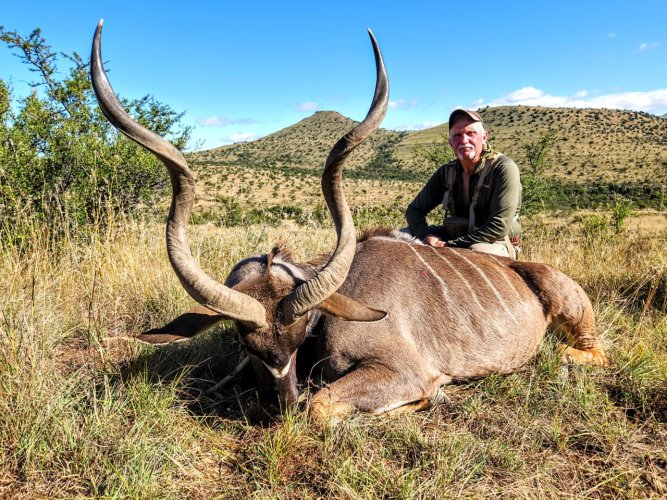
I did get a Kudu after five days, passed dozens. We head back in three weeks to hunt the same place.
I wish I had more time to write a short concise response.

 

Attachments

  • PHOTO-2022-04-26-12-17-31.jpeg
    PHOTO-2022-04-26-12-17-31.jpeg
    364.5 KB · Views: 3
I found the article interesting in that knowing your enemy, or competition, is always a good idea. That the writers lack of objectivity prevented a more favorable analysis is not surprising. Still, despite the denigrating description of hunters and Professional Hunters, the author takes us through a very narrow window for a view of African hunting, which is massive industry catering much more to middle class than the high and mighty. After reading the article I could see where many here would base a decision to not hunt Africa as they don’t want to be held in the same light as those hunters. That is unfortunate. Certainly there are canned hunts in Africa, particularly South Africa. I’ve seen those on tv as well. The constant struggle to keep the fence or residential housing out of view. There are very large high fence operations where you may never see the fence and there are free range operations that simply have cattle fencing. Pick your poison.
What is absolutely certain is most of the wild game was eliminated by the 60s and 70s through poaching and efforts to limit grazing competition. Somebody figured out there was money to be made grazing kudu along with cattle and the rest is history. You can have a canned hunts if you like where you will know for certain you will have a chance at a Kudu or Roan. You an also go free range and figure you’re luck is just like Hemmingways until it isn’t.
Having spent 20 years guiding in Alaska and Oregon I’ve met a lot of guides, none had the depth and breadth of knowledge the African PH has regarding the environment they operate in. Myself included. Really was quite impressive what they need to learn to get licensed. The wife was thrilled to have in depth conversations with our PHs on the ecology of each area we hunted. I couldn’t tell you have many times we stopped and examined a plant community instead of a Kudu’s horns.
We spent a month in South Africa a couple of years ago. The wife’s resume got us visiting a number of hunting/ag operations and they are quite impressive. We hunted 10 days with an outfit that has three ranches totaling 1 million acres, all free range. Almost every day we chased game that got over fences where we could not follow, just like here.
I did get a Kudu after five days, passed dozens. We head back in three weeks to hunt the same place.
I wish I had more time to write a short concise response.

One of the questions I felt needed to be asked of the author, and one that I do feel like they briefly touched on at the end, is if not this system, then what? I feel it's a good example of not letting the perfect get in the way of the good. If having wildlife is the goal, then this is a good proven system, even if it's based on rich, arrogant assholes from Texas who pay a lot of money to kill something they'll never eat. It still beats not having wildlife, not having that local income source.

It's not necessarily fair to the locals that they can't hunt themselves, or can only hunt very little, but we already know that if the existing trophy hunting scheme went away, it wouldn't be long before there wasn't much wildlife left.

I'm jealous of your trips. I used to have no interest in Africa, but the more I learn, the more interested I become.
 
Well I’m certainly not rich or from Texas. I was raised in Oregon and Alaska, worked in the woods and fishing as a young man. Spent 20 years and 5 months working in law enforcement and just a little shy of 20 years guiding, retired from that at 68. Some might say I’m an asshole. I’m not rich by any stretch but I have a pension and saved a little along the way. Just like private land hunts here, the price has gone up but compared to a private land elk or deer hunt, or more of an apples to apples, a private land deer and elk combo, it’s priced pretty fair. The South Africans like to barter as well- something to keep in mind. In many ways it is little different than going to Iowa and buying access to a 400 or even 40 acre parcel to hunt white tails or a 4000 acre piece out west for elk or deer. Private land owners creating value added to their property.
The big difference is in South Africa you can kill ten different animals in 10 days. In Iowa you may shoot a decent buck in five days. The day rate in most of RSA is low.
Air fare can suck, it does this year.
As to the meat. You’ll eat some of what you shoot every day. Camp staff gets most of the rest as do the neighboring villages. Certainly helps keep poaching under control. The family I hunted with lives two hours from their school. The kids and mom go to town during the week and take a lot of the meat with them to feed the kids there, Kind of a boarding school as I understand.
I asked my host last time about cull hunts, he does not sell those to clients, rather he has local guys who want to hunt take care of that issue. Again, kinda sounds like a farmer from Iowa or Pennsylvania, having never hunted in either myself.
If you absolutely need to kill stuff to feel good and you’re a fat asshole, go to a small high fence operation and try not to embarrass the rest of us with your horrible shooting. If you want to hunt with a guide and maybe learn something, go to a free range operation. If you’re in shape and want to see what’s in the bottom of that canyon, they’ll be happy to oblige you. They love a real hunt as much as the likes of us. Had my PH and tracker laughing like hell after the first two or three foot chases trying to get on an animal that bolted. They loved it.
Don’t wait. Go as soon as you can sorta make sense out of it.
 

Latest posts

Forum statistics

Threads
118,911
Messages
2,211,389
Members
38,706
Latest member
Tyler115
Back
Top