Hunting geese is a team sport, unless it is legal to use an electronic caller. It's hard to make enough noise to match a large spread of dekes by yourself.
It's also hard to purchase, transport, set and retrieve, 100 or more goose decoys by yourself.
Most beginners use too many decoys, and too much calling. It took me a long time to be able to leave most of my crap at home, when calling small ponds.
A small piece of camo cloth just enough to break your outline, and half a dozen dekes, will do you more good than an elaborate blind and a cartful of dekes.
Winter days are short, you don't want to spend all morning "building a home", just to spend all afternoon tearing it back down.
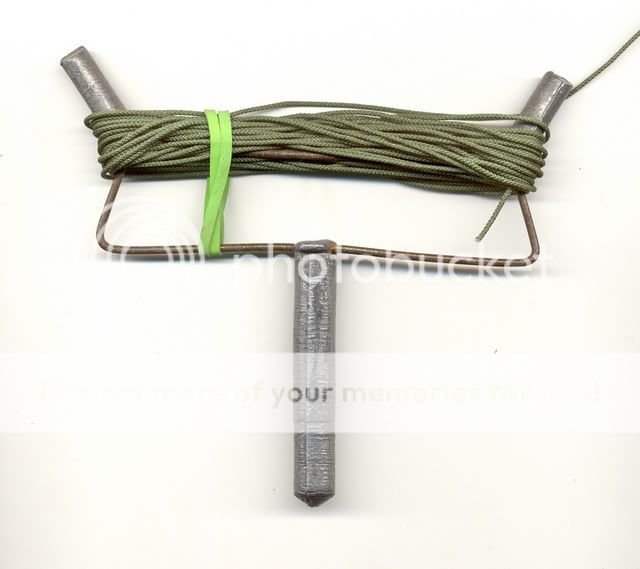
For anchors and lines, I like a weight that the line coils around, so the deke has "just enough" line out to reach the bottom every time.
With the mushroom weights, all the line plays out, and the dekes can wander and tangle. Or they don't reach the bottom well (as a way to keep them from wandering the lines are shortened) and you catch one drifting off... making a break for it!
I generally run about 20 feet of green dacron line on each, but I rarely set birds in water over 8 feet deep (unless I am trying to "guide" birds in, by blocking, ducks generally won't fly in to land, over birds on the water).
Next year, if your private lands work out this winter, spend some time building more permanent blinds (with an eye towards comfort), and some nesting boxes and platforms to rear more birds.
I have had as many birds come into the set, without calling at all, as I have with (over) aggressive calling... you get to dozin' and the sound of mallards plopping into the water wakes you.
It's way more of a visual thing, than a sound thing.
Set your dekes well, and they attract the birds, set em wrong, and they won't come in range, or just swing on by without even slowing down.
I hunt one area, with several small ponds, fairly close together. I have found that if I throw a couple birds in each pond, I do better than if I throw 6 in just one pond.
I might have to do some sneakin' and jump shooting, but it looks more natural, so more birds are drawn to it.
They say not to hunt your best spots in the afternoon. A duck can't remember where he was shot at in the morning, but he will worry all night long about where he was shot at in the afternoon, and may not return there for days.
As far as firearms, depending on shell size, and shot size a 20 ga has every bit of (and sometimes more) the killing power of a 12 ga.
When I reload for my 20 ga (3"), I use exactly the same amount of powder and shot as in my 12 ga (2 3/4").
Being that the tube of the 20 ga has a smaller interior volume, it actually reaches considerably higher pressure, and therefore velocity at the muzzle is a few hundred feet faster.
Going to longer shells (3" and 3 1/2") in 12 ga, or fatter shells like a 10 ga only increases the amount of shot you can throw, not necessarily the velocity.
And you pay for it, in increased recoil, and cost... more lead (or worse non-tox shot) costs more money.
Until your dog comes all the way around, I'd consider a small boat, and even after that, it's totally handy to have... even the best dog can't set and retrieve dekes worth a dang.
My season opens Saturday, can you tell I am excited?
Krusty